Table of Contents
There is a peculiar kind of cruelty in a system designed to be kind. It promises to catch you when you fall, and it does. But then, somewhere between the catching and the standing back up, the net tightens. It holds. It cradles. And eventually, it refuses to let go.
This is the welfare trap. It is not a conspiracy. It is not the product of villains in suits plotting to keep the poor down. It is something far more interesting and far more frustrating. It is the predictable outcome of well intentioned policy meeting the cold arithmetic of human incentives. And no one saw this kind of thing coming quite like a nineteenth century French economist named Frédéric Bastiat, who spent his short life trying to convince his countrymen that good intentions were not enough.
Bastiat had a phrase for this. He called it the seen and the unseen. The seen is what the policy does in plain view. The unseen is what the policy quietly destroys while everyone is busy applauding the seen.
Let us walk through this slowly, because it matters.
The Math That No One Wants to Do
Imagine a single mother working part time at a grocery store. She earns modestly. Through various programs, she also receives housing assistance, food stamps, childcare subsidies, and a health insurance benefit for her children. Add it all together and her total compensation package, counting both her wages and her benefits, comes to a respectable monthly figure. Not luxurious. Not comfortable. But survivable.
Now she gets offered a promotion. A real one. More hours, more responsibility, a meaningful raise. Her gross income jumps by, say, six thousand dollars a year.
She does the math. Or rather, the math is done to her.
The housing subsidy shrinks. The food stamps reduce. The childcare assistance phases out, because she now earns too much to qualify. The health coverage for her kids transitions to something that costs her premiums. By the time she finishes counting, that six thousand dollar raise has left her with perhaps four hundred extra dollars in her pocket. Sometimes less. Sometimes nothing. Sometimes she is actually poorer than she was before.
Economists have a polite term for this. They call it the marginal effective tax rate. In ordinary English, it means the percentage of your next dollar that gets taken away when you earn it. This is the special kind of mathematical insult where working harder makes you worse off.
The wealthy never face this. A hedge fund manager who gets a raise pays maybe forty percent of it in taxes and keeps the rest. The single mother at the grocery store can face an effective rate that would make a medieval tax collector wince.
And here is the part that should make us all uncomfortable. We then turn around and ask why she did not take the promotion.
What Bastiat Would Have Said
Bastiat lived in a France obsessed with helping people through clever government schemes. He wrote essays mocking the logic with such precision that they still sting. His most famous one, about a broken window, argued that destroying a baker’s window does not stimulate the economy, even though the glazier who fixes it certainly benefits. The seen benefit is the glazier’s new income. The unseen cost is everything the baker would have bought instead, if his window had not been broken.
Apply this lens to welfare. The seen benefit is the family that does not starve, the child who has a doctor, the roof that stays over the head. These are real. They matter. We should not pretend otherwise.
But the unseen is also real. The unseen is the promotion not taken. The night class not enrolled in. The side business not started. The marriage not entered into, because marrying someone with income might disqualify the household from benefits. The savings not built, because having more than enough dollars in the bank can erase your eligibility for assistance in some programs.
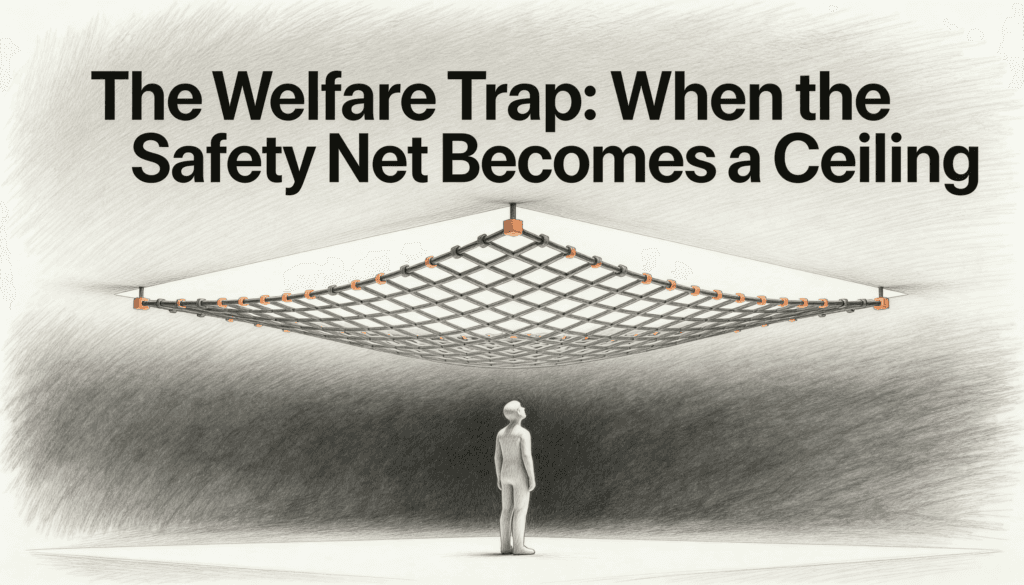
The unseen is the human being whose horizon has been quietly redrawn. The ceiling has lowered itself, not out of malice, but out of arithmetic.
Bastiat would have noted, with that French precision of his, that we have created a system which subsidizes the very condition it claims to solve. We pay people to remain in poverty by punishing them when they try to leave it.
The Counterintuitive Bit
Here is something that surprises people. The most generous welfare states in the world, by some measures, have less of this trap than the United States does. Countries like Denmark and the Netherlands give a lot, but they tend to phase benefits out more gradually, and they invest heavily in training, childcare, and reemployment.
So the issue is not necessarily that we spend too much on the poor. It might be that we spend it in ways that create cliffs instead of ramps. A cliff is what happens when you earn one extra dollar and lose ten thousand in benefits. A ramp is what happens when benefits taper smoothly, so that work always pays.
This is worth dwelling on, because the political conversation tends to collapse into two camps. One side wants to cut benefits and call it tough love. The other wants to expand them and call it compassion. Both miss the structural question, which is not how much we give, but how we give it.
A poorly designed system can be both expensive and trapping. A well designed system can be generous and liberating. The dollar amount is almost beside the point.
The Dignity Problem
There is something else here that the spreadsheets do not capture. Work is not just income. It is identity. It is structure. It is the reason to put on shoes in the morning. It is the place where you meet people, learn things, and become someone you were not before.
When a system makes work irrational, it does not just deprive people of money. It deprives them of the slow accumulation of skills and confidence that turns a job into a career. A person who works at a coffee shop for three years is not in the same place she was at the start. She has learned how to manage difficult customers, how to train new hires, how to be relied upon. None of this shows up in the welfare calculation. All of it shows up in the rest of her life.
When the trap closes, what closes with it is not just upward mobility. It is the chance to become the person you might have become.
What Could Actually Change
A few ideas circulate among people who think about this seriously, and they are worth knowing.
The first is the negative income tax, an idea championed by Milton Friedman, who was about as far from a socialist as a person can get. The basic notion is that instead of a hundred overlapping programs, you give people a single cash transfer that gradually reduces as their earnings rise, but never reduces faster than the earnings rise. Work always pays. The cliff disappears. The bureaucracy shrinks.
The second is the earned income tax credit, which already exists in the United States and which does exactly this for working people with children. It is one of the few programs that economists across the political spectrum tend to like, because it rewards work rather than punishing it. The catch is that it interacts with other programs in ways that can still produce cliffs.
The third is simpler than either. It is the boring administrative work of redesigning benefit phaseouts so that they happen gradually, transparently, and in coordination with each other.
None of this is a perfect solution. Bastiat would have warned us that there are no perfect solutions, only tradeoffs. The question is whether we are honest enough to look at our tradeoffs and ask whether they are the ones we actually want.
The Ceiling We Built
The welfare trap is not a failure of generosity. It is a failure of imagination. We imagined a net and built one, but we forgot that nets, by their nature, have two functions. They catch what falls in. And they hold what they catch.
If we want a system that genuinely helps people rise, we have to design for the rising, not just for the catching. We have to do the unsexy work of looking at every phaseout, every threshold, every disincentive, and asking whether it is serving the person we claim to be helping.
Bastiat understood, almost two centuries ago, that the gap between intention and outcome is where most of human policy lives. We pass laws to do one thing, and they end up doing another, and we are then asked to admire the law rather than examine the outcome.
The safety net is one of the great inventions of modern civilization. It is also, in too many places, a ceiling.
The work of our time, if we are willing to do it, is to lift that ceiling without dropping the floor. To build something that catches without keeping. To remember that the dignity of a human life is measured not by the comfort of its lowest moment, but by the possibility of its highest one.
That is a harder thing to build than what we have now. But it is the thing worth building.