Table of Contents
There is a strange contradiction at the heart of modern life. We worship efficiency. We download apps to save three minutes on our commute. We buy ergonomic chairs, productivity planners, and meal kits that promise dinner in fifteen minutes flat. And yet, the moment we reach a certain rung on the social ladder, we begin to behave in ways that are spectacularly, almost theatrically, inefficient.
We pay extra for handmade goods that take longer to produce. We buy mechanical watches that lose seconds while a free phone keeps perfect time. We wait six months for a reservation at a restaurant where the chef will personally drizzle olive oil onto a single radish. We hire personal trainers to make us suffer in ways our ancestors paid good money to escape.
Why?
A Norwegian American economist named Thorstein Veblen figured this out more than a hundred years ago, and his answer is so uncomfortable that most of us would rather not look at it directly. Efficiency, he argued, is the enemy of status. The two cannot coexist for long. And once you understand why, you start to see the modern world differently. You see the gym, the wedding, the wine list, and the corner office for what they really are.
The Man Who Saw Through Us
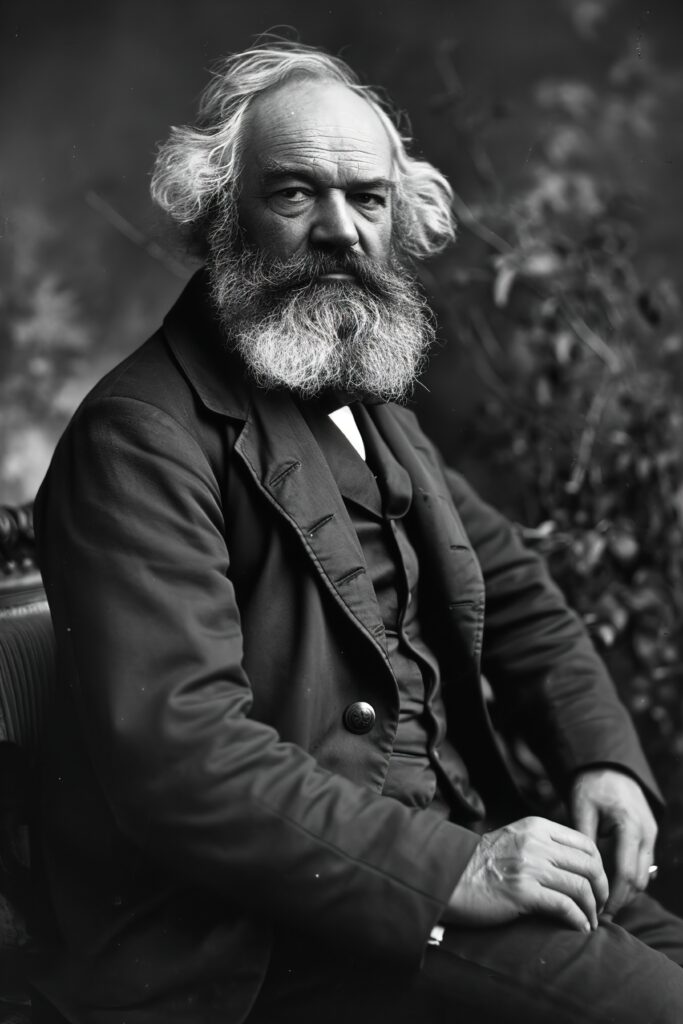
Thorstein Veblen was an odd figure to deliver this verdict. He was the son of Norwegian immigrants, raised on a Wisconsin farm, and by all accounts a difficult man. He dressed badly on purpose. He kept his books on shelves still in their packing crates. He once said that the only way to get ahead in academia was to marry well or to write something nobody could understand. He did the second.
In 1899 he published The Theory of the Leisure Class, a book that pretended to be dry economics but was actually one of the most savage cultural critiques ever written. He invented terms we still use without knowing where they came from. Conspicuous consumption. Conspicuous leisure. The pecuniary canon of taste. He looked at the wealthy people of his day, the gilded barons and their wives draped in lace, and he said, in effect, you are not doing what you think you are doing. You are not enjoying yourselves. You are signaling.
His core insight was simple. In any society where some people have more than others, the people on top need a way to prove they belong on top. They cannot just say it. Anyone can say anything. They have to demonstrate it through behavior that is impossible for the lower orders to copy. And the easiest way to do that is to do something pointless. Something wasteful. Something nobody would do unless they could afford to.
This is why, throughout history, the rich have grown long fingernails, worn impractical clothing, and learned dead languages. None of these things are useful. That is the point. If they were useful, anyone might do them. Their uselessness is the message.
The Logic of Waste
To understand why efficiency kills status, you have to understand what status is for. It is a signal. And a signal only works if it is hard to fake.
Imagine I tell you I am rich. You have no reason to believe me. Now imagine I show up to dinner in a suit that cost more than your car. The suit does the work my words could not. It says: I have so much money that I can spend it on a piece of fabric that will be out of fashion next year. The suit is, in pure functional terms, no better than a much cheaper one. A two hundred dollar suit will keep you just as warm. The expensive suit is not solving the problem of being cold. It is solving the problem of being doubted.
Veblen called this the principle of conspicuous waste. The thing has to be wasteful, and the waste has to be visible, or else it does not signal anything. A man who quietly donates millions to charity may be a saint, but he is not advertising his wealth. A man who buys a yacht he uses twice a year is.
Now apply this to efficiency. Efficiency is, by definition, the opposite of waste. To be efficient is to get the most output from the least input. To remove the unnecessary. To do more with less.
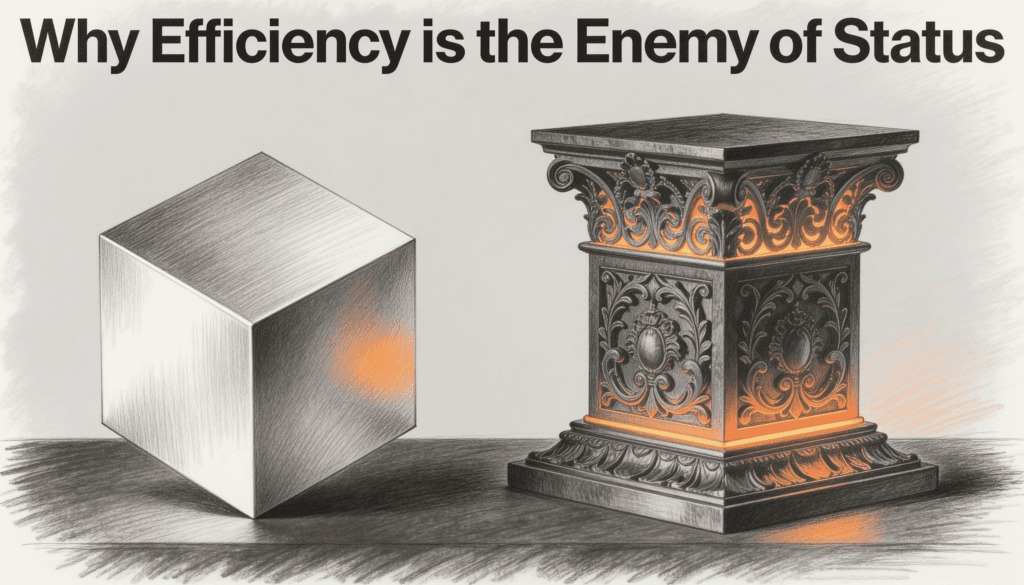
If status comes from waste, and efficiency removes waste, then a fully efficient life cannot produce status. They are pulling in opposite directions. The more efficient you become, the less you are signaling. The more you signal, the less efficient you can afford to be.
Why the Rich Slow Down
This explains something you may have noticed without quite naming it. Poor people are obsessed with speed. Fast food. Fast fashion. Fast cash. Quick loans. Express checkouts. Microwave meals. The lower you are on the income ladder, the more your life is structured around saving time, often because every minute is already accounted for by work.
The rich do the opposite. They slow down on purpose. They take three weeks to make a cheese. They age their wine for decades. They hand stitch their shoes. They go on retreats where they sit silently for ten days. They have their groceries selected by a person who is paid to walk slowly through a market.
A poor person eating a bag of chips on the bus is being efficient. He is getting calories quickly and cheaply, while in transit, with minimal preparation. A wealthy person paying eighty dollars to sit at a counter and watch a chef slice fish for two hours is being maximally inefficient. He could buy that same fish at a supermarket and eat it standing up. But of course, that would prove nothing.
Veblen saw this clearly. He pointed out that the wives of the rich, in his time, were essentially employed to be inefficient. Their elaborate dress, their fragile manners, their inability to perform any useful labor without ruining their gloves, all of it was a public demonstration that their husbands were rich enough to support a person who did nothing measurable. She was a walking, breathing proof of his surplus.
The Modern Disguises
You might think this was a critique of a vanished world. Top hats and parasols. Carriages and calling cards. Surely we have moved past such silliness.
We have not. We have only changed costumes.
Consider the modern obsession with artisanal everything. Hand roasted coffee. Small batch gin. Sourdough bread that requires a starter you have to feed like a pet. None of this is more efficient than the industrial version. That is the point. Industrial bread is cheap, fast, and consistent. Sourdough is slow, expensive, and unreliable. To bake your own sourdough is to announce that you have time, which is the rarest currency of all.
Consider the wedding industry. A wedding could, in theory, be a fifteen minute ceremony at city hall followed by lunch. Most are not. They sprawl over weekends, involve dozens of suppliers, and consume the average annual salary in a single afternoon. Almost none of this is necessary for the legal or emotional fact of two people getting married. All of it is signal.
Consider the modern body. The wealthy of the past were fat because food was scarce and wealth meant access to it. The wealthy of today are lean because food is abundant and wealth means access to the time, trainers, and self denial required to refuse it. The body itself has become a status object, and the marker has flipped, but the logic is identical. Whatever is hardest to attain becomes the thing worth attaining.
Consider the office. There was a time when the executive sat in a corner office, behind a heavy desk, doing visible work. Now the highest status work is increasingly invisible. The truly powerful do not sit at desks. They have meetings. They have lunches. They are on planes. Their schedules are managed by someone else. The further you rise, the less of your work resembles work.
The Counterintuitive Twist
Here is where it gets strange. You might assume that if efficiency is the enemy of status, then efficient people are low status. But this is not quite right.
In some fields, efficiency itself has become a status symbol, but only when it is performed at a level the average person cannot reach. The executive who runs a billion dollar company on four hours of sleep, the founder who codes through the night, the surgeon who operates with terrifying speed, all of these people are signaling status through what looks like efficiency. But notice the trick. Their efficiency is so extreme, so demanding, that it loops back around into waste. It wastes their health, their relationships, their time on earth. The signal is: I can afford to burn myself for this. Most people cannot.
So even when the rich seem to embrace efficiency, they tend to embrace a version of it that ordinary people cannot copy. The hyper productive billionaire is not really showing you efficiency. He is showing you a willingness to sacrifice things you cannot afford to lose.
This is the deep cunning of the status game. Whatever the masses adopt, the elite abandon. When everyone got cars, the rich started biking. When everyone got access to information, the rich started paying for curators. The signal must remain rare, or it stops being a signal.
What This Costs Us
It is tempting to read all this and feel clever. Look at those silly people, signaling away with their five thousand dollar handbags. We are above it. We see through the trick.
But Veblen would not let us off so easily. His point was not that some people are vain. His point was that almost everyone, at almost every income level, is doing some version of this, almost all the time. We are all signaling to someone. The student who buys the right sneakers. The professional who name drops the right book. The parent who talks about how busy their child is. The minimalist who proudly owns very little. Even the rejection of status games is itself a status move.
What it costs us is enormous. It costs us money we do not need to spend. It costs us time we will not get back. It costs us, perhaps most painfully, the ability to know what we actually want, as opposed to what we have been trained to want by the people standing slightly above us on the ladder.
The most efficient version of your life, the one with the least waste, the most direct path from desire to satisfaction, is almost certainly not the life that will impress anyone. It will not photograph well. It will not generate envy at dinner parties. It will not feel like winning, because winning, in the social sense, is measured against others, and the others are all running a different race.
The Quiet Rebellion
There is something liberating in seeing this clearly. Once you understand that status is a game with shifting rules, designed by no one and benefiting almost nobody, you get to ask a question most people never ask. What would I do if I were not signaling?
You might find, as Veblen hinted but never quite said, that the truly free person is the one who has decided which signals to send and which to ignore. Not the person who has opted out of status entirely, because that is impossible for a social animal. But the person who has chosen their audience, narrowed their game, and stopped trying to impress strangers whose approval was never going to mean anything anyway.
That is a kind of efficiency Veblen might have approved of. Not the efficiency of doing more, faster. The efficiency of wanting less, on purpose. The efficiency of refusing to waste your one life proving something to people who are not really watching.
It is also, of course, its own kind of signal. The signal of someone who has read Veblen, perhaps, and decided to take him seriously.
He would have appreciated the irony.