Table of Contents
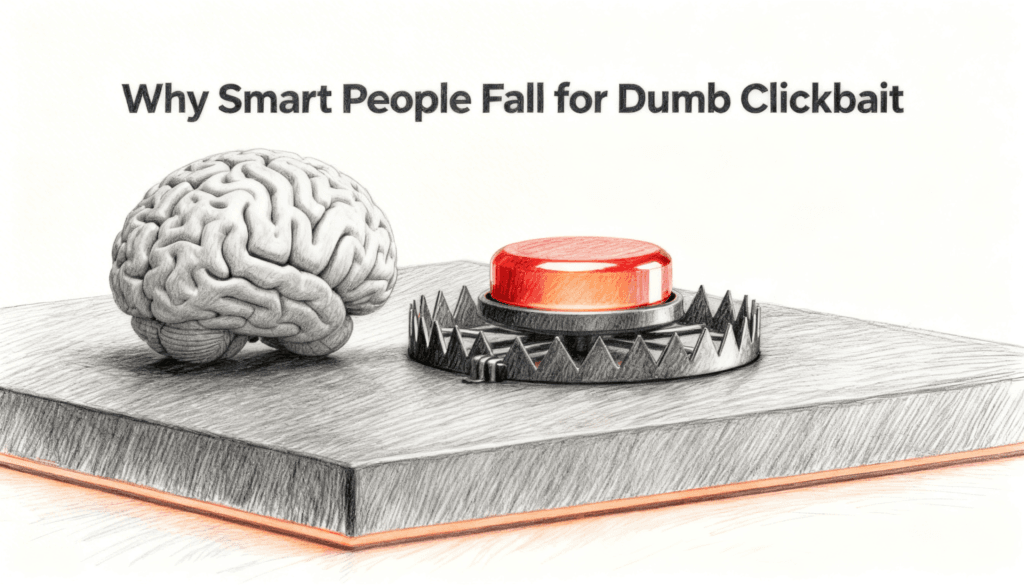
You are probably smarter than you think. You are also probably dumber than you think. And if that sentence made you want to keep reading, you just proved the point of this entire article.
Every day, millions of highly educated, analytically sharp, professionally accomplished people click on headlines they know are garbage. “You Will Not Believe What This Celebrity Looks Like Now.” “Scientists Discover One Weird Trick.” “This Common Food Is Secretly Killing You.” The people clicking are not rubes. They are doctors, engineers, lawyers, professors. They are people who can solve differential equations but cannot resist finding out which Disney princess matches their personality.
This is not a new problem. It is not even a modern problem. A man born in 1561 mapped the exact reasons why this happens, and he did it without ever seeing a smartphone. His name was Francis Bacon, and his theory of human irrationality remains the sharpest diagnosis of our mental weaknesses ever written.
The Man Who X-Rayed the Mind
Francis Bacon was an English philosopher, statesman, and essayist who essentially invented the scientific method as we know it. His big project was figuring out why humans are so reliably terrible at thinking clearly. Before Bacon, most European intellectuals assumed that if you were smart enough and read enough Aristotle, you would arrive at the truth. Bacon thought this was laughable. Intelligence, he argued, was not a shield against error. It was often the engine of it.
In his 1620 work Novum Organum, Bacon introduced what he called the “Idols of the Mind.” These are not golden calves or graven images. They are systematic distortions in human thinking, built into the very architecture of how we process information. Bacon identified four categories, and each one maps onto the modern clickbait economy with disturbing precision.
What makes Bacon so remarkable is not that he noticed people make mistakes. Plenty of philosophers managed that. What makes him remarkable is that he understood something deeply counterintuitive: the smarter you are, the more elaborate your mistakes become. Intelligence does not fix these errors. It decorates them.
The First Idol: The Tribe
Bacon called the first distortion the Idol of the Tribe. This refers to the biases that come from simply being human. Every member of our species shares them. We see patterns where none exist. We remember hits and forget misses. We assume the universe is more orderly than it actually is.
This is the idol that makes clickbait work at the most basic level. When you see a headline that reads “New Study Proves Coffee Extends Your Life,” something in your brain lights up. Not because you have carefully evaluated the methodology of the study. Not because you understand the difference between correlation and causation. But because your brain is a pattern completion machine that desperately wants the world to deliver clean, satisfying narratives.
The Idol of the Tribe explains why smart people are not immune to this. The bias is not a function of intelligence. It is a function of biology. Your prefrontal cortex might know that a single study proves nothing. But your limbic system has already clicked the link, because the limbic system does not read peer review.
Here is what Bacon understood that most people still do not: this tendency actually gets worse with intelligence. A smart person who reads that coffee headline will not just click it. They will click it, read it, and then construct an elaborate justification for why this particular study is actually credible. A less analytical person might click, skim, and forget. The smart person builds a fortress around the error.
The Second Idol: The Cave
The Idol of the Cave is Bacon’s term for individual biases. Where the Idol of the Tribe affects all humans equally, the Idol of the Cave is personal. It comes from your specific education, your temperament, your experiences, and the particular groove your thinking has worn into over the years. Everyone, Bacon wrote, has their own private cave that refracts and distorts the light of reality.
This is where clickbait gets surgical. Modern content algorithms do not serve everyone the same headlines. They serve you headlines tailored to your cave. If you are a politically liberal academic, your clickbait looks different from a conservative small business owner’s clickbait. But both of you are clicking, and both of you are falling for the same structural trick: content that confirms what you already believe while making you feel like you are learning something new.
The Idol of the Cave explains a phenomenon that baffles many people: why experts fall for misinformation in their own fields. You would think a nutritionist would be less likely to fall for a bogus diet headline. Often, the opposite is true. The nutritionist has a deeper cave. They have more prior beliefs, more theoretical commitments, more professional identity wrapped up in certain positions. When a headline confirms their existing framework, it does not feel like clickbait. It feels like validation.
This is the dark genius of personalized content. The algorithm does not need to trick you. It just needs to find your cave and shine a light that matches the shape of the walls.
The Third Idol: The Marketplace
Bacon’s third idol is the Idol of the Marketplace. This one concerns language itself. Words, Bacon argued, are not neutral containers for ideas. They shape, distort, and sometimes completely fabricate the concepts they claim to describe. When people communicate, they are not exchanging pure thoughts. They are exchanging words, and words come with baggage.
If you want to understand why clickbait headlines are written the way they are, this is your idol. Consider the machinery of a phrase like “Scientists Baffled.” Those two words do extraordinary work. “Scientists” borrows the authority of an entire institution. “Baffled” simultaneously elevates the mystery and subtly undermines that authority. The headline is not communicating information. It is performing a linguistic magic trick.
Bacon noticed that the most dangerous words are not the obscure ones. They are the common ones. Words like “natural,” “proven,” “breakthrough,” “toxic.” These words feel precise but are actually hopelessly vague. When a headline announces a “breakthrough” in cancer research, what does that mean? It could mean anything from a Nobel Prize caliber discovery to a marginal statistical finding in a mouse study. But the word “breakthrough” has already done its work. Your brain has already assigned it meaning, and that meaning is almost certainly too large.
Smart people are especially vulnerable to the Idol of the Marketplace because they have larger vocabularies and more confidence in their ability to parse language. They think they are reading carefully. But careful reading is not enough when the words themselves are rigged. You cannot critically analyze your way out of a semantic trap if you do not realize the semantics are the trap.
The Fourth Idol: The Theater
The final idol is the Idol of the Theater. This refers to the grand systems of thought, the philosophical and ideological frameworks that people adopt wholesale and then use to interpret everything. Bacon compared these systems to stage plays: elaborate, internally consistent, compelling, and entirely fictional.
This is the idol that explains why smart people do not just click on one piece of clickbait. They build entire worldviews out of it. Consider how this works in practice. A person with a strong ideological framework encounters a clickbait article that fits the narrative. They do not treat it as one isolated piece of questionable content. They slot it into their system. It becomes evidence. It becomes part of the story they tell themselves about how the world works.
The Idol of the Theater is why you can find brilliant people who believe genuinely absurd things. Not because they are stupid, but because they are running powerful cognitive software on corrupted data. Their reasoning is impeccable. Their premises are wrong. And because the reasoning is so good, they become more confident in the wrong conclusions than a less analytical person would ever be.
Bacon saw this everywhere in the intellectual culture of his time. Aristotelian philosophers had built magnificent logical structures on foundations that crumbled the moment you tested them empirically. The system was beautiful. The system was wrong. And the beauty of the system was exactly what prevented people from questioning it.
Replace “Aristotelian philosophy” with “my curated social media feed” and you have a perfect description of the modern information environment.
Why Intelligence Makes It Worse
Here is the thread that runs through all four idols: intelligence is not a defense against irrationality. It is a multiplier. This is probably the most counterintuitive and most important insight Bacon ever produced.
A smart person who encounters a biased piece of content can do something a less smart person cannot. They can rationalize it. They can construct elaborate arguments for why this particular piece of nonsense is actually reasonable. Psychologists have a modern term for this. They call it motivated reasoning. But Bacon was there first, and his version is more honest. He did not just say people reason toward their preferences. He said the entire apparatus of human cognition is built to do this, and that more powerful cognitive apparatus means more powerful self deception.
This is why the clickbait industry does not target the gullible. It targets everyone, and it works on everyone, because the vulnerabilities it exploits are not bugs in human cognition. They are features. We evolved to find patterns, to seek confirmation, to respond to language emotionally, and to organize information into coherent narratives. These are not flaws. They are the tools that made civilization possible. Clickbait simply turns those tools against their owners.
What Bacon Would Tell You to Do About It
Bacon was not a pessimist. He did not describe the Idols of the Mind so that people could despair at their own irrationality. He described them so that people could build systems to counteract them. That was the whole point of the scientific method: not to make humans smarter, but to make human stupidity less consequential.
So what would Bacon prescribe for the clickbait age?
First, distrust your own reactions. If a headline makes you feel something strongly, that is a reason for suspicion, not confidence. The Idols are emotional before they are intellectual. The feeling of “yes, I knew it” is almost always the Idol of the Cave talking.
Second, watch the words. When you encounter language that feels authoritative but is actually vague, slow down. “Experts say” means nothing. “Studies show” means less. Ask which experts. Ask which studies. The Idol of the Marketplace thrives on your willingness to let language do the thinking for you.
Third, be especially skeptical of information that fits too neatly into your existing beliefs. Bacon understood that the most dangerous falsehoods are not the ones that contradict what you think. Those are easy to reject. The dangerous ones are the falsehoods that feel like natural extensions of what you already know.
Fourth, and most importantly, accept that you are not above this. The moment you believe you are too smart to fall for manipulation is the moment you become the easiest person in the room to manipulate. Bacon’s entire philosophical project began with this premise: the first step toward thinking clearly is admitting that you do not.
The Headline You Clicked to Get Here
There is, of course, an irony baked into this entire article. You clicked on it. Maybe the title promised something about smart people and dumb clickbait, and your brain did exactly what Bacon predicted it would do. You saw a pattern that interested you. You filtered it through your own cave of assumptions about your own intelligence. You responded to words like “smart” and “dumb” that smuggled in value judgments. And you probably fit this piece into some larger framework you already hold about media, technology, or human nature.
Bacon would not blame you for this. He would simply point out that recognizing the trap is not the same as escaping it. The Idols of the Mind are not obstacles you overcome once. They are the permanent weather of human consciousness. The best you can do is carry an umbrella.
And maybe, just maybe, the next time you see a headline that feels engineered to hijack your attention, you will hear a 400 year old voice in the back of your mind whispering: check which idol is pulling the strings.
Then you will probably click anyway. But at least you will know why.