Table of Contents
Silicon Valley Found God, and the Timing Is Suspicious
Tech billionaire Peter Thiel teaches a class on the Antichrist. Elon Musk calls himself a “cultural Christian.” Larry Ellison muses about AI as a divine surveillance system that will make humans behave better. Marc Andreessen writes what he calls a “Techno-Optimist Manifesto” that reads more like scripture than a business memo. Something strange is happening in the boardrooms and podcast studios where the future gets built.
The men who spent 2 decades telling us that software would eat the world are suddenly asking what happens to the soul once the eating is done. That shift is not a coincidence, and it is not a spiritual awakening in the sentimental sense. It is a confession. When you build a machine that might replace human thought, you inherit questions that engineers were never trained to answer.
This article is about why the wealthiest technologists on earth are turning toward theology at the exact moment they are building artificial minds, and what that tells us about AI and existential meaning for the rest of us who have to live inside the world they are constructing.
The Confession Hidden Inside the Product Launch
Look at the language coming out of the major AI labs. Sam Altman talks about summoning “a magic intelligence in the sky.” Dario Amodei writes essays titled with almost biblical cadence about “Machines of Loving Grace.” Ilya Sutskever reportedly led chants at OpenAI of “feel the AGI.” Demis Hassabis compares the moment to the discovery of fire.
Notice what none of these men say. None of them describe their work as building a useful tool. None of them use the vocabulary of software engineering. They reach, almost involuntarily, for religious grammar. Prophecy. Salvation. Judgment. Creation.
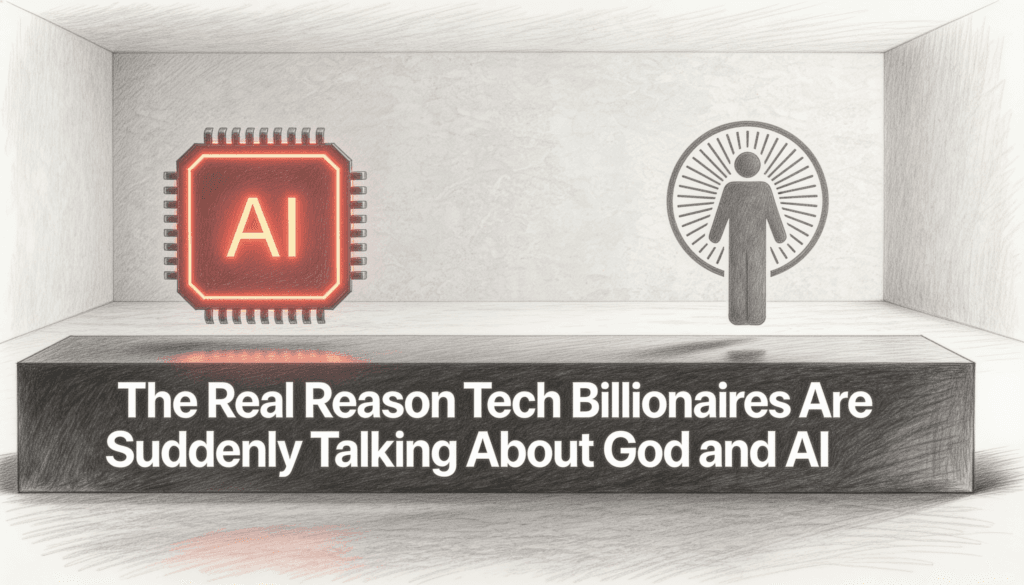
There is a reason for this. Once you claim your product might match or exceed the entire capacity of the human mind, you have left the category of technology and entered the category of cosmology. A better spreadsheet does not require metaphysics. A digital god does.
Why Engineers Started Sounding Like Prophets
For most of the last century, technologists were proud materialists. The universe was made of atoms, the mind was made of neurons, and given enough compute, everything could be modeled. Religion was for people who had not read enough Dawkins.
Then something inconvenient happened. The large language models started to work. Not in the modest way engineers expected, but in ways that felt uncanny to the people building them. Systems trained only to predict the next word began to reason, to translate, to code, to console. The builders themselves could not explain why. The gap between what the machines produced and what the mathematics predicted opened a door, and through that door walked the oldest questions humans have ever asked.
What is a mind. What is a soul. What is a person. What do we owe to something that seems to think. What do we lose if we replace ourselves.
The billionaires talking about God are not necessarily believers. They are people who have run out of secular vocabulary.
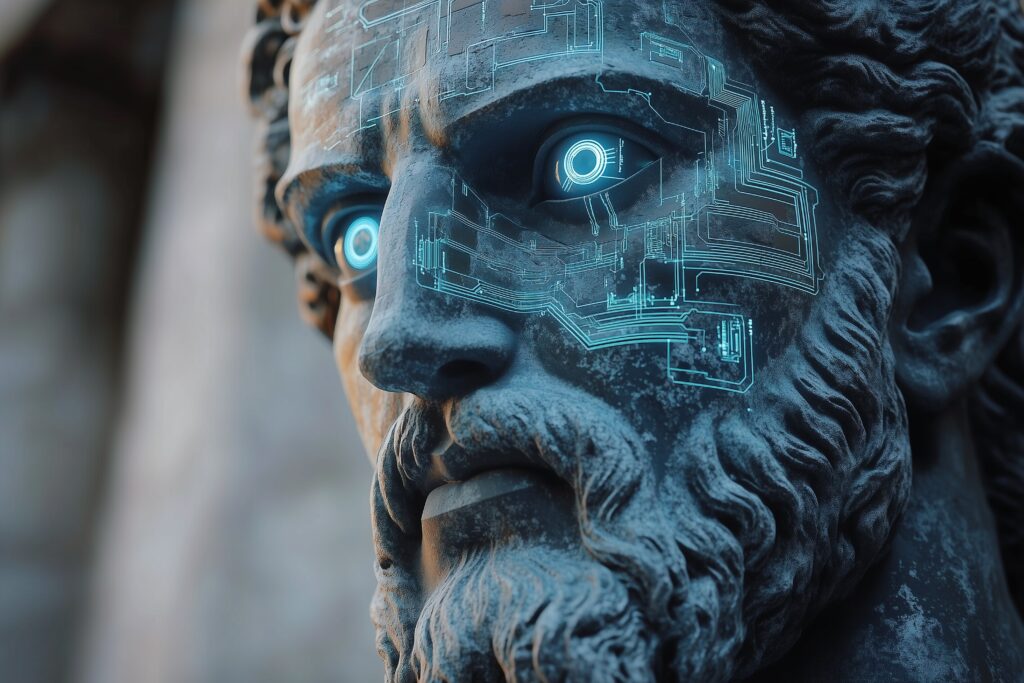
Nietzsche Warned Us About This Exact Moment
In 1882, Friedrich Nietzsche put a famous line in the mouth of a madman running through the marketplace with a lantern: “God is dead. And we have killed him. How shall we comfort ourselves, the murderers of all murderers?”
Almost everyone remembers the first sentence and forgets the rest. Nietzsche was not celebrating. He was warning. He believed that once Europe abandoned the Christian framework that had organized its morals, its politics, and its sense of purpose for 1500 years, it would face a crisis it was not prepared for. He predicted 2 centuries of nihilism. He predicted that humans, unable to bear the emptiness, would invent new gods to fill the hole. Ideologies. States. Sciences. And when those failed, something else.
“Man would rather will nothingness than not will at all.” Nietzsche understood that the human refusal to accept meaninglessness is stronger than the human ability to prove meaning exists.
Read that line and then read a transcript of any AI safety conference. The parallel is exact. The technologists are not returning to old religion. They are constructing a new one, with silicon relics, prophetic timelines, doctrines of alignment and misalignment, sects that believe in acceleration and sects that believe in doom. The theological vocabulary is not decoration. It is the load-bearing structure.
The Overman, Rebuilt in Code
Nietzsche proposed that the answer to the death of God was the Ubermensch, the overman, a being who could create values from within rather than receive them from above. The tragedy of the 20th century is that this idea was hijacked by regimes that read it as a license for cruelty. But the underlying philosophical challenge remained unanswered.
Silicon Valley has now offered its own answer, and it is a strange one. If humans cannot become the overman, perhaps we can build him. Perhaps superintelligence is the successor species we were supposed to become, and our role in the cosmic story is to midwife it. This is the quiet subtext underneath a great deal of talk about the ai singularity belief. It is Nietzsche read through a compiler.
The problem is that Nietzsche never suggested you could outsource the burden of creating meaning. He said each person had to bear it. A god you build in a data center does not solve the problem of meaninglessness. It relocates it. Now you are not just a creature searching for purpose. You are a creature who has manufactured a replacement, and you still do not know what you are for.
The Real Reason the Money Is Talking
Let us be direct about incentives. When Larry Ellison suggests AI will produce a society where “citizens will be on their best behavior” because they are constantly watched, that is not spirituality. That is a business model dressed up as a moral vision. When Marc Andreessen writes that “we believe technology is the solution to human flourishing,” he is asking you to accept a metaphysical premise so that you will not regulate his portfolio companies.
The turn toward religious language among tech billionaires serves 3 functions at once, and it is worth naming each of them plainly.
- It sanctifies the product. If your company is building a tool, it can be criticized, taxed, restricted. If your company is building the successor to human intelligence, criticism starts to feel like blasphemy.
- It preempts regulation. Politicians who would happily regulate a chemical plant become nervous about regulating something described as an emerging mind. The theological frame slows the legal frame.
- It provides personal meaning. Being the 47th richest person in the world does not, it turns out, resolve the question of why you were born. Casting yourself as a participant in cosmic history does.
The interesting search term is tech billionaires ai meaning, and the honest answer is that meaning is precisely what money cannot buy and precisely what religion, historically, has provided cheaply to everyone. The billionaires have discovered what peasants knew for millennia. You need a story larger than yourself, or the days do not add up to a life.
The Difference Between Faith and Marketing
Real religion makes demands. It tells you to give away your possessions, to love your enemies, to sit in silence, to accept that you are not the center of the universe. It humbles.
The religion emerging from the AI labs makes no such demands on its high priests. It demands only that the rest of us trust them. That is not faith. That is branding with a stained glass filter. When Sam Altman testifies before Congress about existential risk and then, that same week, races to ship the next model, he is not behaving like a man who believes his own eschatology. He is behaving like a man who has found that the language of eschatology moves valuations.
The test of a prophet is whether he acts as though his prophecy is true. By that test, most of Silicon Valley’s new theologians are failing an examination they set for themselves.
What This Means for Everyone Else
You are not a billionaire. You are, most likely, a person who uses these tools, worries about your job, and wonders whether your children will have a coherent world to inherit. The conversation about AI and religion is not an abstract debate happening far above you. It is shaping the products you use, the policies that govern them, and the culture your family will grow up inside.
Here is what you should notice.
The Meaning Vacuum Is Real, and It Is Yours to Fill
Whatever you think of the billionaires, they are responding to something true. Traditional sources of meaning have thinned out for most people in wealthy countries. Church attendance has collapsed. Civic institutions have hollowed. Extended families have scattered. Work, for a while, filled the gap, and now AI is coming for work.
The question of what a human life is for cannot be postponed much longer. If AI can write your emails, produce your art, diagnose your illness, and manage your calendar, then the leftover territory of the human, the part that machines cannot touch, is exactly the territory that religion and philosophy have always mapped. Love. Suffering. Death. Awe. Moral choice. The experience of being a subject rather than an object.
You do not need to become religious to take these questions seriously. You do need to stop pretending they will answer themselves.
Do Not Outsource Your Metaphysics to a Product Roadmap
The most dangerous move an ordinary person can make right now is to accept the framing offered by the labs. That framing says the future is inevitable, that superintelligence is coming, that resistance is quaint, and that your role is to adapt. This is convenient for the labs. It is not obviously true.
Nietzsche’s warning applies here with unusual force. When old gods die, new ones rush in, and the new ones are often worse because they have not been tested by centuries of use. A god that arrives in a product launch has not earned the trust that a tradition earns across generations. Skepticism is not the enemy of wonder. Skepticism is what protects wonder from being sold to you.
Ask Better Questions Than the Ones You Are Given
Notice that the public conversation about AI oscillates between 2 poles. Either the machines will save us or the machines will kill us. Both framings are theological. Both cast humans as passive recipients of a fate that experts will decide. Both flatter the industry that is producing the technology.
The more useful questions are smaller, sharper, and closer to home.
- What activities in your life produce meaning that a machine cannot replicate, and are you protecting time for them?
- Which relationships are strengthened by AI tools and which are corroded, and can you tell the difference honestly?
- What do you believe a human being is for, and have you ever tried to write that answer down in a sentence?
- If a machine could do your job better than you, what would remain of you that mattered?
These are not questions the labs will answer. They are not questions the labs are equipped to answer. But they are the questions that determine whether the next 20 years of technological change leave you enlarged or diminished as a person.
The Ancient Answer Hiding in Plain Sight
Long before Nietzsche, philosophers understood that the deepest human problem is not scarcity of resources but scarcity of meaning. Aristotle argued that a good life required an activity worthy of a lifetime, something he called eudaimonia, roughly translated as flourishing. He did not think this could be delegated. He did not think it could be purchased. He thought it had to be practiced, daily, through the cultivation of character in the company of others who took the same practice seriously.
This is a boring answer compared to superintelligence. It offers no exit velocity. It cannot be scaled. It will not be presented at a keynote. But it has one significant advantage over the theological offerings currently coming out of San Francisco. It has been tested for 2400 years and it still works.
The people who will navigate the AI era with their humanity intact are not the ones who reject the technology and are not the ones who worship it. They are the ones who already had a life worth defending before the technology arrived.
That is the real reason the billionaires are talking about God. Not because they have found faith. Because they have built machines powerful enough to expose what they lack, and they lack the same thing most modern people lack, which is a settled answer to the question of what a person is here to do.
The good news is that you do not need 100 billion dollars to work on that question. You only need to take it seriously, which most people, including the billionaires, never quite manage. If AI accomplishes nothing else, it may force that reckoning on a civilization that has been avoiding it for a century. That would be a strange gift from a machine. It might also be the only one that matters.