Table of Contents
There is a peculiar inversion happening in the halls of power, and it has been hiding in plain sight for over a century.
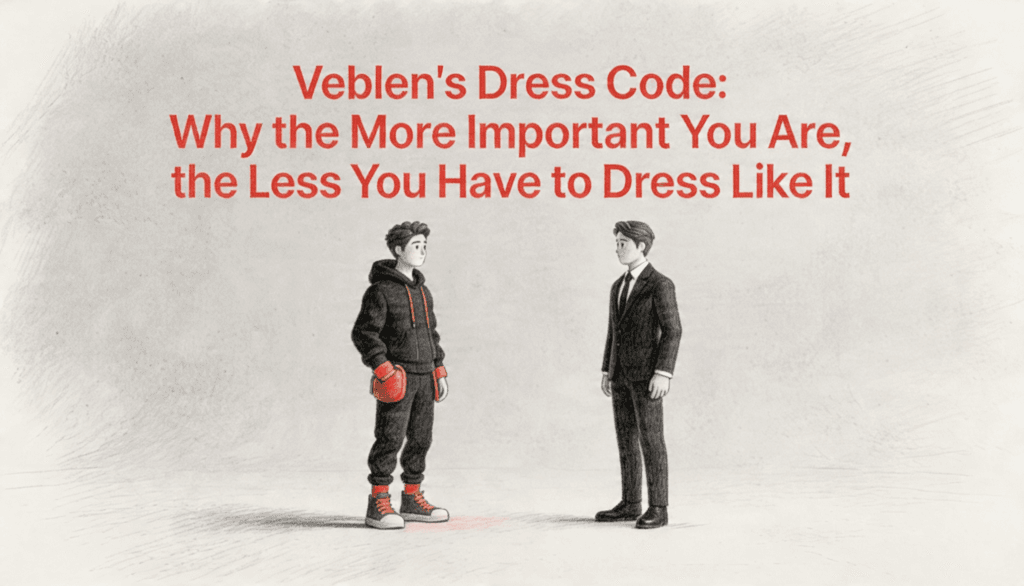
The richest man in whatever room he enters often looks like he just rolled out of a camping trip. The founder who controls billions dresses like he is running late for a college lecture he did not prepare for. Meanwhile, the junior analyst on his first day showed up in a suit so sharp it could cut glass.
This is not an accident. This is a signal, and it is one that Thorstein Veblen saw coming before anyone owned a hoodie.
The Economist Who Noticed Everything
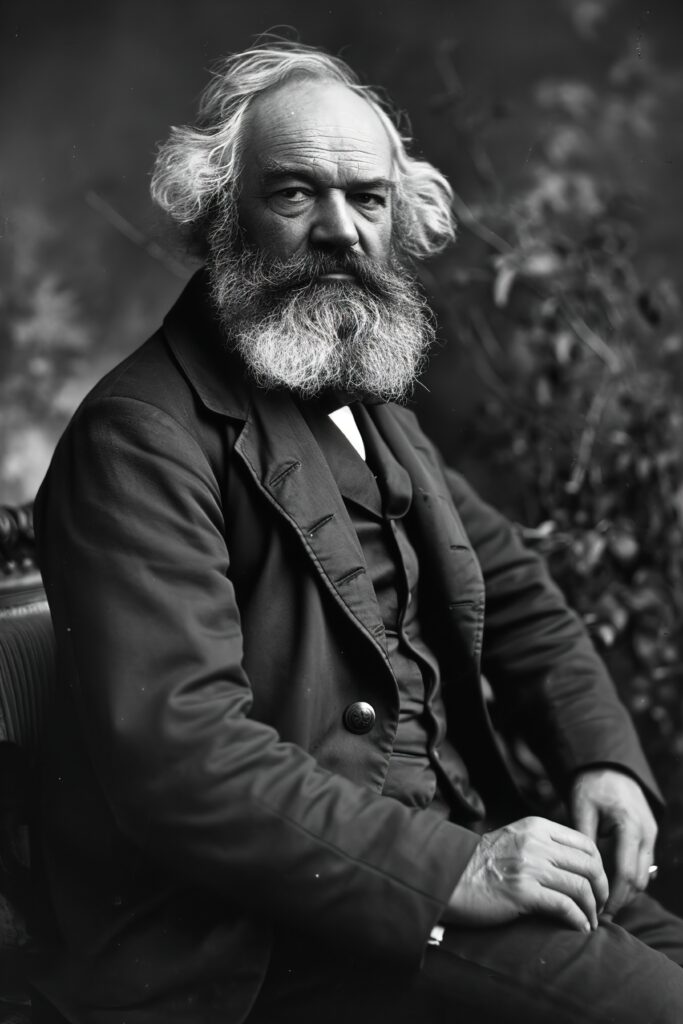
Thorstein Veblen was a strange man. Born in 1857 to Norwegian immigrants in rural Wisconsin, he grew up an outsider looking in at American capitalism with the detached curiosity of a biologist studying ants. He was brilliant, difficult, socially awkward, and perpetually broke. He bounced between universities, alienated colleagues, and never quite fit into the world he spent his life dissecting.
In 1899, he published The Theory of the Leisure Class, a book that introduced the world to a concept so durable it still explains your Instagram feed: conspicuous consumption. The idea was simple but devastating. People do not buy expensive things purely because those things are better. They buy them to show other people that they can afford to buy them. The purpose of wealth, Veblen argued, is not comfort. It is display.
But here is where Veblen gets interesting for our purposes. Buried in his observations about the wealthy was a subtler insight about clothing, labor, and status that has only grown more relevant with time. Veblen noticed that the way people dress is not just about taste. It is about proving something. And the thing you need to prove depends entirely on where you sit in the hierarchy.
The Suit as a Receipt
For most of modern history, dressing well meant dressing expensively. The logic was straightforward. Fine fabrics, tailored cuts, and elaborate accessories were expensive. If you wore them, you were advertising that you did not need to do physical work. Your clothes were, in Veblen’s framework, evidence of leisure. They were a receipt for a lifestyle.
This made perfect sense in a world where the line between rich and poor was drawn by who got their hands dirty. A white shirt was not just a fashion choice. It was a declaration: I do not dig. I do not haul. I do not sweat. The impracticality was the point. You were wearing proof that you could afford to be useless.
And this system worked beautifully for a long time. The boardroom uniform of the twentieth century, the dark suit and the polished shoe, was not really about looking professional. It was about looking like you belonged to a class of people who made decisions rather than carried them out. Every silk tie was a tiny flag planted on the hill of status.
But then something shifted.
When Everyone Got the Memo
The problem with any status signal is that it only works as long as not everyone can copy it. And suits, eventually, became accessible. Mass production made decent clothing cheap. Fast fashion made trendy clothing disposable. Suddenly, the junior analyst could dress like the CEO. The intern could walk in looking like a managing director. The visual grammar of success became available to anyone with a credit card and a lunch break near a shopping district.
This is what economists call a signaling problem. When everyone can send the same signal, the signal stops carrying information. If every person at the meeting is wearing a suit, the suit no longer tells you who matters. It becomes noise.
And so the people at the top did what powerful people have always done when the masses catch up. They changed the rules.
The Hoodie Inversion
Mark Zuckerberg did not become famous for wearing a gray t-shirt. He was already famous. The t-shirt became famous because he wore it. This distinction matters more than it appears to.
When someone at the very top of a hierarchy dresses down, they are not failing to send a signal. They are sending a different one. The message is not “I could not afford a suit.” The message is “I do not need one.” And that, paradoxically, is a far more powerful statement than any bespoke jacket could ever make.
This is the Veblen inversion. At a certain altitude of status, the effort you put into your appearance starts working against you. Trying too hard signals that you still have something to prove. Not trying at all signals that the proving is finished. You have already won. The scoreboard is off.
Steve Jobs had his black turtleneck. Zuckerberg has his gray shirt. Tech billionaires across Silicon Valley show up to meetings that will determine the fate of entire industries dressed like they are about to mow a lawn. And nobody tells them to change. Nobody can.
The Invisible Uniform of Power
What looks like the absence of a dress code is actually the most exclusive dress code of all. It just operates on inversion. The less effort you visibly invest in your appearance, the more power you are silently claiming. But this only works if everyone in the room already knows who you are.
This is the critical detail that most people miss. Dressing down is not a universal strategy. It is a privilege of the already established. When a billionaire wears a plain t-shirt, people see confidence. When a job applicant wears a plain t-shirt, people see a problem.
Context is doing all the heavy lifting. The same outfit reads completely differently depending on who is wearing it and what room they are standing in. A venture capitalist in flip flops at a pitch meeting is signaling casual dominance. A founder in flip flops at the same meeting might be signaling that they do not understand the game yet, or that they understand it so well they have decided to skip it entirely. The audience has to already possess enough information to decode which one it is.
This creates a fascinating double bind for people in the middle. They cannot dress down because they have not earned the right to be casual. But they also cannot dress up too aggressively because that reveals their anxiety about their position. The middle of any hierarchy is, sartorially speaking, a minefield.
The Peacock Paradox
There is a useful parallel here from evolutionary biology, and it illuminates Veblen’s insight from an unexpected angle.
The peacock’s tail is absurdly impractical. It is heavy, conspicuous, and makes the bird easier to catch. But that is exactly why it works as a mating signal. The peacock is essentially saying: I am so fit, so strong, so genetically superior that I can survive despite carrying this ridiculous disadvantage. The cost is the proof.
For most of economic history, expensive clothing worked the same way. Wearing impractical, costly garments was the human version of the peacock’s tail. You were handicapping yourself to prove you could afford the handicap.
But now the signal has flipped. The new peacock tail is the absence of display. The modern power move is not carrying the weight of visible luxury. It is being so secure in your position that you carry nothing at all. No watch worth mentioning. No shoes worth noticing. No effort worth commenting on. The new handicap is the risk of being underestimated, and only someone who cannot actually be underestimated can afford to take it.
What Veblen Did Not Predict
Veblen was remarkably predictive, but even he might be surprised by how thoroughly his framework has been inverted. He wrote about conspicuous consumption at a time when visibility was the currency of status. More was more. Bigger was better. You wore your wealth like armor.
What he might not have anticipated is a world where the truly powerful have become conspicuously inconspicuous. Where the highest form of status display is the refusal to display at all. Where the most expensive outfit in the room is the one that looks like it cost nothing.
There is an irony here that Veblen, who had a dry sense of humor buried under layers of academic prose, might have appreciated. The leisure class he described spent enormous energy proving they did not need to work. The new leisure class spends enormous energy proving they do not need to prove anything. The performance has not stopped. It has just gotten more sophisticated.
The Rest of Us Are Still Playing the Old Game
Here is the uncomfortable truth that sits beneath all of this analysis. Most people do not have the luxury of opting out of the dress code. Most people still need the suit, the polished shoe, the careful presentation. Not because they are shallow, but because the world still reads their appearance as information about their competence, their seriousness, their belonging.
The freedom to dress badly is distributed about as evenly as wealth itself. Which is to say, not evenly at all.
A young lawyer showing up to court in a hoodie is not making a power move. She is making a career mistake. A teacher wearing flip flops to a parent meeting is not channeling Zuckerberg energy. He is getting a talking to from the principal. The rules that the powerful get to break are the same rules that everyone else still has to follow. And the breaking itself is what marks the boundary between the two groups.
This is perhaps the most Veblenian observation of all. The dress code has not disappeared. It has simply added a layer. There is now a visible code for people who are still climbing and an invisible code for people who have already arrived. And the invisible one is, by design, impossible to imitate. You cannot fake not caring about what people think. Or rather, you can, but everyone can tell.
The Real Lesson
So what do we actually take from all of this?
First, that status signals are never static. They evolve, they invert, and they will always find new ways to separate insiders from outsiders. The moment a signal becomes widely available, it stops working, and a new one takes its place. This is as true in fashion as it is in language, in architecture, in the cars people drive, and in the social media platforms they choose.
Second, that the relationship between effort and status is more complicated than it looks. There is a U-shaped curve at work. At the bottom, you cannot afford to try. In the middle, you must try visibly. At the top, you perform the appearance of not trying, which is its own elaborate form of effort. Nobody accidentally builds a wardrobe of identical gray t-shirts. That is a choice, and it is a choice that requires the security of knowing that no one will hold it against you.
Third, and perhaps most usefully, that awareness of these dynamics is itself a form of power. When you understand that clothing is a language, you can start reading the room more accurately. You can see who is performing confidence and who actually possesses it. You can notice when someone is dressing for the role they want and when someone is dressing to signal they have outgrown all roles entirely.
Veblen died in 1929, just before the stock market crash that would have confirmed many of his darkest suspicions about American capitalism. He never saw Silicon Valley. He never saw a CEO in sandals negotiate a deal worth more than some countries produce in a year. But he gave us the framework to understand it.
The dress code has not been abolished. It has been reversed. And the people who understand the reversal are, as always, the ones who set the terms for everyone else.
That gray t-shirt is not humble. It is the most expensive thing in the room. You just cannot see the price tag.