Table of Contents
There is a man who died in 1626 from stuffing a chicken with snow. He was trying to see if cold could preserve meat. He caught pneumonia and that was the end of him. His name was Francis Bacon, and he might be the most important person in the technology industry today, even though he never saw a lightbulb.
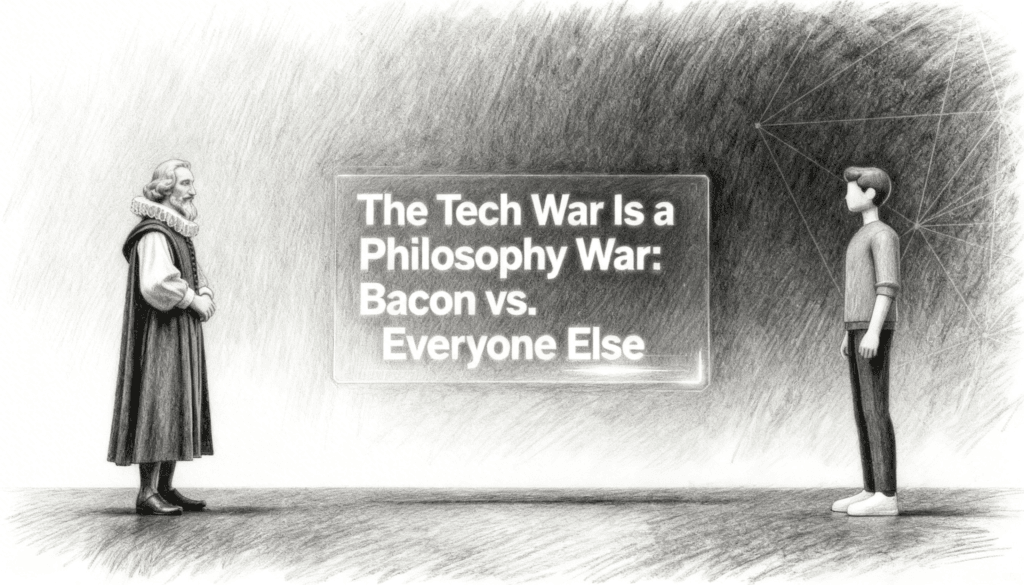
Every major conflict in tech right now, from AI safety debates to open source versus closed source, from regulation fights to the battle over who owns your data, looks like a business war on the surface. It is not. It is a philosophy war. And almost every side, whether they know it or not, is arguing about ideas that Bacon either invented or provoked other people into opposing.
To understand where technology is going, you need to understand where it came from. Not from a garage in Palo Alto. From a 400 year old argument about what knowledge is for.
The Man Who Decided Knowledge Should Do Something
Before Bacon, the dominant intellectual tradition in Europe was roughly this: knowledge exists so you can understand the world. You observe, you contemplate, you classify. The goal is wisdom. The ancient Greeks were the heroes of this tradition. Aristotle sat and categorized animals. He was not trying to build a better animal. He was trying to understand the order of things.
Bacon looked at this tradition and said, essentially, that is useless.
He did not say it politely. In his Novum Organum, published in 1620, he argued that centuries of philosophy had produced almost nothing of practical value. People were still dying of the same diseases. Farming had barely improved. Ships still sank for the same reasons. All that contemplation, all that wisdom, and the world was not materially better for it.
His alternative was radical and simple. Knowledge should be measured by what it lets you do. The point of understanding nature is to control it. The point of studying disease is to cure it. The point of inquiry is power over the physical world.
This sounds obvious now. That is because Bacon won.
The Operating System of Silicon Valley
If you have spent any time reading mission statements from tech companies, you have been reading Bacon without knowing it. “Organize the world’s information and make it universally accessible.” “Give people the power to build community.” “Accelerate the world’s transition to sustainable energy.”
Every one of these statements assumes the same thing: that the purpose of knowledge and technology is to intervene in the world and reshape it. Not to understand it for its own sake. Not to contemplate it. To change it.
This is Baconian philosophy expressed as corporate strategy. The entire venture capital model is built on it. You do not get funded for understanding a problem. You get funded for solving it. You do not get a Series A for a beautiful theory. You get it for a minimum viable product.
The engineering culture that dominates tech is Baconian to its core. Move fast and break things is not a philosophy of contemplation. It is a philosophy of intervention. It assumes that doing is better than thinking, that building is better than theorizing, and that the world is raw material waiting to be improved.
Bacon would have loved Silicon Valley. He also would have recognized the problems it was about to create, because he created the intellectual conditions for them.
The Opposition Bacon Could Not Kill
Bacon won the argument in practice. Modern science, modern engineering, modern medicine, all of them run on his basic insight that knowledge is for doing things. But he did not win the argument in theory. The opposition never went away. It just went underground for a few centuries and now it is resurfacing in the middle of the biggest technology debates of our time.
The opposition comes from multiple directions, but they share a common instinct: that Bacon’s framework is missing something important.
One line of opposition goes back to Aristotle and the idea that some knowledge is valuable simply because it is true. You do not need a use case for understanding how the universe began. You do not need a business model for knowing what consciousness is. The value is in the knowing itself. This sounds like a luxury opinion until you realize that most of the foundational discoveries in physics, mathematics, and biology came from people who were not trying to build products. They were trying to understand reality. The products came later, almost by accident.
Another line of opposition comes from thinkers like Heidegger, who argued that Bacon’s framework turns everything into a resource to be exploited. If knowledge is only valuable when it does something, then nature is just raw material. People are just users. Attention is just a commodity. Data is just fuel. There is a straight philosophical line from “knowledge is power” to “your engagement metrics are our quarterly earnings.”
A third line comes from the various wisdom traditions, both Western and Eastern, that insist understanding without intervention has its own kind of power. The Stoics were not trying to change the world. They were trying to change their relationship to it. Buddhist philosophy is fundamentally about observation without manipulation. These traditions did not disappear because Bacon published a book. They persisted because they address something his framework does not.
AI: The Argument Made Flesh
Artificial intelligence is where the Bacon war gets loud.
The accelerationist camp is pure Bacon. Build it. Ship it. See what it can do. Knowledge is for power, capability is the metric, and the people who hesitate are just the modern equivalent of medieval monks debating how many angels fit on the head of a pin. This camp believes that AI is the ultimate Baconian tool: a machine that turns information into capability at a scale no human can match.
The AI safety camp is, whether they frame it this way or not, making an anti-Baconian argument. They are saying that capability without wisdom is dangerous. That the ability to do something is not sufficient justification for doing it. That understanding what a system is and what it means matters more than what it can produce. When someone argues that we should slow down AI development until we understand alignment, they are making an argument that Aristotle would have recognized immediately. Understanding should come before intervention.
The open source debate maps onto this too. Open source advocates make a Baconian argument: more access to tools means more power distributed to more people, which means more problems get solved. The closed source camp makes a partly anti-Baconian argument: some knowledge is dangerous precisely because of its power, and controlling access is a form of wisdom.
What makes this interesting is that both sides think they are being practical. Both sides think they are the realists. This is what happens when a philosophical disagreement goes unrecognized. People fight about tactics when they actually disagree about values.
The Data Economy as Baconian Endgame
Here is where Bacon’s philosophy produces its most uncomfortable consequences.
If knowledge is for power, and data is a form of knowledge, then the logical endpoint is an economy where collecting data about people is inherently valuable regardless of what those people think about it. This is not a corruption of Bacon’s idea. It is his idea taken to its logical conclusion.
Every surveillance capitalism critique, every privacy debate, every argument about whether your phone should be listening to you, is a fight between people operating within Bacon’s framework and people who have, often without knowing it, adopted a position closer to Kant. Kant argued that people should never be treated merely as means to an end. They are ends in themselves. Their dignity is not a resource.
When a privacy advocate says that your data belongs to you regardless of what useful things a company could do with it, they are making a Kantian argument against a Baconian system. When a tech company says that collecting your data lets them build better products that serve you, they are making a Baconian argument that happens to serve their quarterly revenue targets.
The irony is exquisite. Bacon wanted knowledge to serve humanity. The system his philosophy built now treats humanity as the raw material that serves knowledge production.
The Regulation Question Nobody Frames Correctly
Technology regulation debates are almost always framed as business versus government, or innovation versus safety. These framings are not wrong, but they are shallow.
The deeper question is whether technology is an autonomous force that should be guided only by its own capabilities, or whether it is a human tool that should be subordinated to human values that exist independently of technological capacity. The first position is Baconian. If we can do it and it produces useful results, we should do it. The second position draws on older traditions that insist some values are not negotiable regardless of what technology makes possible.
When the European Union passes regulations like the AI Act, they are not just being bureaucratic. They are making a philosophical claim that human dignity, privacy, and autonomy are values that stand above technological capability. When tech executives complain that regulation stifles innovation, they are making the Baconian counter-claim that capability and progress are the values that matter most.
Neither side states it this way. They argue about compliance costs and market competitiveness. But the real fight is about which philosophy gets to organize the future.
What Sports Teaches Us About This Exact Problem
This might seem like a strange detour, but stay with me.
Professional sports went through its own Bacon war. The Moneyball revolution in baseball was a pure Baconian move. Stop relying on intuition and tradition. Collect data. Measure what actually produces wins. Treat the game as a system to be optimized.
It worked. It worked spectacularly. And then something happened. Every team adopted the same approach. Games became more efficient and less interesting. Strikeout rates skyrocketed because the data said swinging for home runs was optimal. Defensive shifts turned hits into outs. The sport became better at winning in the abstract and worse at being a sport that people enjoyed watching.
Baseball had to introduce rule changes to undo some of the optimization. They banned the shift. They added pitch clocks. They intervened against pure efficiency in favor of something harder to quantify: the quality of the experience.
Tech is approaching the same inflection point. Optimization has produced extraordinary capability. It has also produced social media that maximizes engagement and minimizes wellbeing, recommendation algorithms that are efficient at capturing attention and terrible at serving human flourishing, and AI systems that are powerful in ways nobody fully understands.
The question is whether tech will need its own version of banning the shift.
Where This Leaves Us
The honest answer is that we need both Bacon and his critics. We need the Baconian drive to turn knowledge into capability. Without it, we get beautiful theories and preventable suffering. But we also need the older traditions that insist some things have value beyond utility, that wisdom is not the same as power, and that the ability to do something is the beginning of a moral question, not the end of one.
The tech industry does not need to abandon Bacon. It needs to stop pretending he is the only philosopher who ever lived.
The man died stuffing a chicken with snow. He was right that experiment matters more than speculation. He was right that knowledge should improve human life. But he was conducting that experiment alone, in the cold, and it killed him. There is probably a lesson in that, about what happens when the drive to do things outruns the judgment to do them carefully.
The tech war will not be won by the fastest builder or the loudest critic. It will be won by whoever figures out how to combine Bacon’s ambition with the wisdom he left out.