Table of Contents
There is a phrase so deeply embedded in political language that most people never stop to examine it. “Public servant.” Say it slowly. Let it sit. Now ask yourself a simple question: when was the last time you felt served by the Department of Motor Vehicles?
Murray Rothbard, the American economist and libertarian thinker who spent decades dissecting the anatomy of the state, had a straightforward answer to that question. He argued that the entire concept of the public servant is one of the most successful pieces of political marketing ever created. Not because it describes reality, but precisely because it disguises it. The language of service conceals the mechanics of power. And once you see through the framing, the machinery underneath looks very different from what the brochure promised.
The Language Trick
Rothbard understood something that most policy debates ignore entirely. Language is not neutral. When we call a government employee a “public servant,” we are not making a factual observation. We are importing a moral framework. The word “servant” implies selflessness, sacrifice, subordination to the needs of others. It places the bureaucrat below the citizen in a hierarchy of purpose. The citizen is the master. The bureaucrat exists to fulfill the citizen’s needs.
But Rothbard pointed out that this framing has almost no relationship to how bureaucracies actually function. A servant who cannot be fired, who sets the terms of his own employment, who decides what services you receive and when you receive them, and who gets paid whether you are satisfied or not, is not a servant in any meaningful sense. He is something closer to a landlord. You are living in his building, paying rent through taxation, and hoping he gets around to fixing the plumbing.
This is not cynicism. It is observation. And Rothbard was careful to distinguish between the individual motivations of government workers, which can be perfectly decent, and the structural incentives of the system they operate within. A person can join the civil service with genuine idealism and still end up behaving in ways that serve the institution rather than the public. The system does not need villains. It only needs incentives.
The Incentive Problem No One Talks About
Here is where Rothbard’s analysis becomes genuinely uncomfortable for defenders of the status quo. In the private sector, a business survives by satisfying customers. If it fails to do so, it loses revenue. Eventually, it disappears. This feedback loop is ruthless, sometimes unfair, but undeniably real. It means that private enterprises face constant pressure to deliver value. Not because businesspeople are morally superior, but because the structure punishes failure.
Government agencies face the opposite incentive structure. When a private company fails to solve a problem, it goes bankrupt. When a government agency fails to solve a problem, it requests a bigger budget. Think about that for a moment. The worse a bureaucracy performs, the more resources it can claim it needs. Failure is not punished. It is funded.
Rothbard saw this as the central perversion of public administration. The bureaucrat does not benefit from solving problems efficiently. Efficiency means fewer employees, smaller budgets, and reduced institutional importance. What bureaucrat in his right mind would work toward making his own position unnecessary? The rational move, in purely structural terms, is to ensure that problems persist, that solutions remain incomplete, and that the need for the agency’s existence is perpetually renewed.
This does not require conspiracy. It does not even require awareness. It only requires human beings responding to the incentives in front of them. The same species that invented market competition also invented the budget hearing. And in a budget hearing, the currency is not customer satisfaction. It is crisis.
Rothbard and the Economics of Bureaucracy
Rothbard did not arrive at these conclusions from nowhere. He built on the work of Ludwig von Mises, particularly Mises’s 1944 book Bureaucracy, which argued that government agencies are structurally incapable of economic calculation in the way that private firms are. Without market prices, without profit and loss signals, without the possibility of bankruptcy, a bureaucracy has no reliable way to measure whether it is using resources well.
But Rothbard pushed the analysis further. He argued that bureaucracies do not merely lack market signals. They actively develop internal cultures that resist any attempt to impose them. Performance metrics in government are notoriously squishy. When is the last time a federal agency published a clear, measurable standard of success and then voluntarily shut itself down for failing to meet it? The question answers itself.
Rothbard compared this to a business that measures its success not by whether customers are happy, but by how many employees it has. Imagine a restaurant that evaluated its performance by counting the number of waiters on staff rather than the number of diners who returned. You would call that restaurant insane. But you would also call it a government agency.
The Expansion Imperative
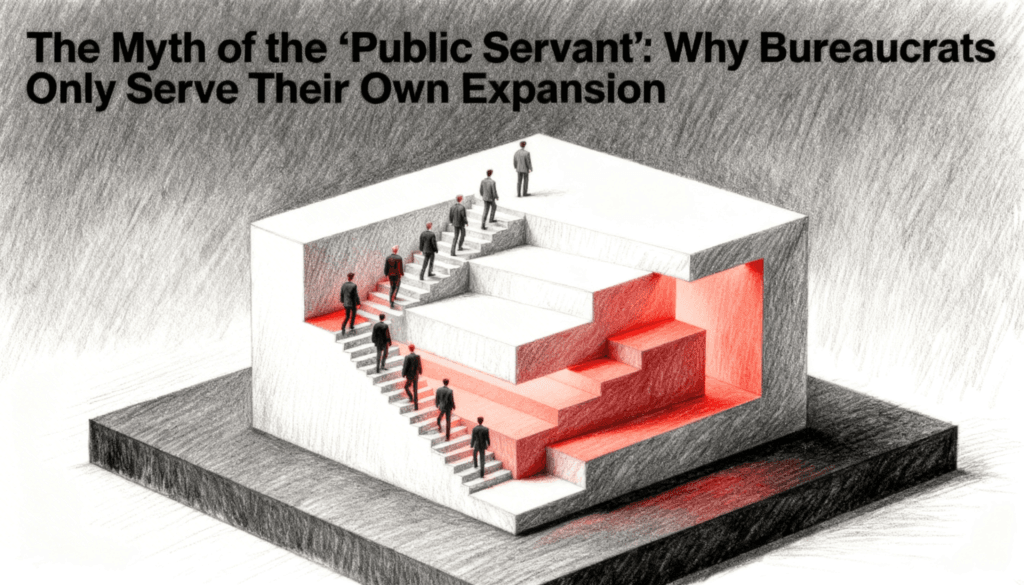
One of Rothbard’s most striking claims is that bureaucratic expansion is not a bug. It is a feature. Every government agency has a built in incentive to grow. More staff means more budget. More budget means more influence. More influence means more job security for the people at the top. The empire building that occurs within government is not a deviation from the system’s logic. It is the system’s logic expressed in its purest form.
Consider the history of any major government department. Find one that has voluntarily reduced its own size. Find one that returned unspent budget to the treasury and asked for less money the following year. You will be looking for a very long time. The pattern is almost universal: agencies grow. They add programs. They create subdivisions. They hire. And they never, ever shrink, except under extreme external political pressure, and even then they tend to re-emerge under new names.
Rothbard noted that this creates a ratchet effect. Government grows during crises because emergencies justify new powers and new spending. But when the crisis passes, the new powers and new spending remain. The emergency is temporary. The bureaucracy is permanent. This is how you end up with agencies created to address problems that were solved decades ago, staffed by people whose primary function is to justify the continued existence of the agency itself.
There is a wonderful irony here. The very people who warn most loudly about corporate greed and unchecked private power seem entirely unbothered by unchecked bureaucratic power. A CEO who expands his company is viewed with suspicion. A department head who expands her agency is viewed as a dedicated public servant. The double standard is so culturally embedded that pointing it out feels almost rude.
The Missing Feedback Loop
What makes Rothbard’s critique so difficult to dismiss is that it identifies a structural problem, not a moral one. He was not arguing that government workers are bad people. He was arguing that they operate in a system with no functioning feedback loop.
In markets, the feedback loop is price. Prices transmit information about supply, demand, value, and scarcity. They allow millions of individual decisions to coordinate without central direction. When something is not working, prices change. Resources flow to where they are valued. Waste is punished because someone has to pay for it out of their own pocket.
In government, the feedback loop is politics. And politics is a remarkably poor mechanism for transmitting information about efficiency. Voters do not evaluate the performance of individual agencies. They vote on broad themes, on personalities, on party loyalty, on cultural identity. A senator who promises to cut the budget of the Department of Education is making a political statement, not an efficiency calculation. And the bureaucracy knows this. It knows that its survival depends not on performance but on political protection.
Rothbard drew an analogy that has aged remarkably well. He compared government agencies to organisms in an environment with no predators. In ecology, when you remove predators from an ecosystem, prey species do not simply thrive in perfect balance. They overpopulate. They consume resources beyond sustainability. They degrade their own environment. The same dynamic plays out in institutional ecology. Without competitive pressure, without the possibility of extinction, agencies do not optimize. They bloat.
What Rothbard Gets Right That Most People Miss
The most valuable element of Rothbard’s critique is not his policy prescriptions, which are radical enough to make most political moderates uncomfortable. It is his insistence on looking at institutions as they actually operate rather than as they claim to operate.
This is a surprisingly rare intellectual move. Most political debate takes place within the frame that institutions have already established for themselves. We discuss whether the Department of Education needs more funding or less funding. We rarely ask whether the Department of Education’s primary function is education or self preservation. We argue about healthcare policy within the assumption that health agencies are organized around patient outcomes. Rothbard’s contribution is to question that assumption and to provide an economic framework for understanding why institutions systematically deviate from their stated purposes.
You do not have to agree with Rothbard’s anarcho-capitalist conclusions to benefit from his analysis. You do not have to believe that all government is illegitimate to recognize that the phrase “public servant” does a tremendous amount of ideological work while describing very little of institutional reality.
The next time someone tells you that a new government program will solve a problem, ask a simple question. What happens to the program if it succeeds? If the answer is that it keeps operating, keeps its budget, and keeps its staff, then you have learned something important about whose interests the program actually serves.
Rothbard’s great insight was not that government is evil. It was that government is an institution, and institutions follow their own logic. That logic prioritizes survival, growth, and the accumulation of resources. Not because the people inside are selfish, but because the structure rewards exactly those outcomes.
Call it public service if you like. But do not be surprised when the servant starts setting the menu.