Table of Contents
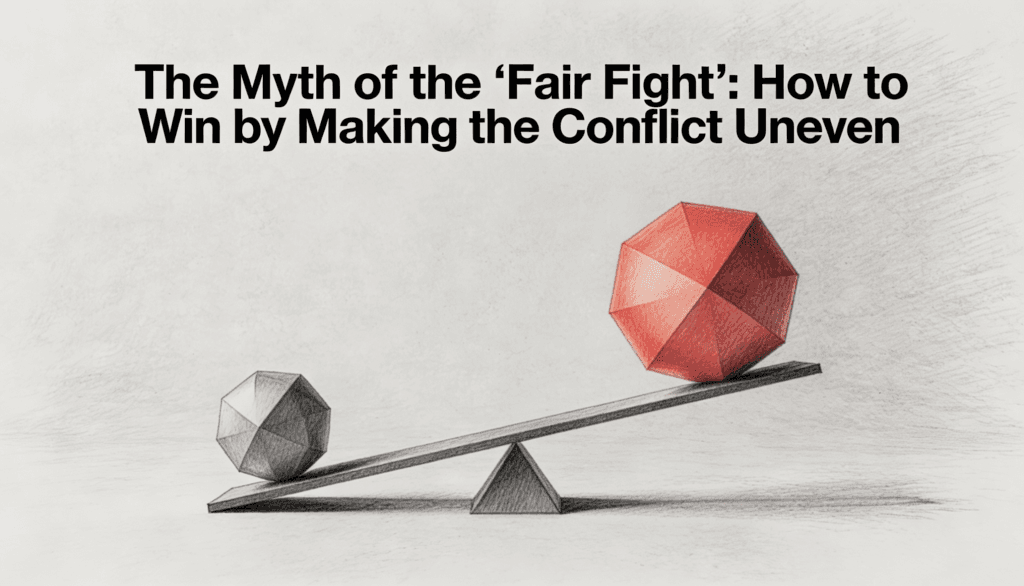
There is a strange idea floating around in modern life. It tells us that real victory only counts when it comes from a fair fight. Two equals, same rules, same starting line, may the better one win. It sounds noble. It also happens to be one of the most expensive lies a person can believe.
Sun Tzu, writing roughly two and a half thousand years ago, would have found this idea charming in the way an adult finds a child charming for believing the floor is lava. He spent an entire book, The Art of War, explaining that the smart general avoids fair fights the way a sensible person avoids stepping on a rake. The whole point of strategy, he argued, is to arrange the situation so that by the time the actual confrontation happens, the outcome is already decided.
This is not cynicism. It is not even particularly aggressive. It is just an honest look at how victory actually works, in war, in business, in negotiation, in your career, and in that argument you keep losing with your in laws.
The Fight Is Won Before It Starts
Sun Tzu has a line that gets quoted so often it has lost most of its bite. He said that the victorious warrior wins first and then goes to war, while the defeated warrior goes to war first and then seeks to win. Read it slowly. He is not talking about confidence or mindset or any of the soft stuff a motivational poster would do to it. He is talking about preparation so thorough that the battle itself becomes a formality.
Think about how this looks in real life. A lawyer who spends three months building a case before the trial is not fighting fair. He is showing up with every document indexed, every witness rehearsed, every weakness in the other side mapped. The opposing counsel who walks in trusting his charisma is not in a fair fight. He is in a slaughter. The trial itself is theater. The decision was made in the months of work nobody saw.
The same is true of the job interview where one candidate researched the company, the team, the interviewer, the company’s last earnings call, and the specific pain points the role is meant to solve. The other candidate read the job description on the train. They are not equals walking into the same room. They only look that way for about ninety seconds.
The fair fight is a story we tell ourselves after the fact. The real fight happened weeks earlier, in a library, in a notebook, in a quiet room where one person was working while the other was relaxing.
Pick Your Ground
There is another thing Sun Tzu kept hammering on, and it is the idea of terrain. He thought about it constantly. Where will the fight happen? Who chose the location? What does the ground favor? He devoted whole sections of his book to classifying types of terrain and how each one shapes the outcome.
For us, terrain means context. It means the platform, the format, the venue, the medium, the conditions under which the contest will play out.
Consider two people with similar talent. One is a brilliant speaker who freezes up in writing. The other is a brilliant writer who sweats through his shirt at the thought of a stage. Put them both on a podcast and one of them is going to look like a genius. Put them both behind a keyboard and the result flips. Neither is more talented than the other in some absolute sense. They are just standing on different ground.
The mistake most people make is accepting whatever terrain they are handed. The boss schedules the difficult conversation at the end of the day when you are tired. The negotiation happens in their office, in their chairs, on their schedule. The argument plays out on the platform where your opponent has more followers. You walked in, sat down, and started fighting on ground that was already tilted against you.
Sun Tzu would ask, with what I imagine to be a faintly disappointed look, why you did that. Why did you not propose a different time? A different venue? A different format entirely? Why did you accept the terms of engagement as if they were laws of nature?
You can almost always change the terrain. You can ask to move the meeting to a coffee shop, suggest writing your thoughts down first, propose a different deadline, switch from a phone call to email, bring an ally, bring data, bring anything that shifts the conditions in your favor. The people who lose most often are the ones who never thought to ask.
The Cost of Visibility
Here is something counterintuitive. The more visible you are about your intentions, the weaker your position becomes. Sun Tzu was almost obsessive about this. He believed that all warfare is based on deception, not because he was sneaky by nature, but because clarity to your opponent is a gift you should never give for free.
This shows up everywhere in ordinary life. The job candidate who tells the recruiter exactly how much he is willing to accept has just set his ceiling. The buyer who shows the seller how much he loves the house has just guaranteed he will pay more. The new employee who announces his ambitions on day one has just given his rivals a head start.
None of this requires lying. It just requires not narrating your entire strategy out loud. Most people share too much, too early, to too many people, because sharing feels like progress. It feels like clarity, like honesty, like being a good communicator. It is often none of those things. It is often just information leaking out of you into rooms where it will be used against your interests.
The quiet operator who keeps his plans to a small circle, who does not announce his next move on social media, who lets his work speak before he does, is not being secretive in some morally suspicious way. He is simply refusing to fight a fair fight. He is keeping the asymmetry he has earned.
Asymmetry Is Not Cheating
Now, here is where people get nervous. There is something about the language of strategy that sounds, to modern ears, like instructions for being a bad person. Make the fight uneven? Use deception? Pick your battles? It sounds like the philosophy of someone who is about to do something unpleasant.
But asymmetry is not the same as dishonesty. It is not the same as harming someone. A surgeon who has performed an operation ten thousand times has a deep asymmetry of skill over the patient on the table. We do not call this unfair. We call it competence. The patient is grateful for it.
A teacher who knows the subject inside out has a vast asymmetry of knowledge over the student. The student benefits from this. The whole point of going to a teacher is that the relationship is uneven in the right direction.
The same applies to almost every domain where one person serves, helps, leads, or competes with another. Asymmetry is the natural state of things. Sun Tzu was not telling us to invent it. He was telling us to stop pretending it does not exist and to start being thoughtful about which side of it we are standing on.
The myth of the fair fight is harmful precisely because it convinces capable people not to use their advantages. It tells the prepared person to slow down so the unprepared one can catch up. It tells the experienced player to handicap himself in the name of sportsmanship. It tells you that winning by being better prepared is somehow less honorable than winning by raw luck on the day. This is absurd. It is also the kind of thinking that makes excellent people lose to mediocre ones.
Avoid the Battles You Cannot Win
There is one more piece of this puzzle. Sun Tzu was a strong believer in not fighting battles you were going to lose. This sounds obvious until you notice how often people do exactly that.
We pick arguments we cannot win because we feel we have to defend our pride. We enter competitions we have no chance in because someone implied we should. We take on rivals who outclass us in every relevant dimension because backing down would feel like failure. Sun Tzu would say that fighting the wrong battle is the failure. Choosing not to fight is often the most strategic move available, and it costs nothing except the small bruise to your ego that comes from saying – not today.
What This Looks Like in Practice
Strip all of this down and you get a few simple instructions. They are not glamorous. They will not look impressive to anyone who is not paying close attention. That is part of the point.
Prepare more than feels reasonable. Most people stop preparing the moment they feel comfortable enough to begin. The advantage goes to the person who keeps going after that.
Choose your terrain. If the format of the fight does not suit you, propose a different one. If the timing is bad, push it. If the venue tilts against you, suggest another. The opening move of any negotiation is the negotiation about how the negotiation will happen.
Reveal less than you think you should. Information given for free is information that can be used against you. This does not require secrecy. It just requires a small pause before you tell someone something they did not ask for.
Notice your advantages and use them without apology. If you have prepared more, you deserve to win more. If you know the field better, you should expect to do better. There is no medal for handicapping yourself in the name of fairness.
Walk away from the wrong fights. Most contests in life are optional. The skill of knowing which ones to enter is worth more than the skill of winning the ones you enter blindly.
The Real Trick
Sun Tzu’s deepest insight, the one buried under all the talk of armies and terrain and deception, is something quieter. He believed that the highest form of victory was the one nobody noticed. The battle that did not have to be fought. The war that was won by arrangement, by preparation, by patience, by being so well positioned that the opponent simply gave up or went elsewhere.
This is the part of his philosophy that gets lost in modern translations and quoted out of context. He was not a fan of fighting. He thought fighting was the failure mode. The whole apparatus of strategy, in his view, existed to make the actual confrontation unnecessary or so one sided that calling it a fight would be generous.
The myth of the fair fight tells you to enter the arena, square up, and let the better person win. Sun Tzu would tell you to make sure, long before anyone enters the arena, that you are the better person, on the better ground, with the better information, facing a problem you actually want to solve. Then walk in and finish what was already decided weeks ago.
The world rewards this kind of thinking. It does not reward it loudly, with applause and trophies. It rewards it quietly, with results. Which, in the end, is the only reward that matters.