Table of Contents
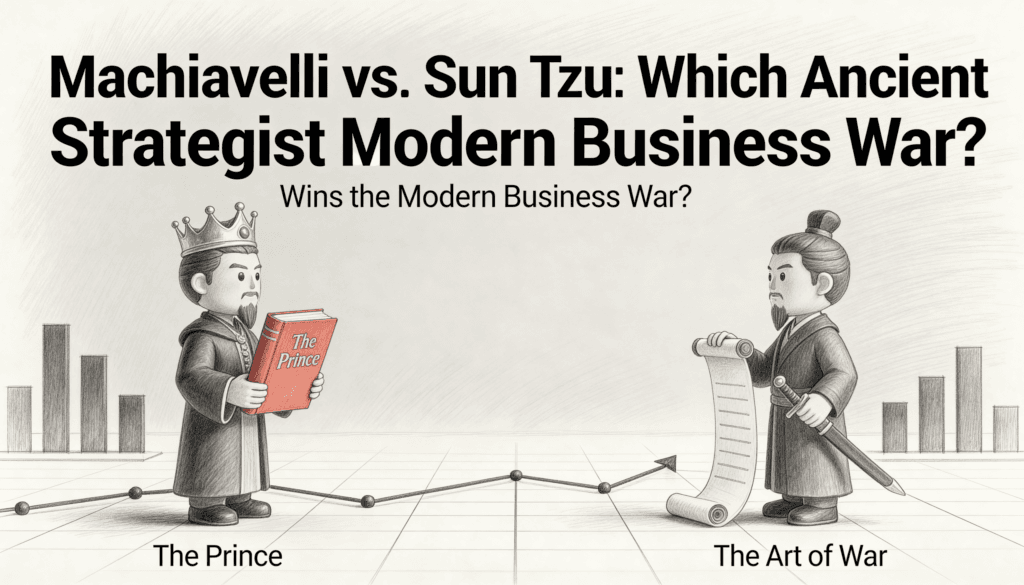
Two men. Two books. Roughly two thousand years between them. And yet both end up sitting on the same shelf in airport bookstores, sandwiched between productivity guides and biographies of people who allegedly wake up at 4 a.m.
Sun Tzu wrote The Art of War somewhere around the 5th century BC. Niccolò Machiavelli wrote The Prince in 1513, while unemployed and hoping to flatter his way back into a job. Both texts have since been hijacked by hedge fund managers, startup founders, and that one guy in your office who quotes them in Slack.
But if we strip away the LinkedIn polish and ask a serious question, which of these two ancient minds actually wins in modern business? Whose playbook holds up when the battlefield is a quarterly earnings call instead of a literal battlefield?
Let us put them in the ring.
The Two Philosophies, Without the Mystique
Sun Tzu believed the highest form of victory was winning without fighting. His central obsession was avoiding waste. Waste of soldiers, waste of time, waste of resources. He liked deception, but only as a tool to make conflict shorter or unnecessary. To Sun Tzu, a long war was already a lost war, even if you eventually won it.
Machiavelli believed something darker and, depending on your mood, more honest. He believed that human beings are mostly self interested, that power is the only currency that truly matters, and that being feared is more reliable than being loved. He did not romanticize anything. He looked at history, saw what actually worked, and wrote it down without flinching.
Sun Tzu wants you to be water. Machiavelli wants you to be the rock the water flows around, except the rock is also plotting something.
One is a strategist. The other is a realist. The difference matters more than it sounds.
Round One: Hiring and Firing
Modern business loves to talk about culture. Free snacks, ping pong tables, mission statements that could double as motivational posters in a dentist office. This is the Sun Tzu lane, technically. Treat your people well, he wrote, and they will follow you into deep valleys without fear.
But Machiavelli would point out that the same employees who love the snacks will also leave for a competitor offering 15 percent more, and they will do it without writing you a goodbye note. He would argue that loyalty bought with kindness is rented, not owned.
Here is where things get interesting. The companies that actually retain talent over decades tend to combine both. They create environments people genuinely want to work in, which is the Sun Tzu move. But they also pay attention to power dynamics, succession, internal politics, and the quiet ways people position themselves. That is pure Machiavelli.
The naive manager picks one side. The effective one understands that culture is the visible layer, and politics is the layer underneath. Pretending the second does not exist does not make it disappear. It just means you are losing a game you refused to acknowledge you were playing.
Round one: Tie, but only because most leaders refuse to admit Machiavelli is in the room.
Round Two: Competition and Market Strategy
Sun Tzu is famous for the line that the best generals subdue the enemy without fighting. In business terms, this is what people now call category creation, or building a moat, or finding a blue ocean. Instead of stabbing your competitors, you simply build something they cannot follow you into.
Apple did not beat BlackBerry in a knife fight. Apple created a different product category and let BlackBerry run out of oxygen. That is Sun Tzu energy. The war was won before BlackBerry knew it had started.
Machiavelli would look at this and nod, but then add something uncomfortable. He would point out that Apple also crushes suppliers, controls developers, and uses its app store like a feudal landlord. The category creation is the elegant part. The ongoing dominance is the brutal part. Both are necessary.
Here is the counterintuitive bit. Most business writing celebrates only the elegant move. The pivot, the brilliant insight, the founder vision. But the boring, ugly, Machiavellian work of maintaining power once you have it gets glossed over, because nobody wants to write a TED talk titled “How We Quietly Squeezed Our Suppliers for a Decade.”
Sun Tzu wins the headline. Machiavelli wins the next twenty years.
Round two: Machiavelli, narrowly. Winning is romantic. Staying on top is mechanical.
Round Three: Negotiation
This is where Sun Tzu shines almost embarrassingly. His entire framework is built around understanding the other side better than they understand themselves. Know your enemy and know yourself, he wrote, and in a hundred battles you will never be in peril.
Translated into a conference room, this means doing your homework. Knowing what the other party actually needs, not what they say they need. Knowing their constraints. Knowing the deadline pressure they are under. Knowing whether their CEO just got chewed out in a board meeting and now needs a win.
Machiavelli would agree with all of this, but he would add a layer. He would say that the goal of negotiation is not just to win the deal. It is to position yourself for the next deal, and the one after that. Reputation, he understood, is a long game. Burn the wrong person and the story follows you.
This is where modern business often goes wrong in a way both men would find absurd. People treat negotiation as a single transaction. They squeeze every drop, brag about it, and then wonder why nobody returns their calls eighteen months later.
Sun Tzu and Machiavelli would both look at this and shake their heads. One because it is wasteful. The other because it is stupid. Same conclusion, different reasoning.
Round three: Sun Tzu, but only if you remember Machiavelli is reading over your shoulder.
Round Four: Crisis Management
When things go badly, which they always eventually do, philosophies get tested. This is where the airport bookstore wisdom often falls apart.
Sun Tzu has a famous principle about not pursuing a defeated enemy too far. Leave them a way out, he advised, because cornered animals fight twice as hard. In business this translates to graceful exits, soft landings for executives who failed, settlements instead of lawsuits when possible.
Machiavelli has a less popular but more useful principle for crisis. He wrote that injuries should be inflicted all at once, so that being tasted less, they offend less. In modern terms, if you have to do layoffs, do them once, deeply, and never again. Drip layoffs over six quarters destroy a company from the inside, because every employee spends every Monday wondering if today is their day.
Most companies do exactly the wrong thing. They announce small rounds of cuts repeatedly to avoid appearing brutal, and in doing so they create a culture of paralyzed fear. They think they are being kind. They are being slow torturers.
Here Machiavelli is not just useful. He is correct in a way that hurts to admit.
Round four: Machiavelli, decisively. Crisis is where wishful thinking dies first.
Round Five: Long Term Survival
Now we get to the deepest question. Which philosophy actually keeps you alive over decades?
Sun Tzu would argue that the businesses that last are the ones that adapt. Be like water, he said, take the shape of whatever container you find yourself in. The ability to read terrain, shift positioning, and avoid pointless battles is what separates a dynasty from a footnote.
Machiavelli would counter that adaptation alone is not enough. You also need the willingness to be ruthless when the moment requires it. He observed that rulers who tried to be kind in all circumstances were eventually destroyed by people willing to be cruel in the right ones. He was not celebrating cruelty. He was simply pointing out that the world does not reward consistent niceness with consistent safety.
Look at the companies that have survived a hundred years. Coca Cola, Ford, IBM, Disney. None of them got there by being purely strategic or purely ruthless. They got there by being patient when patience was rewarded and brutal when brutality was required. They knew when to be Sun Tzu and when to be Machiavelli, and they did not confuse the two.
The companies that died chose the wrong philosophy at the wrong moment. Kodak was strategic about everything except the digital threat sitting in its own labs. Blockbuster was kind to its customers, charging late fees that funded its own gravedigger. They were not stupid. They were just one philosophy short of survival.
Round five: Tie, because longevity requires both, used in sequence.
So Who Wins?
Here is the honest answer. Neither wins, and that is the point.
Sun Tzu without Machiavelli is a dreamer. He sees the elegant solution but underestimates how much of business is just human beings being petty, greedy, and shortsighted. His worldview assumes a level of rationality that does not exist in most boardrooms.
Machiavelli without Sun Tzu is a thug. He understands power but not positioning. He will win every confrontation and lose the war, because he never asks whether the confrontation needed to happen at all.
The real lesson is that these two men were not writing competing manuals. They were writing complementary ones, separated by language, geography, and two thousand years, but pointing at the same underlying truth. Strategy without realism is naive. Realism without strategy is brutal. You need both, and you need to know which one the moment is asking for.
The leaders who actually win in modern business are the ones who can switch between these two minds quickly. Sun Tzu when planning. Machiavelli when defending. Sun Tzu when entering a market. Machiavelli when protecting one. Sun Tzu when hiring. Machiavelli when firing.
The mistake is picking a permanent identity. The leader who is always the wise sage gets eaten by someone willing to be uglier. The leader who is always the ruthless prince eventually gets overthrown by someone with better strategy and a better story.
The Quiet Truth Underneath Both
Here is what almost nobody mentions about these two books. Both authors wrote them while losing.
Sun Tzu wrote during the Warring States period, when China was a chaotic mess of constant conflict. Machiavelli wrote The Prince after being tortured and exiled by the very government he had served. Neither man was sitting in a corner office dictating wisdom. Both were studying power because they had been hurt by their lack of it.
That is the part the airport bookstore version leaves out. These were not theoretical works. They were survival manuals written by people who had personally watched what happens to those who do not pay attention.
Modern business loves to package their ideas as productivity hacks, as if reading them on a treadmill will turn you into a titan. But the actual lesson of both books is more humbling. The world is not fair. Power is not given. Being right is not enough. And the people who succeed long term are not the ones with the best ideas. They are the ones who understood, early, that strategy and realism are both required, and that pretending otherwise is its own kind of defeat.
So who wins the modern business war? Whoever read both, took them seriously, and stopped trying to choose a side.