Table of Contents
Most people who have heard of Auguste Comte know him as the father of sociology, the man who coined the term and insisted that human society could be studied with the same rigor as chemistry or physics. Fewer people know that he also designed, in painstaking detail, a complete society from scratch. And almost nobody remembers that in this blueprint, the banker was not the villain. The banker was the hero.
This is strange enough to be worth investigating. In an era when financial institutions attract about as much public trust as used car dealerships, Comte’s vision of the banker as a kind of civic saint deserves a second look. Not because he was right in every detail. He was often spectacularly wrong. But because he was asking a question that refuses to go away: what should money actually be for?
A Man Between Two Worlds
To understand Comte’s financial thinking, you have to understand the world that produced him. Born in 1798, he grew up in the wreckage of the French Revolution. The old social order, with its kings and priests and feudal landlords, had been violently dismantled. But nothing stable had replaced it. France lurched from republic to empire to monarchy and back again, like someone trying to stand up on a ship in a storm.
Comte watched all this and concluded that the problem was not political. It was intellectual. Society had destroyed its old belief system, the one organized around God and king, but had failed to build a new one. People were living in what he called the “metaphysical stage,” a period of abstract slogans about liberty and rights that sounded inspiring but provided no practical guidance for organizing millions of people into a functioning civilization.
His solution was positivism. The idea, stripped to its essentials, was that science should replace religion as the organizing principle of society. Not science as a collection of facts, but science as a way of thinking: observation over speculation, evidence over dogma, practical results over beautiful abstractions.
This much is well known. What is less discussed is where Comte put the money.
The Banker as Public Servant
In Comte’s System of Positive Polity, published between 1851 and 1854, he laid out a detailed hierarchy for his ideal society. At the top, providing moral and intellectual guidance, would be a priesthood of secular sociologists. They would function like the Catholic clergy but without the theology, guiding public education and moral development. Below them, running the actual machinery of government and the economy, would be industrialists and bankers.
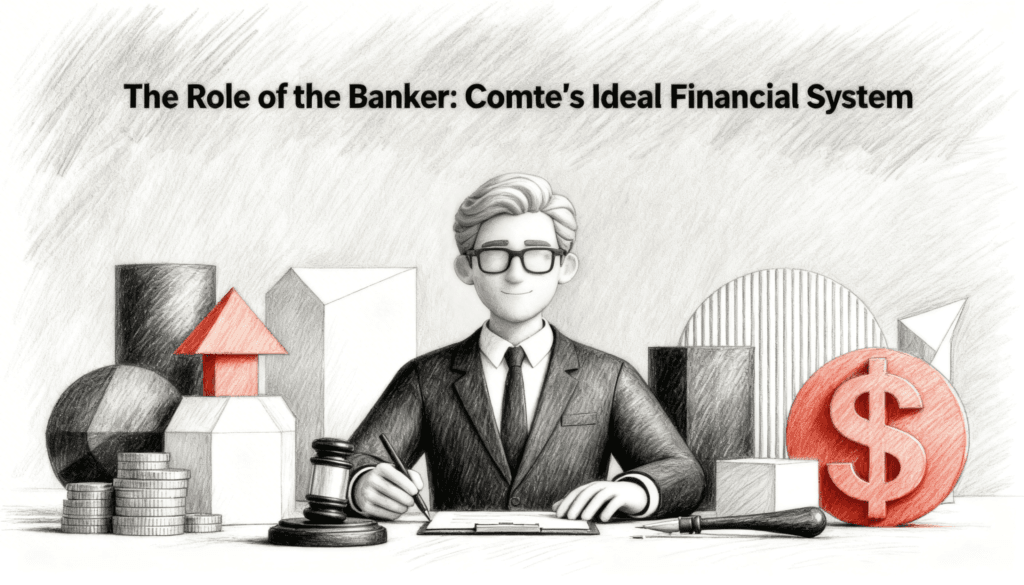
Here is where things get interesting. Comte did not imagine bankers doing what bankers actually do. He imagined them doing something far more radical. In his system, the banker was not an accumulator of personal wealth. The banker was a trustee. Capital, in Comte’s view, was not really private property in the way we understand it. It was a social resource that happened to be administered by individuals. The banker’s job was to direct this resource toward its most productive social uses.
Think of it as the difference between owning a house and managing a public park. You live in the house. You decide what color to paint the walls. But the park belongs to everyone, and your job is to keep it functional, beautiful, and accessible. Comte wanted bankers to think of capital the way a good park ranger thinks of public land: as something entrusted to them, not something that belongs to them in any absolute sense.
This was not communism. Comte explicitly preserved the institution of private property. He simply argued that property carried social obligations. The wealthy had a duty to use their wealth productively, and if they failed in that duty, public opinion, guided by the sociologist priests, would pressure them into line. No expropriation needed. Just a culture that made selfishness genuinely embarrassing.
Why Bankers and Not Politicians?
One of the more surprising aspects of Comte’s system is his deep distrust of politicians and democratic processes. He saw electoral politics as inherently destabilizing, a machine for manufacturing conflict rather than resolving it. Professional politicians, in his view, were people whose primary skill was winning arguments, not solving problems. They were trained in rhetoric, not reality.
Bankers, by contrast, had to deal with the world as it actually was. If a banker lent money to a failing enterprise, the money disappeared. There was no spin, no reframing, no committee hearing that could make a bad loan good. Finance, for all its flaws, was anchored in consequences.
Comte also admired the fact that banking required a kind of systemic thinking that politics rarely demanded. A banker had to understand how different industries connected, how credit flowed through an economy, how short term decisions affected long term outcomes. This was exactly the kind of integrative, scientific thinking that Comte valued above all else.
There is something almost charming about this level of faith in financial professionals. It is the kind of optimism that could only have been formulated by someone who had never witnessed a credit default swap or a collateralized debt obligation. But the underlying logic is not silly. Comte was making the point that practical competence, the ability to manage complex systems under real constraints, is more valuable in governance than ideological conviction.
The Ghost of Saint Simon
Comte did not develop these ideas in a vacuum. He spent his formative years as secretary to Henri de Saint Simon, one of the most original and eccentric social thinkers of the early nineteenth century. Saint Simon had argued that the future belonged to industrialists and scientists, not to aristocrats and soldiers. He believed that the productive classes, the people who actually made and did things, should govern, while the idle classes, those who merely inherited and consumed, should step aside.
Comte absorbed this basic framework and refined it. Where Saint Simon was visionary but chaotic, Comte was systematic to the point of obsession. He created detailed plans for everything from the structure of government to the content of a positivist library (exactly one hundred books, which he personally selected, arguing that reading anything else would contaminate the mind). He designed holidays, rituals, and even a new calendar. He was, in the memorable words of T. H. Huxley, building Catholicism minus Christianity.
But the financial architecture was not mere decoration. It was central to the whole project. Comte understood something that many idealists miss: a social system that ignores economics is a social system that will be ignored. He needed the bankers because he needed the money, and he needed the money because he needed the infrastructure, and he needed the infrastructure because otherwise positivism was just a philosophy seminar with delusions of grandeur.
Property as Social Function
Perhaps the most genuinely radical element of Comte’s financial thinking was his reconception of property. Most political philosophers of his time, and ours, treat property as either a natural right (the liberal tradition) or as theft (the socialist tradition). Comte did something different. He treated property as a social function.
In this view, the question is not whether you have a right to your money. The question is whether you are performing the social function that your money enables. A factory owner who runs an efficient factory that employs workers and produces goods is fulfilling the social function of capital. A factory owner who shuts down the factory and speculates on grain prices is not.
This distinction has a surprisingly modern feel. Consider the contemporary debate about shareholder value versus stakeholder capitalism. The shareholder value camp says a company exists to maximize returns for its owners. The stakeholder camp says a company has obligations to its workers, its community, and its environment. Comte was making the stakeholder argument nearly two centuries ago, and making it more forcefully than most of its current advocates.
He went further. In his system, the spiritual power, the secular priesthood, had the authority to publicly censure wealthy individuals who failed in their social duties. This was not legal punishment. Comte did not want the state seizing assets. It was social punishment. The banker who hoarded capital or directed it toward speculation rather than production would face the full weight of organized public disapproval.
If this sounds toothless, consider how sensitive modern corporations are to reputational damage. A viral social media campaign can wipe billions off a company’s market value overnight. Comte did not have Twitter, but he understood the basic mechanism. He understood that the rich care about their status, and that status can be weaponized in the service of the common good.
The Hierarchy of Competence
Comte’s financial system was part of a larger hierarchy that is worth examining, partly because it is illuminating and partly because it is appalling.
At the top sat the sociologist priests, providing moral guidance. Below them came the bankers and industrialists, managing the economy. Below them came the merchants, manufacturers, and farmers. And below everyone, or perhaps alongside everyone in a different dimension, came women, whose role Comte assigned as the guardians of private morality. Women were to be moral exemplars, inspiring men toward altruism through their feminine virtue. They would not vote, hold property, or participate in public life.
It is hard to overstate how badly this has aged. Comte’s views on gender were retrograde even by the standards of his own time, and they were explicitly shaped by his romantic obsession with Clotilde de Vaux, a woman he knew for barely a year and a half before her death from tuberculosis in 1846. He idealized her into a symbol of feminine perfection and built his entire social theory around the resulting fantasy.
But strip away the gender politics and the hierarchy reveals something interesting about how Comte thought about institutions. He was trying to solve the oldest problem in political philosophy: how do you get competent people into positions of power and keep incompetent people out? His answer was to separate power into different kinds. Moral authority in one place, economic authority in another, democratic authority nowhere.
This is profoundly undemocratic. Comte knew it and did not care. He argued that democracy was an inherently unstable arrangement that privileged popularity over competence. Whether you find this alarming or refreshing probably depends on your experience of democratic politics.
Where Comte Connects to Now
The most interesting thing about Comte’s financial system is not its details, many of which are idiosyncratic to the point of eccentricity. It is the underlying questions, which keep resurfacing in different forms.
Consider the rise of Environmental, Social, and Governance investing, the ESG movement. At its core, ESG is a Comtean idea: the notion that capital has social obligations beyond generating returns. When BlackRock’s Larry Fink writes his annual letter to CEOs urging them to consider their social impact, he is channeling, probably unconsciously, a line of thinking that runs back through stakeholder theory, through various forms of corporate social responsibility, all the way to a French philosopher who thought bankers should be treated like secular priests.
Or consider the debate about central banking. Modern central banks, institutions like the Federal Reserve or the European Central Bank, occupy a curious position in democratic societies. They wield enormous economic power but are deliberately insulated from democratic accountability. Their leaders are appointed, not elected. Their deliberations are opaque. They operate on the theory that monetary policy is too complex and too important to be left to politicians.
Comte would have approved. He would have seen central banks as a partial realization of his vision: technically competent individuals managing economic resources in the public interest, guided by scientific principles rather than political pressures. He would also, one suspects, have been horrified by the degree to which these institutions serve the interests of the financial sector rather than the public.
The Problem of the Good Banker
The fatal weakness in Comte’s system is also its most important lesson. He assumed that bankers could be made good through moral education and social pressure. He assumed that people who controlled vast amounts of capital would willingly submit to the guidance of philosopher priests and accept that their wealth carried social obligations.
History has not been kind to this assumption. The pattern, repeated across centuries and cultures, is that people who accumulate power use that power to resist constraints on its exercise. The banker who is supposed to be a public trustee discovers that being a private owner is more enjoyable. The industrialist who is supposed to serve the community discovers that serving shareholders is more profitable. The moral pressure that Comte relied on tends to evaporate in the presence of sufficient wealth.
And yet. The idea keeps coming back. Philanthropic pledges, benefit corporations, impact investing, sovereign wealth funds, community land trusts. All of these are attempts to solve the same problem Comte identified: how do you make capital serve society rather than the other way around?
None of them work perfectly. Neither did Comte’s system. But the question persists because the problem persists. We live in a world where the allocation of capital is perhaps the single most consequential decision any society makes. Who gets funded and who does not determines what gets built, what gets researched, what gets preserved, and what gets destroyed. Comte understood that this power was too important to be left to the profit motive alone.
A Verdict
Comte was wrong about many things. His views on women were inexcusable. His authoritarian tendencies were disturbing. His planned library of exactly one hundred approved books was, to put it gently, a red flag. His secular religion was, as Huxley noted, Catholicism without the only interesting part.
But he was asking the right question. What is money for? Not what does money do, or how does money work, but what should money accomplish? He answered that money should serve humanity, that bankers should be stewards rather than owners, and that the ultimate measure of a financial system is not how much wealth it generates but how well it distributes that wealth in service of the common good.
You do not have to accept Comte’s answer to recognize that we are still struggling with his question. Every debate about inequality, every argument about regulation, every controversy about corporate responsibility is a footnote to the problem he identified in the middle of the nineteenth century.
Capital is power. Power requires accountability. And accountability requires a shared understanding of what that power is supposed to accomplish.
The banker, in Comte’s vision, was not a parasite or a predator. The banker was a trustee of civilization. It is an absurdly idealistic vision. It is also, in its way, the only vision that makes the existence of banking morally defensible. Whether we can ever get there is another question entirely. But at least Comte had the nerve to ask it.