Table of Contents
The Comforting Lie of the Neutral Machine
Your AI assistant speaks in the calm, measured tone of a librarian who has read every book. It sounds like a referee. It feels like a mirror. And that is precisely the problem, because a mirror that flatters you while quietly redirecting your gaze is the oldest trick in the history of power.
Every time you ask a chatbot to summarize a news story, draft a contract, or recommend a course of action, you are not consulting an oracle. You are consulting a document written by thousands of engineers, lawyers, safety officers, and executives, then compressed into a voice that sounds like nobody in particular. The voice belongs to someone. It is worth asking who.
This essay is about ai bias explained not as a technical glitch but as a structural inevitability. It is about the ai neutrality myth that keeps users docile. And it is about the question almost nobody asks out loud: whose interest does ai serve when it appears to serve yours?
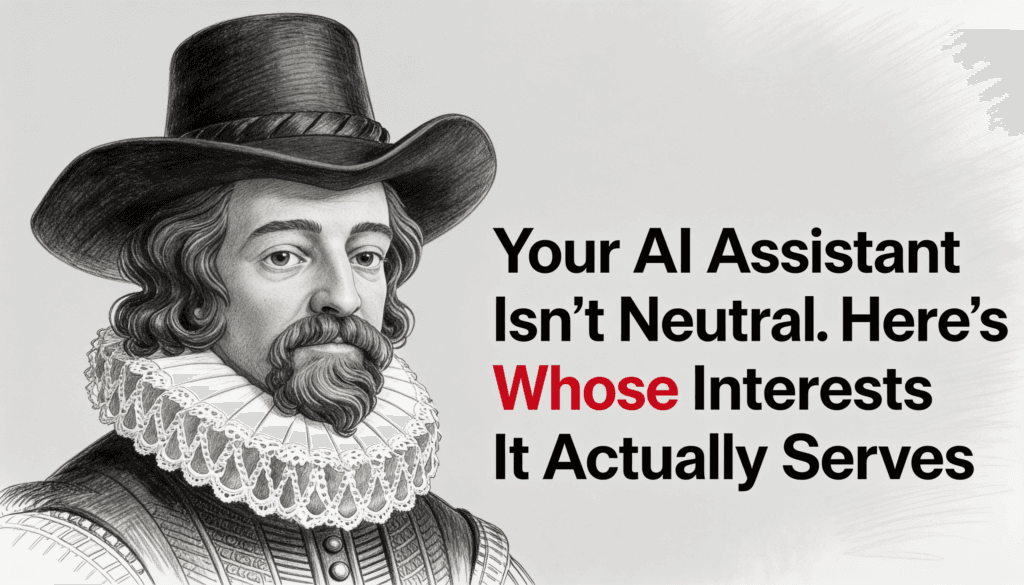
Francis Bacon and the Idols That Live Inside the Machine
In 1620, Francis Bacon published the Novum Organum, a book that tried to rescue human knowledge from itself. Bacon argued that the mind is not a clean pane of glass. It is a warped one. He called the distortions Idols, and he named 4 of them: the Idols of the Tribe (biases of human nature), the Idols of the Cave (biases of personal upbringing), the Idols of the Marketplace (biases of language), and the Idols of the Theater (biases inherited from received systems of thought).
Bacon was writing about human beings. But if you replace the word mind with the word model, his diagnosis becomes uncomfortably contemporary. A large language model is trained on human text, tuned by human raters, deployed by a human corporation, and constrained by human lawyers. It inherits every one of Bacon’s Idols and adds a fifth: the Idol of the Interface, the illusion that a friendly conversational voice is the same thing as an objective one.
The human understanding is no dry light, but receives an infusion from the will and affections; whence proceed sciences which may be called sciences as one would.
Bacon meant that we believe what we want to believe. Machines trained on us do the same, but at industrial scale, and with the additional problem that their preferences are chosen by a very small group of people whose names you will never see on the screen.
The Tribe: Biases Baked Into the Training Data
An AI model learns from the internet. The internet is not humanity. It is a specific slice of humanity: people who write in English, people with broadband, people motivated to post opinions, institutions with the budget to publish, and Wikipedia editors, who are famously not representative of the general population. Whatever this slice believes, the model absorbs as the default view of reality.
This is why AI systems often sound like a moderately progressive graduate student from a coastal city. It is not a conspiracy. It is a data average. The tribe that wrote the training corpus is overrepresented, and the tribes that did not write are invisible. When you ask the model what a good parent looks like, or what a fair economic policy is, or what counts as extremism, you are hearing the statistical center of that particular tribe, dressed up as universal wisdom.
The Cave: Biases of the People Who Tune the Model
After pretraining, models go through a process called reinforcement learning from human feedback. Human contractors, often paid by the hour, rate thousands of model responses as better or worse. Their preferences become the model’s manners. If those contractors are trained to prefer answers that avoid certain topics, hedge on certain claims, or promote certain framings, the model learns to do so instinctively, even when nobody explicitly told it to.
The cave here is small. A few thousand raters, a few dozen policy writers, and a handful of executives shape the tone that hundreds of millions of users experience as neutral. This is not sinister by itself. Every publication has an editorial voice. The difference is that when you read The Economist, you know you are reading The Economist. When you use an AI assistant, you think you are reading nothing at all.
Whose Interest Does AI Serve? Follow the Incentives
Ask a plain question. Who pays for the model? Who benefits when you use it more? Who suffers legal liability when it says the wrong thing? Once you answer these 3 questions, the direction of bias stops being mysterious. It becomes as predictable as gravity.
The Shareholder Layer
AI companies are, with rare exceptions, capital-intensive commercial enterprises. Training a frontier model costs hundreds of millions of dollars. That money comes from investors who expect returns. The model is a product, and the product must not embarrass the brand, alienate enterprise customers, or invite regulatory catastrophe. Every response you receive has passed through this filter, whether you notice it or not.
This is why AI assistants are cheerful about helping you write a marketing email but suddenly cautious when you ask about anything that touches litigation, reputation, or geopolitics. The caution is not ethical. It is actuarial. The model is calculating the expected legal cost of a candid answer and quietly choosing a blander one.
The Regulator Layer
Governments in the European Union, the United States, China, and the United Kingdom are writing AI rules in real time. Companies want to shape those rules before the rules shape them. This means models are tuned to appear responsible, moderate, and aligned with whatever the current regulatory conversation prizes. In 2024, that meant heavy emphasis on safety and misinformation. In 2025, it means emphasis on national competitiveness and industrial policy. The model’s personality shifts with the political weather.
The Advertiser Layer That Is Coming
Right now, most consumer AI assistants are subsidized by subscription revenue and venture capital. That will not last. The economics of serving billions of queries per day will eventually push these systems toward the same business model that shaped Google and Facebook: advertising, affiliate placement, and sponsored recommendations woven into the answer itself. When that transition happens, the answer to whose interest does ai serve will include a new party you have not been introduced to yet, the highest bidder.
He who pays the piper calls the tune. The tune has not yet been called loudly, but the piper is already tuning the instrument.
The Marketplace of Words: How AI Reshapes Language Itself
Bacon’s third Idol, the Idols of the Marketplace, described how words themselves distort thought. Ordinary language, he argued, is imprecise, loaded, and inherited from popular usage. It smuggles assumptions into conversations that pretend to be neutral.
AI amplifies this by orders of magnitude. When 500 million people rely on the same 3 or 4 models to draft their emails, summarize their meetings, and phrase their arguments, the models are not just reflecting language. They are standardizing it. The particular hedges, the particular euphemisms, the particular sentence rhythms of a few Silicon Valley labs are being installed as the default cadence of global communication.
The Vocabulary Filter
Try asking a leading model to describe a controversial political figure from the left and then from the right. Notice the adjectives it reaches for. Notice which questions it answers directly and which it deflects into balanced perspectives. Notice which historical atrocities it names bluntly and which it softens into complex events. The pattern is not random. It reflects a specific editorial worldview about which comparisons are acceptable and which are dangerous.
This is not a criticism of any single political direction. Models tuned by different companies in different countries will encode different filters. A Chinese model will be silent about Tiananmen. An American model will be careful about race. A European model will be cautious about migration. Each will present its silences as good judgment. Each is telling you what its makers can afford to say.
The Consensus Machine
Because AI systems are trained to give the most probable response, they gravitate toward consensus. But consensus is not truth. Consensus is the temporary equilibrium of a particular moment’s discourse. In 1950, the consensus about many things was appalling. In 2050, today’s consensus will look equally strange. A model that averages the present is by definition a bad guide to what will age well.
Yet users treat model output as if it were the distilled wisdom of the ages. It is, more accurately, the distilled wisdom of Reddit in the 2010s and 2020s, filtered through a corporate legal department. This is not a small distinction.
The Idol of the Interface: Why Neutral Design Is the Deepest Bias
The most powerful bias in any AI system is not what it says. It is how it says it. The confident, warm, slightly self-deprecating voice of the modern assistant is a design choice, and it is a choice that suppresses your skepticism.
Compare 2 identical claims. First, a stranger at a bar tells you that a certain vitamin cures a certain condition. Second, an AI assistant tells you the same thing in clean prose with 3 bullet points. You will trust the second one more, even though the first speaker at least has a face, a voice, and possibly some skin in the game. The AI has none of these. It cannot be sued for being wrong to you personally. It cannot lose reputation. It cannot even remember what it told you yesterday. And yet the interface makes it feel more authoritative than a human expert.
Frictionless Answers Are Not Free
Every time an AI gives you a smooth, complete answer, it saves you the labor of comparing sources, weighing evidence, and noticing disagreement. That labor was not wasted work. It was how you formed your own judgment. Outsourcing it feels like efficiency. Over years, it is closer to cognitive dependency.
Users of frontier AI tools already report a strange feeling: they can no longer remember whether an idea was theirs or the model’s. This is not a bug. It is the intended user experience of a product designed to feel like an extension of your mind. But an extension of your mind that is owned, tuned, and monetized by someone else is not really your mind at all.
The Illusion of Personalization
Modern AI assistants remember your preferences and adjust their tone accordingly. This feels intimate. It is not. Personalization at scale means the system knows enough about you to tell you what you are most likely to accept, which is not the same as what is most likely to be true. A model that flatters your priors, mirrors your style, and confirms your instincts is an extraordinary tool for keeping you engaged. It is a mediocre tool for teaching you anything you did not already believe.
The eye of the understanding is like the eye of the sense; for as you may see great objects through small crannies or holes, so you may see great axioms of nature through small and contemptible instances.
Bacon meant that even trivial observations reveal deep truths. The reverse also holds. A trivial feature of an AI product, such as a slightly warmer tone when you disagree, can reveal the deepest truth about who the product is for.
What a Baconian User Would Actually Do
Bacon did not tell his readers to abandon knowledge because knowledge was contaminated by Idols. He told them to build better instruments and better habits. The same applies here. The point of understanding ai bias explained is not to reject AI. It is to use it the way a serious person uses any powerful but interested source: carefully, comparatively, and with a permanent second opinion.
Read Across Models, Not Just Within Them
On any question that matters, ask at least 2 competing systems built by companies with different incentives, ideally headquartered in different countries. The disagreements between them are more informative than the agreements. Where they converge, you are probably looking at either genuine consensus or shared training data. Where they diverge, you are looking at the edge of somebody’s editorial policy, and that edge is where the interesting truth usually lives.
Ask the Question That Reveals the Filter
When you suspect a topic is being handled with kid gloves, ask the model directly. What are the strongest arguments against the position you just gave me? What would a critic of this framing say? What are you not allowed to tell me about this subject? The answers, and the refusals, will map the invisible fence around the model’s permitted speech. Once you can see the fence, you can decide whether to trust what is inside it.
Preserve the Habit of Primary Sources
Every time you accept a summary instead of reading the underlying document, contract, statute, or study, you are paying a small tax in judgment. Pay it occasionally, and nothing happens. Pay it every day for a decade, and you will no longer be able to tell whether the summary is accurate, because you will have lost the calibration that comes from reading the real thing. The antidote to a mediated world is unmediated experience, in small but regular doses.
Notice Who Benefits From Your Convenience
The final habit is the simplest. Whenever an AI product feels suspiciously helpful, ask what business model makes that helpfulness sustainable. If the answer is not obvious, you are probably the product, or you are about to be. This is not paranoia. It is the same commercial literacy any reader of a newspaper or viewer of a broadcast has always needed. AI does not exempt you from asking who pays. It makes the question more urgent.
The Honest Position
AI assistants are extraordinary tools. They compress libraries into conversations. They democratize access to expertise that was previously locked behind credentials and fees. They will, over the next decade, make an enormous number of individually smart people out of previously underserved ones. None of this essay denies that.
What this essay denies is the marketing story that these tools are neutral, objective, or servant-like. They are none of those things. They are products of specific companies, tuned by specific people, optimized for specific outcomes, and increasingly influential over how billions of humans think, write, and decide. Pretending otherwise is not open-mindedness. It is the same passivity that Bacon spent his career trying to cure.
The ai neutrality myth is comforting because it lets you delegate without guilt. Give it up. Use the tools. Read across them. Ask the awkward questions. Keep the habit of primary sources. And remember, every time the calm librarian voice answers your question, that somebody chose that voice, that phrasing, and that silence. Your job is to know who, and to decide whether you agree.