Table of Contents
John Stuart Mill, writing in 1861, made a claim that drove the more egalitarian philosophers of his time slightly mad. He argued that not all pleasures are created equal. Some pleasures, he said, are higher. Others are lower. And no amount of intensity in the lower ones could ever match the quieter, deeper satisfaction of the higher ones.
His famous line goes something like this: it is better to be a human dissatisfied than a pig satisfied. Better to be Socrates dissatisfied than a fool satisfied. The pig and the fool, he conceded, might disagree. But that is only because they have never tasted the other side.
Now, more than 160 years later, we have a strange new test case for Mill’s theory. We have machines that produce images, music, and prose on demand. We type a few words and receive something that looks like art. The output is fast, polished, and often beautiful in a way that is hard to argue with on the surface.
So here is the question. If Mill is right, where does AI-generated art sit on his ladder? Is it a higher pleasure or a lower one? And does the distinction even matter anymore?
I think it matters quite a lot. Let me explain why.
The Two Kinds of Pleasure
Mill split pleasures into two camps. The lower pleasures are bodily and immediate. Eating a good meal. Lying in the sun. Watching something flashy on a screen. They do not require effort, training, or much in the way of attention. They feel good, then they fade, and you reach for the next one.
The higher pleasures are different. They come from the use of what Mill called our higher faculties. Thinking. Creating. Engaging with serious art. Reading a difficult book and slowly understanding it. Playing a piece of music after months of practice. Sitting with a painting long enough to notice what the artist was doing in the corner you almost missed.
The key feature of higher pleasures is that they take work. You have to develop the capacity to enjoy them. Nobody is born loving Bach or Tolstoy. You grow into them, and the growing is part of the pleasure itself.
Mill thought that anyone who had genuinely experienced both kinds of pleasure would always prefer the higher. Not because the higher pleasures are more fun in the moment, but because they engage more of you. They use more of what you are.
Hold that thought. We are going to bring it to the machines.
What AI-Generated Art Actually Gives You
When you generate an image with an AI tool, the experience goes like this. You type a sentence. You wait a few seconds. Something appears. You look at it. You might tweak the prompt and try again. Then you save it or share it or move on.
What is the pleasure here? It is real. I am not pretending otherwise. There is genuine satisfaction in seeing a thought take visual form quickly. There is a kind of magic in watching a machine do something that used to take a trained human hundreds of hours.
But notice what the pleasure does not require. It does not require you to have learned anything. It does not require you to have developed taste, technique, or any kind of skill. It does not require you to fail, struggle, and try again over years. It does not require you to know why one composition works and another falls flat.
The pleasure is real, but it is shallow in a very specific way. It is the pleasure of receiving, not the pleasure of making.
This is Mill’s lower pleasure dressed in new clothes. Fast, easy, satisfying in the moment, and almost entirely passive.
The Counter Argument Worth Taking Seriously
Now, a fair person reading this might push back. They might say something like: hold on. Photography was once dismissed for the same reasons. So was electronic music. So was digital art. Every new tool gets called shallow until people get used to it.
This is a real point and worth sitting with for a moment.
But here is the difference. When a photographer takes a picture, they have made dozens of decisions. Where to stand. What to include. What to leave out. When to press the shutter. What to do with the image afterward. The tool is fast, but the artist is still doing the artistic work.
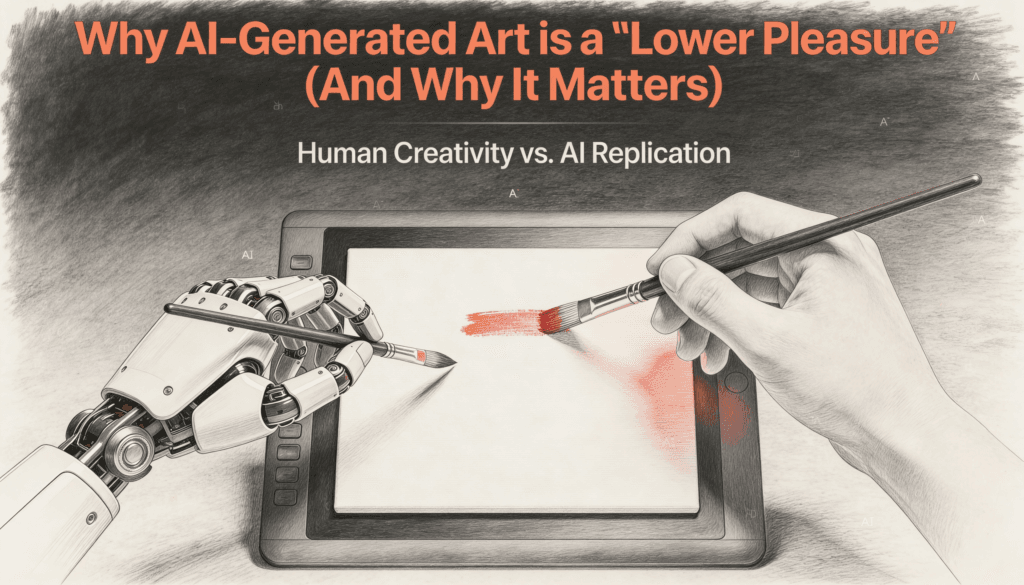
When you prompt an AI, the artistic decisions are mostly being made by a system trained on millions of other people’s work. You are choosing from its outputs. You are curating, not creating. And curation is a real skill, but it is not the same skill as making something.
Why This Matters for the Person Using It
Mill cared about higher pleasures for a specific reason. He thought they made us more fully human. They developed our capacities. They left us better than they found us.
The danger of lower pleasures, in his view, was not that they were sinful or wrong. It was that if you spent too much time on them, you would slowly lose the ability to enjoy anything else. Your higher faculties would atrophy from disuse. You would become, in his unkind phrase, the satisfied pig.
This is the part that should make us nervous about AI-generated art. Not because the images are bad, but because of what we become when we make them this way.
If you spend two years learning to draw, you do not just end up with the ability to draw. You end up with new eyes. You see light differently. You notice the shape of a hand on a coffee cup. You walk past a tree and suddenly understand why it looks the way it does. The skill changes you.
If you spend two years prompting an AI, you end up with a large folder of images and very little else. The capacity has not been built. The eyes have not changed. You have not grown into someone who can see more clearly. You have only gotten faster at typing requests.
This is the quiet cost of the lower pleasure. It does not just give you less. It also keeps you from becoming the kind of person who could have wanted more.
The Strange Case of the Audience
There is another piece of this that does not get talked about enough. Art is not only a thing the artist makes. It is also a thing the audience receives. And the audience has its own work to do.
The trouble with a flood of AI-generated images is that it trains the audience to skim. There is too much of it, and it arrives too fast, and almost none of it rewards a second look. You scroll past it the way you scroll past everything else. The art and the attention degrade each other in a loop.
I am not blaming the technology for this. I am pointing out that the experience of being a person who looks at art is also a higher pleasure in Mill’s sense. It takes development. And it can be lost.
What About the People Who Cannot Draw?
Plenty of people have ideas they cannot execute. They can imagine a scene but cannot paint it. They can hear a melody but cannot play it. For these people, AI tools are genuinely freeing. They give voice to something that would otherwise stay locked inside.
I do not want to be the kind of critic who tells these people their pleasure is not real. It is real. And it is meaningful to them.
If you generate an image of a scene from your childhood and it moves you, that is something. But it is not the same as the act of a painter who spent ten years learning how to render light on water so that one day they could paint exactly the lake they remembered.
Both have value. But they are not equivalent. And pretending they are flattens the conversation in a way that hurts everyone.
What we are really arguing about, when we argue about AI art, is what art is for.
If art is for producing pleasing images, then the machines are winning, and there is not much more to say. They are faster, cheaper, and frequently more pleasing than the average human.
But if art is for something else, then the picture changes. If art is a way of being in the world. If it is how we work out what we think. If it is the trace of a particular consciousness wrestling with a particular problem at a particular moment. If it is, as Mill might have said, a higher pleasure that requires development on both ends, by the maker and the viewer.
If that is what art is, then AI-generated images are not really art at all. They are something else. A new medium of consumption. A kind of visual fast food. Useful, sometimes delicious, occasionally inspired. But not the thing itself.
The Practical Upshot
I am not here to tell you to never use these tools. I use them sometimes. They are good for certain jobs. Mockups, drafts, throwaway images for a slide deck. Lower pleasures have their place. Mill ate dinner. He just did not pretend that dinner was the same as reading Wordsworth.
What I am saying is this. Pay attention to where these tools are taking your hours. Notice whether you are developing capacities or just generating outputs. Ask yourself, every so often, whether the time you are spending is making you into someone who can enjoy more of the world or someone who can only enjoy less of it, faster.
Mill thought the test of a good life was not whether you were happy in the moment. It was whether you had developed the parts of yourself that made deeper happiness possible.
That test still holds. And it is a useful one to apply, not just to art, but to most of what we do with the strange new machines now sitting on our desks.
The pig is satisfied. Socrates is not. Mill thought we knew which one we should rather be.
I still think he was right.