Table of Contents
There is an old joke from the Soviet era that goes like this. A worker says to his boss, “They pretend to pay us, and we pretend to work.” Everyone laughs. Then everyone goes home to an empty fridge.
That joke is not really a joke. It is an economic theory wearing a clown nose. And it sits at the center of one of the most stubborn problems in human history, which is what happens to people when you remove their reason to try.
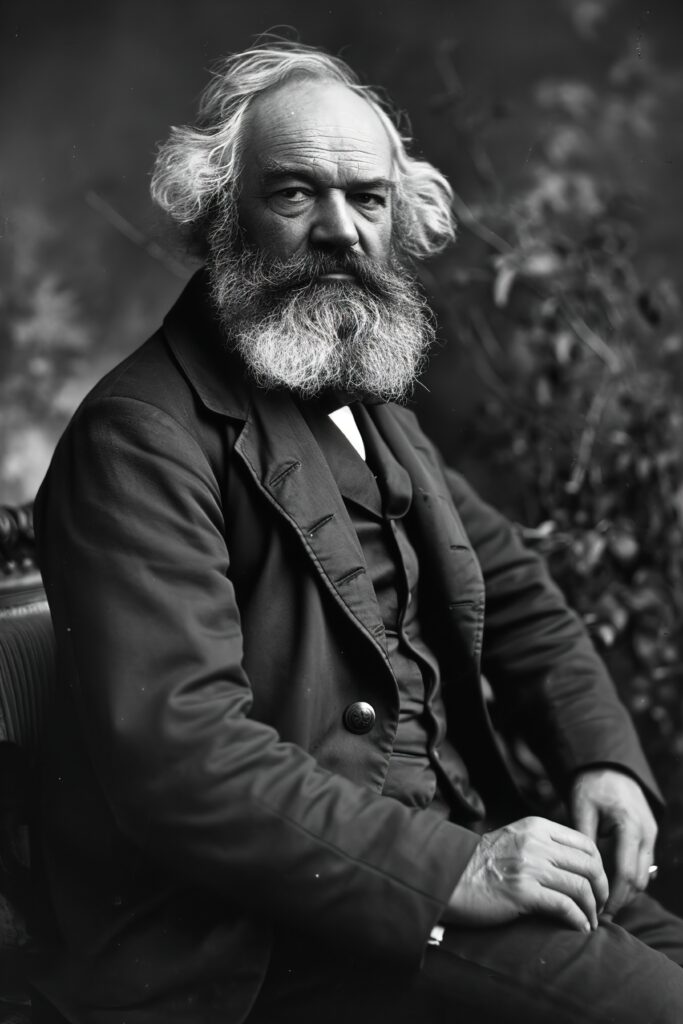
Karl Marx had a beautiful idea. Beautiful in the way a snow globe is beautiful. Self contained, perfectly arranged, and completely sealed off from weather. He looked at the factories of the nineteenth century, saw workers grinding themselves into dust while owners grew fat, and concluded that the problem was profit itself. Strip away the profit motive, he argued, and you strip away the exploitation. Workers would finally own what they produced. The chains would fall off. Humanity would walk into a sunlit field of cooperative labor and shared abundance.
It is a lovely picture. The trouble is that humans are not made of paint.
The Quiet Engine Inside Every Worker
Before we talk about why the Marxist experiment kept producing breadlines instead of utopia, we have to talk about something invisible. Something economists call incentive and the rest of us call the reason we get out of bed.
When you wake up tomorrow and go to work, you are not doing it because a poster on the wall told you to love your country. You are doing it because there is a paycheck attached to your effort, and that paycheck buys groceries, rent, a coffee, maybe a vacation if you stretch. The link between what you do and what you get is the engine. It is quiet, almost invisible, but it hums under every productive economy on earth.
Marx wanted to rip that engine out and replace it with a different fuel. Solidarity. Class consciousness. The pride of building something for the collective. He believed that once workers understood they were laboring for each other rather than for a boss in a top hat, they would work harder, not less. The bond of brotherhood would do the job that money used to do.
This is where the snow globe meets the weather.
What Happened When the Theory Met the Field
The twentieth century ran the experiment. It ran it big, and it ran it many times. The Soviet Union, Maoist China, Eastern Europe, Cuba, North Korea, Cambodia. Different cultures, different climates, different leaders. The results were strangely similar.
Productivity collapsed. Quality cratered. Innovation stopped almost completely. The fields produced less grain than they had under the czars. The factories turned out shoes that did not fit and tractors that broke after a week. People started hoarding, bartering, and stealing. Black markets bloomed in every basement.
Why? Because when you tell a farmer that he will receive the same ration whether he plants ten acres or one, he plants one. When you tell a factory worker that his pay is fixed regardless of output, he produces the minimum that keeps the inspector happy. When you tell an engineer that promotion comes from party loyalty rather than clever design, he stops designing cleverly. He starts attending more meetings.
None of this is because Russians or Chinese or Cubans are lazy. It is because humans, all of us, respond to the feedback we get. We are pattern matching animals. Show us that effort produces reward, and we pour ourselves into effort. Show us that effort produces nothing, and we conserve our energy for things that do matter, like waiting in line for toilet paper.
The Part Nobody Wants to Admit
Marx was not entirely wrong about exploitation. There really were brutal factory owners in 1850s Manchester. Children really did lose fingers in machines. Wages really were squeezed to the bone while owners built mansions. Anyone who reads about that era and feels nothing has a heart made of accounting paper.
The strange twist is that the system Marx hated, capitalism, ended up fixing most of those problems faster than the system he proposed. Not out of kindness. Out of competition. Once one factory paid a little more, the others had to follow or lose their best workers. Once unions formed, hours dropped. Once technology improved, dangerous jobs became safer. The same profit motive that Marx blamed for the suffering became, weirdly, the mechanism that pulled millions out of it.
Meanwhile, the countries that abolished profit in the name of the worker produced some of the worst working conditions in modern history. Forced labor camps. Famines that killed tens of millions. Secret police who arrested anyone who complained that the bread was moldy.
This is not a cheerful irony. It is a heavy one.
The cure killed more patients than the disease ever did.
The Problem of Knowledge
There is a deeper reason these economies failed, and it does not get talked about enough. It is not just about lazy workers. It is about something the economist Friedrich Hayek called the knowledge problem.
In a market economy, prices carry information. When coffee gets expensive, it tells producers to grow more and consumers to drink a little less. When prices fall, the opposite happens. Nobody is in charge of this. The price moves because millions of small decisions push it around. It is the closest thing humans have built to a giant nervous system.
Marxist economies tried to replace that nervous system with a central committee. A room full of officials would decide how many shoes the country needed next year, what size, what color, and which factories would make them. Sounds organized. In practice, it was a disaster, because no committee can possibly know what fifty million people actually want.
So the shoes were the wrong size. The bread arrived in the wrong cities. The tractors were built without thinking about which crops needed planting. The whole economy ran on guesswork dressed up in five year plans.
Without prices, there is no signal. Without signals, there is no coordination. Without coordination, you get queues. Long, miserable, hopeless queues.
The Slow Death of Wanting To
Now here is the part that pulls everything together. The part about the human soul.
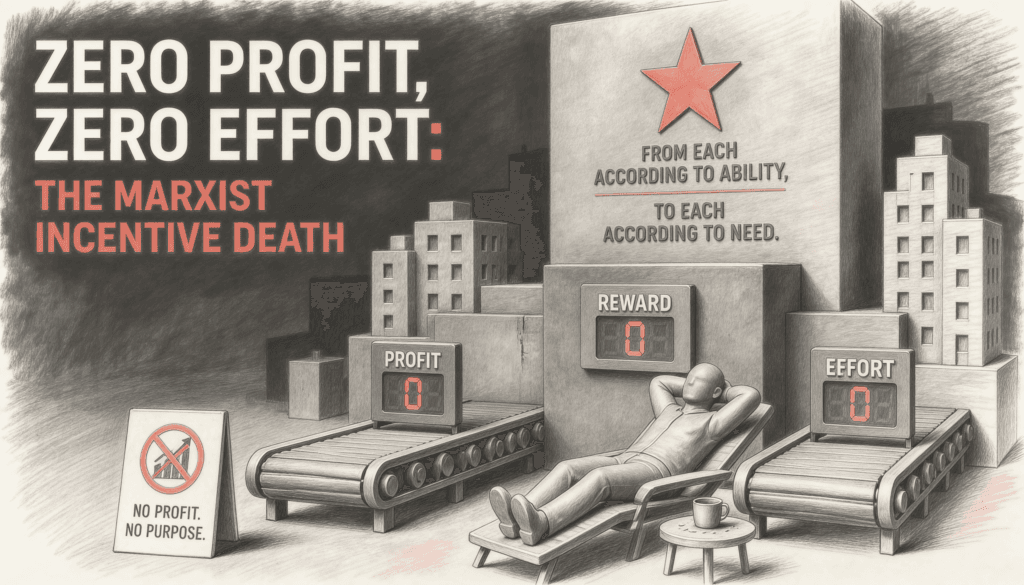
When effort and reward get unlinked, something dies inside people. Slowly. It is not dramatic. There is no funeral. One day you just notice that the man at the counter is not really looking at you, and the woman at the factory is not really turning the bolt, and the cook is not really cooking, and the doctor is going through the motions because the line outside is endless and his salary will not change no matter what he does.
This is the incentive death Marx never accounted for. He thought you could replace the desire for personal gain with the desire to serve the collective. But the collective is an abstraction. Your family is real. Your apartment is real. Your aching back is real. When the abstraction asks you to sacrifice the real things and offers nothing back, eventually you stop sacrificing. You show up. You clock in. You do nothing.
Why This Still Matters Today
You might be thinking, fine, the Soviet Union is gone. Why bring up an old debate?
Because the temptation Marx represented has not gone anywhere. It just changed clothes. Every few years some clever person rediscovers the basic idea, that profit is the problem, that markets are cruel, that if we just had smart enough planners and good enough algorithms we could organize everything from above. The slogans get better. The math gets fancier. The conclusion is the same.
And every time this idea gets tested at scale, the same thing happens. Effort drains out of the system. Talent leaves. Lines form. The people who were supposed to be liberated end up trapped in something worse than what they had before.
This does not mean markets are perfect. They are not. They produce inequality that can be ugly. They reward luck as much as merit. They sometimes burn through the planet like it is firewood. Anyone who pretends capitalism is flawless is selling something.
But the answer to a flawed system is not a broken one. The fixes that work, things like labor protections, social safety nets, antitrust laws, public education, do not require killing the profit motive. They require channeling it, taxing it, restraining it where it bites. You can put guardrails on a car without removing the engine.
The Lesson Nobody Wants to Frame
If there is a lesson in all of this, it is unromantic and stubborn. People work hard when working hard pays. They build great things when building great things gets recognized. They take risks when risk has a reward. None of this is greedy in any embarrassing sense. It is just how the wiring works.
You can dress this truth up in different philosophies, call it self interest or rational choice or even, if you want to be poetic, the music of human striving. But the bottom line never moves. Where reward dies, effort dies. Where effort dies, abundance dies. Where abundance dies, freedom usually follows it into the grave.
Marx wanted to free workers from chains. He ended up forging new ones, heavier than the originals, decorated with slogans. The lesson of the twentieth century is not that his compassion was wrong. It is that compassion without an understanding of incentives is a beautiful suicide note.
So the next time someone tells you that the profit motive is the root of all evil, ask them a simple question. If you remove it, what makes the bread show up tomorrow? Watch them try to answer. Then go buy a loaf of bread, while you still can, from someone who got out of bed because their effort was going to mean something.
That bread, warm and crusty and waiting for you on the shelf, is not a small miracle. It is the quiet engine, still humming.