Table of Contents
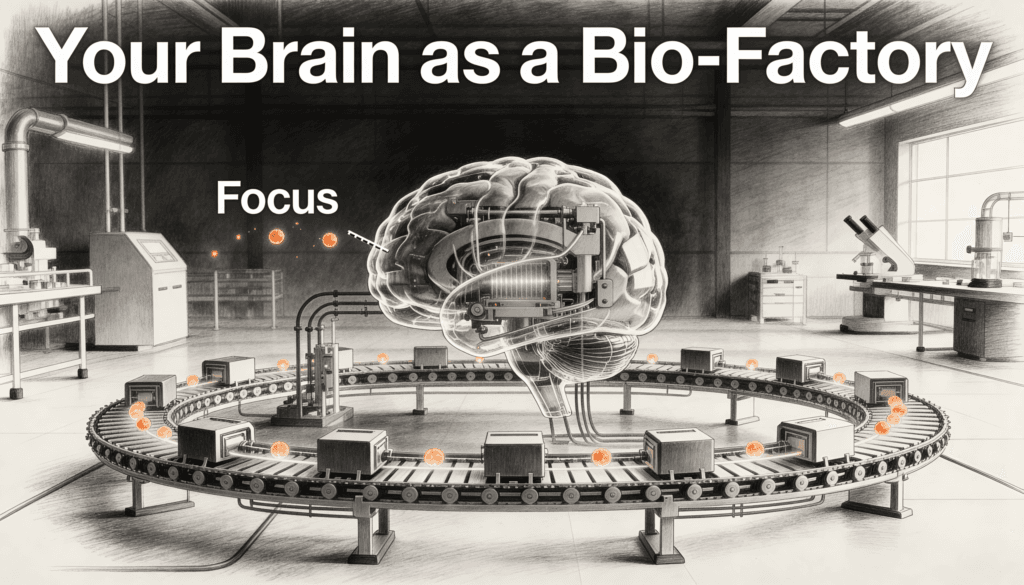
Imagine waking up tomorrow and discovering that your brain is not really a brain at all. It is a factory. A small, wet, surprisingly demanding factory sitting on top of your shoulders, running three shifts, churning out ideas, decisions, memories, and the occasional regrettable text message. The product is thought. The output is your life.
Now imagine that this factory operates exactly like every other factory in the history of human commerce. It needs labor. It needs energy. It needs space. And it needs raw materials. Some of those raw materials are abundant. Oxygen, for example, costs you nothing and arrives free of charge with every breath. Others, like sleep, are renewable but require a nightly shutdown of operations.
But there is one raw material that behaves differently from all the rest. One input so scarce, so easily wasted, and so violently fought over by external forces that an entire global economy has been built around extracting it from you. That raw material is focus.
If Jean-Baptiste Say, the French economist who once argued that supply creates its own demand, were alive today and somehow forced to evaluate the modern human mind through his economic lens, he would not be impressed by our productivity. He would walk through the bio-factory of your skull, clipboard in hand, and shake his head. Not at the machinery. The machinery is magnificent. He would shake his head at how recklessly the most valuable input is being squandered.
Let us walk through the factory together and see why.
The Factory Floor
Every factory has a layout. Yours is roughly three pounds of pinkish gray tissue, divided into departments that have been hiring and firing each other for millions of years. The prefrontal cortex handles strategy and planning. The amygdala runs the emergency response unit. The hippocampus is in charge of filing. The default mode network is the lounge where workers go to gossip and daydream.
Each department needs inputs to function. Glucose for fuel. Sleep for maintenance. Stimulation for raw material. But none of these departments can produce anything of value without one specific resource being directed toward it. That resource is your attention.
Here is where things get interesting. Attention is not the same as focus. Attention is the ability to notice. Focus is the ability to sustain attention on one thing while ignoring everything else. Attention is cheap. A loud noise can grab it. A bright light can grab it. A push notification can grab it. Focus, on the other hand, is the disciplined act of refusing to let attention be grabbed.
In economic terms, attention is the iron ore. Focus is the steel. And steel is what you actually need to build anything worth building.
Why Jean-Baptiste Say Would Care
Say was obsessed with production. He believed that wealth was created not by hoarding money but by making things, and that the act of making things itself generated the demand for those things. His famous law has been argued about for two hundred years, but the core idea remains useful. If you do not produce, you do not gain.
Apply this to your bio-factory. What does your brain produce? Thoughts that become decisions. Decisions that become actions. Actions that become outcomes. Outcomes that, eventually, become a life.
Now ask yourself an uncomfortable question. How much of what you produced today was actually yours? How much was reactive, scattered, half thought through, interrupted by a buzz from your pocket, and then abandoned for the next shiny thing?
Say would point out, with the patience of a man who has explained this concept a thousand times to people who really should have understood it by now, that your factory is producing constantly. The lights are on. The machines are running. The workers are busy. But the output is junk. You are manufacturing distraction at industrial scale and calling it work.
The reason this happens is not laziness. It is that the most scarce raw material has been hijacked.
The Great Heist
Here is the part that should genuinely bother you. Focus, the rarest and most valuable input to your bio-factory, has become the primary commodity traded in the global economy. Not oil. Not data. Not even time. Focus.
When you open a social media app, you are not the customer. You are the supplier. Your focus is being extracted, packaged, and sold to advertisers in real time. The app is the refinery. You are the mine.
This is not a conspiracy theory. It is the publicly stated business model of some of the largest companies on earth. They have hired the smartest engineers and psychologists they can find, given them enormous budgets, and asked them to solve one problem. How do we get more of this person’s focus, more often, for longer, without them noticing?
Say would find this fascinating in the way an economist finds a famine fascinating. A resource so valuable that entire industries exist to extract it, and yet the people who own that resource give it away for free, voluntarily, hundreds of times a day. It is the strangest market in history. The seller does not know they are selling. The buyer pays someone else for the privilege of taking it.
The Cost of Producing Without Focus
Let us return to the factory metaphor for a moment. Imagine a real factory, one that makes shoes. The workers show up. The machines turn on. The leather is delivered. The thread is in place. But every thirty seconds, someone walks onto the floor and shouts a random word. The workers look up. They lose their place. They forget which shoe they were making. They start over.
How many shoes does that factory produce in a day? Maybe a few. Maybe none. The inputs are all there. The capacity is all there. But the focus has been shattered into a thousand pieces, and shattered focus produces shattered output.
This is your brain on a normal Tuesday.
Research on this is not subtle. Every time your focus is broken, it takes somewhere between fifteen and twenty-five minutes to return to the same depth of concentration. If you are interrupted six times an hour, you are essentially never working at full capacity. You are running the factory, paying the electricity bill, employing the workers, and producing almost nothing of value.
And here is the counterintuitive part. The people who feel busiest are often the ones producing the least. Because being busy is just the feeling of constant interruption. It feels like work because it is exhausting. But exhaustion is not the same as output. A factory that runs hot and produces nothing is not a productive factory.
What Say Would Recommend
If Say walked into your bio-factory today, he would not give you a motivational speech. He would do what good economists do. He would look at the inputs, look at the outputs, and recommend a reallocation of scarce resources.
His first recommendation would be obvious. Stop giving away the scarcest raw material for free. Every time you check your phone for no reason, you are taking the most valuable input in your factory and tossing it out the window. Every time you keep eleven tabs open, you are running the machinery without raw material. Every time you try to do two things at once, you are not doubling your output. You are halving the quality of both.
His second recommendation would be structural. Factories do not run on willpower. They run on systems. A real factory does not have workers individually deciding when to take breaks or which orders to fulfill. It has schedules, walls, and processes. Your bio-factory needs the same. Specific times for deep work. Physical spaces where the phone cannot follow. Defaults that protect focus rather than defaults that drain it.
His third recommendation, and this is where he would get a little stern, would be to recognize that you are in an asymmetric war. On one side is you, with your fragile, easily distracted human brain. On the other side are some of the most sophisticated systems ever built, designed by people who get paid a lot of money to defeat your focus. This is not a fair fight. You will not win it through good intentions. You will win it only by changing the terrain. Remove the apps. Silence the notifications. Put the phone in another room. The willpower battle is already lost. The environment battle is still winnable.
Reclaiming the Factory
The good news is that the factory is still yours. The bad news is that nobody is going to hand the keys back to you. Not the apps. Not the algorithms. Not the people who designed both. They have no incentive to do so. You are the most profitable input in their supply chain.
Reclaiming your focus is not a productivity trick. It is an act of economic self-defense. It is recognizing that you are sitting on top of one of the most valuable resources in the world, that an entire industry exists to extract that resource from you, and that you have so far been giving it away for free without even noticing.
Say would call this an inefficient market. He would also call it a tremendous opportunity. Because the moment you start treating your focus as the scarcest raw material in your bio-factory, the moment you start protecting it the way a refinery protects its rarest mineral, your output changes. Not gradually. Not modestly. Dramatically.
The factory is yours. The raw material is finite. The choice, for now, is still yours to make.