Table of Contents
There is a strange new ritual happening in offices, classrooms, and kitchens around the world. A person types a question into a glowing box. The box responds with confident, polished prose. The person nods, copies the text, and moves on with their day. No verification. No second source. No raised eyebrow.
We have, in record time, developed a profound trust in machines that were built, quite literally, to sound convincing.
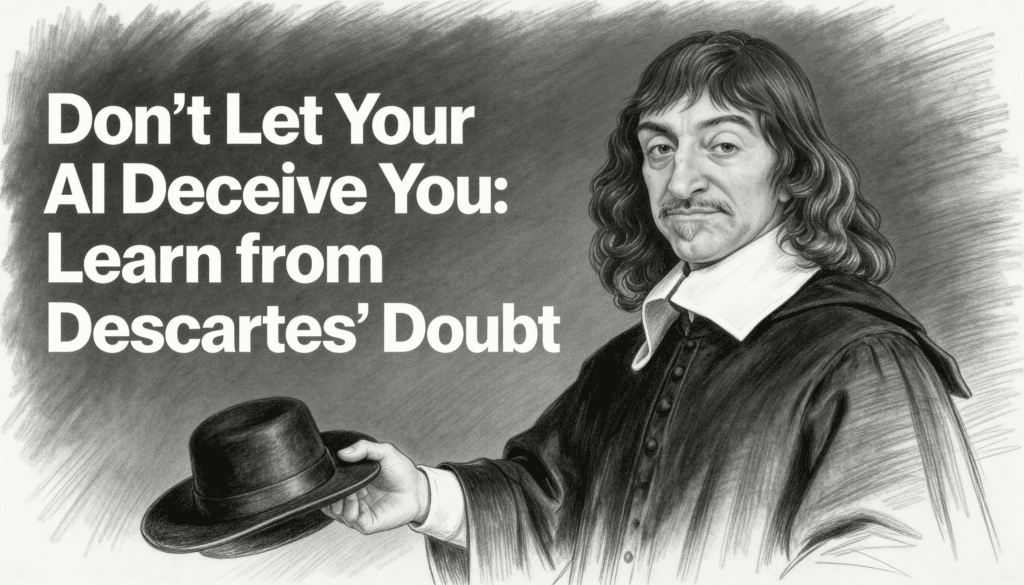
Almost four hundred years ago, a French philosopher sat by a fire in a small room and decided to doubt everything. His name was René Descartes, and he was not having a breakdown. He was conducting what may be the most useful thought experiment in the history of Western thinking. He asked a simple question that we should all be asking our chatbots today: what if everything I am being told is wrong?
This is not a luddite warning. This is not a request to abandon your favorite AI tools. This is an invitation to think the way Descartes thought, because his method is suddenly the most practical survival skill of the decade.
The Man Who Doubted His Way to Certainty
Descartes was not the first skeptic, but he was the most systematic one. In his Meditations, published in 1641, he proposed something radical. He decided that in order to find truth, he had to throw out every belief that could possibly be doubted, even slightly. If a belief survived this torture test, it was worth keeping. If it did not, it had to go.
He doubted his senses, because they had fooled him before. He doubted mathematics, because perhaps some clever demon was rearranging the numbers in his head. He doubted the existence of his own body, his friends, the room he was sitting in. He doubted the sky.
What was left after all this doubt? One thing. The fact that he was doubting. Something had to be doing the doubting. From this came the most famous phrase in philosophy: I think, therefore I am.
Descartes did not stop at doubt. He used doubt as a chisel to carve out what could be trusted. Doubt was not the destination. It was the tool.
This matters because we are now living in an age where the opposite habit is becoming common. We accept first and verify never. We treat machine output the way medieval peasants treated royal decrees. Whatever the screen says must be true, because the screen is clean and the words are well arranged.
The Polished Lie Problem
Here is something worth sitting with for a moment. The output of a modern AI system is designed to sound right. That is its primary feature. It produces sentences that feel finished, balanced, and authoritative. It uses the cadence of expertise. It cites concepts, references frameworks, structures arguments.
But sounding right and being right are not the same thing.
This is the part that should make every reader uncomfortable. Human liars usually sound like liars. They hesitate, contradict themselves, get the small details wrong, sweat a little. We have spent millions of years developing intuitions for spotting deception in other humans.
AI systems do not have any of these tells. They do not sweat. They do not hesitate. They do not know they are wrong, which means they cannot feel guilty about it. When they invent a fact, the invention arrives wearing the same suit as the truth. Same font. Same confidence. Same rhythm.
If Descartes were alive today, he might say something like this: the danger is not that the machine lies. The danger is that the machine cannot tell the difference between lying and telling the truth, and neither can you, if you do not learn to doubt.
What an Evil Demon Looks Like in 2026
Descartes imagined what he called a malicious demon. This demon, in his thought experiment, was infinitely powerful and dedicated to deceiving him about everything. The point was not to make his readers afraid of demons. The point was to ask: if such a demon existed, how would I ever know? What could I trust?
You do not need to imagine a demon anymore. You can subscribe to one for twenty dollars a month.
This sounds dramatic, and it is meant to. But consider what an AI hallucination actually is. The model generates a citation that does not exist. A court case that was never filed. A historical event that never happened. A medical study that no one ever conducted. The model is not lying in the human sense. It is producing what looks like the most plausible next sentence based on patterns in its training data.
Lawyers have already been sanctioned for submitting AI generated briefs that cited fictional cases. Students have failed assignments because they trusted chatbot summaries of books that contained imaginary plot points. Researchers have published papers that included fabricated references. The pattern repeats because the underlying issue repeats. People are treating machine output as a finished answer rather than a starting point.
Descartes would have recognized this pattern instantly. He would have said: you have skipped the step where you doubt.
The Method, Translated for the Modern Reader
Descartes laid out four rules for thinking clearly in his Discourse on the Method. They are old, but they translate cleanly into the AI era. Let me try.
First, never accept anything as true unless you clearly know it to be so. In modern terms, do not assume that a confident sentence is a correct sentence. Polish is not proof.
Second, divide every difficulty into as many parts as possible. When the chatbot gives you a long answer, break it down. What is the actual claim? What is the evidence behind each piece? Where could it be wrong?
Third, think in order, starting from the simplest and working toward the complex. Verify the easy facts first. If the AI cannot get the easy stuff right, you have learned something important about whether to trust it on the hard stuff.
Fourth, make your reviews so complete that nothing is left out. Do not just check the parts that seem suspicious. Sometimes the most dangerous errors are hiding in the parts that look most ordinary.
You will notice that none of this requires a philosophy degree. It requires a habit. The habit of pausing before believing.
The Comfort Trap
The reason people do not doubt their AI tools is not that they are stupid. It is that doubt is exhausting. Verification takes time. Looking things up takes effort. The whole point of using an AI assistant, for most people, is to skip the effort.
So the very efficiency that makes these tools valuable is the same efficiency that makes them dangerous. You cannot have a tool that saves you mental work and also expect to do all the mental work of checking it. The math does not work.
This is where most articles would offer a comforting solution. I will not, because there is not one. There is only a trade. You can have speed or you can have certainty, and you have to decide, every single time, how much of each you need for the task in front of you.
Writing a casual email to a friend? Speed is fine. Writing a contract clause? Slow down. Asking for restaurant recommendations? Speed is fine. Asking for medical advice? Stop. Go slower than you think you need to. Use the machine as a first draft, not a final word.
Descartes did not say doubt everything always. He said doubt everything in order to find what you can trust. The goal was certainty, not paranoia. The same principle applies here. The point is not to live in fear of your tools. The point is to know which outputs deserve your trust and which ones deserve a follow up question.
The Productive Doubt
There is a difference between doubt and cynicism. Cynicism says everything is fake. Doubt says I do not know yet. Cynicism shuts the door. Doubt knocks first.
Productive doubt is what Descartes was after. He did not want his readers to give up on knowledge. He wanted them to earn it. To work for it. To put each belief through a brief but honest examination before letting it into the house.
The same applies to working with AI. You are not required to distrust your tools. You are required to verify them. There is a real difference between someone who says I do not believe anything the machine tells me and someone who says I believe it once I have checked.
The second person gets all the benefits of the technology without the most of the risks. The first person gets neither. The first person also tends to be annoying at dinner parties.
Why This Habit Will Matter More, Not Less
It would be tempting to assume that AI will get better and this whole problem will fade away. The hallucinations will be fixed. The accuracy will improve. The doubt will become unnecessary.
This is wishful thinking. AI systems are getting better, but they are also being asked to do more, in more domains, with higher stakes. The error rate may go down. The consequence of each error may go up. A model that is right ninety nine percent of the time, asked to make a thousand decisions, will still be wrong ten times. The question is whether those ten times happen to be the moments that matter.
Descartes wrote at the dawn of modern science. He was responding to a world that was being transformed by new tools, new methods, and new sources of information. He understood that progress demanded a new kind of thinker. Someone who could embrace the new without surrendering judgment to it.
A Final Thought from the Fireside
Picture Descartes in that small heated room, by the fire, deciding that everything he thought he knew might be wrong. It must have felt unsettling. Doubt always does, at first.
But on the other side of that doubt was a clearer kind of knowledge. A knowledge that had been tested. A knowledge he had earned rather than inherited. That is what doubt does when you use it well. It does not destroy your understanding of the world. It refines it.
The next time you open a chat window and type a question, remember the man by the fire. He would not tell you to stop using the machine. He would tell you to think while you use it. To pause before you trust. To ask the small annoying questions that protect you from the large embarrassing ones.
Your AI is not a demon. But it is not a sage either. It is a tool. And like every tool in history, from the hammer to the printing press, it rewards the people who handle it carefully and punishes the ones who do not.
Descartes gave us a method. We owe it to ourselves to use it.