Table of Contents
There is a strange thing that happens when you walk past a luxury store. The lights are dim. The door is heavy. A person in a suit watches you from inside, and you, despite having done nothing wrong, feel like you should keep walking.
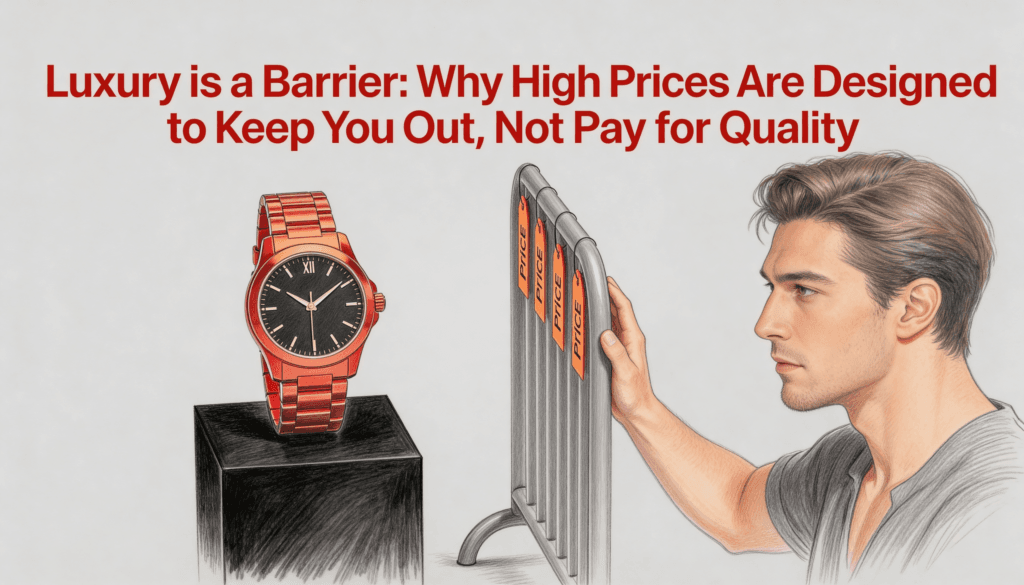
That feeling is not an accident. It is the product. You are standing in front of a wall, and the wall is the price tag.
More than a hundred years ago, an awkward and brilliant economist named Thorstein Veblen looked at the rich people of his time buying useless silver spoons and oversized hats and said something that still rings true today. The point of buying expensive things, he argued, is not to enjoy them. The point is to prove you can. And by extension, to prove that other people cannot.
This is the dirty secret of luxury. The high price is not a side effect of quality. The high price is the entire point.
The handbag that costs more than a car
Let us start with a simple question. Why does a leather handbag cost twelve thousand dollars?
The honest answer is uncomfortable. It is not because the leather is twelve thousand dollars better than the leather on a two hundred dollar bag. Cows are cows. Stitching is stitching. There is a ceiling on how good a piece of leather can be, and we passed it long ago.
So what are you actually paying for?
You are paying for the fence. You are paying for the fact that your neighbor cannot afford it. You are paying for the moment when someone glances at the logo and adjusts their posture. The bag is not a bag. The bag is a receipt that proves you had twelve thousand dollars to spend on something you did not need.
Veblen had a name for this. He called it conspicuous consumption. The word conspicuous is doing a lot of work there. It means visible, obvious, designed to be seen. You are not buying a thing. You are buying a signal, and the signal only works if other people can read it.
The trick that quality plays on us
Luxury brands have spent a century training us to believe that price equals craft. And to be fair, sometimes it does. A handmade Swiss watch genuinely takes longer to build than a quartz one from the supermarket. A bespoke suit is genuinely cut to your body.
But here is the part nobody likes to admit. Beyond a certain point, the connection between price and quality breaks. A four hundred dollar bottle of wine is not four times better than a hundred dollar bottle. It is often not better at all. Blind taste tests have humiliated wine experts for decades. People who confidently identify a vintage when they can see the label suddenly cannot tell red from white when blindfolded.
The same is true of perfume, cars, watches, restaurants, and clothing. There is a curve, and the curve flattens. Past a certain price, you are no longer paying for the thing. You are paying for the gate.
And the gate has to be expensive, because if it were not, anyone could walk through it. That would defeat the whole purpose.
The paradox of the cheap luxury
This is why luxury brands behave in ways that would get any normal business fired.
Burberry once burned tens of millions of dollars worth of unsold clothing rather than discount it. Hermes makes you wait years for a Birkin bag, and the waiting is part of the appeal. Imagine a grocery store telling you that you cannot buy bread until you have proven yourself worthy. You would walk out. But in luxury, the rejection is the seduction.
A discount would be catastrophic for these companies, not because they would lose margin, but because they would lose meaning. If anyone can buy it, no one wants it. The exclusivity is the substance. The price is the wall, and the wall must stay tall.
There is a strange beauty in how openly this works. The customer is not being tricked. The customer knows. That is the point. You are not buying the bag in spite of the price. You are buying it because of the price.
The economist who saw it coming
Veblen wrote about this in 1899. He called it The Theory of the Leisure Class, and the title alone tells you what he thought of the people he was studying. He noticed that the rich did not spend money to be comfortable. They spent money to be seen. Their entire lifestyle was a performance, and the performance had an audience of one. The other rich.
Veblen pointed out something we still do not want to face. Useful things are embarrassing in high society. A practical car is suspicious. A sensible watch is provincial. The ideal possession is one that announces, loudly, that the owner does not need to worry about practicality. A diamond is the perfect example. It does nothing. It cannot be eaten, worn for warmth, or used to build anything. Its only function is to glitter and to cost a lot. That is precisely why it works.
If diamonds were useful, they would be cheaper. If they were cheaper, they would not be diamonds.
The democratization that was not
Something interesting happened in the last few decades. The middle class got richer, or at least got better at borrowing. Suddenly luxury brands had a problem. Their core customers, the actually wealthy, were a small market. The aspirational middle, the people who would stretch to buy one bag, were enormous.
So luxury did something clever. It split itself in two.
The truly expensive items remained out of reach. But beneath them, the brands created an entry tier. A wallet. A keychain. A small canvas bag with a famous logo. These items were affordable enough that ordinary people could buy in. And buying in felt like belonging.
But here is the irony, and it is a sharp one. The moment middle class buyers could afford the entry products, those products lost status with the actual rich. A logo that everyone wears stops being a flag and starts being a uniform. The truly wealthy moved on, to quieter brands with no logos at all, recognizable only to other insiders. They started wearing clothes you cannot identify unless you are already in the club. The new luxury was not louder. It was quieter, and the quietness itself was the new gate.
This is sometimes called stealth wealth, and it is the next move in a very old game. When the wall everyone can see stops working, you build a wall that only some people can see.
The brain on prestige
The participants who thought they were drinking the expensive version reported more pleasure. And here is the part that should bother you. Their brains agreed. The pleasure centers actually lit up more. They were not lying. They genuinely enjoyed the wine more, because they believed it was better.
Price, it turns out, changes the experience of the thing itself. The luxury is not in the bottle. The luxury is in the story you tell yourself about the bottle. And the higher the price, the better the story.
This is why a bag that cost two thousand dollars to make can sell for thirty thousand. The extra twenty eight thousand is not fraud. It is the cost of the story. And for many buyers, the story is what they actually wanted.
Why this matters if you are not rich
You might be reading this and thinking, fine, rich people are silly, but what does this have to do with me. The answer is, more than you would like.
The same logic that drives luxury bags drives almost everything we buy. The phone you upgrade every two years is not meaningfully better than the one before it. The brand of sneaker you wear says something about you whether you intend it to or not. The neighborhood you live in, the school you send your kids to, the coffee you order. We are all signaling. We just have different audiences and different budgets.
Veblen would say we are all members of some leisure class, even if our class is small and our leisure is modest. We all use possessions to mark our place. The only difference between the woman with the twelve thousand dollar bag and the man with the limited edition sneakers is the price of the ticket. The game is the same.
There is something liberating about seeing this clearly. Once you understand that a lot of what you want is not really about the thing, but about what the thing says, you can ask a sharper question. What am I actually trying to communicate, and to whom. Sometimes the answer is real. Sometimes you genuinely want the object. But often you will find that you wanted to be seen a certain way, and the object was just the cheapest available method.
Or, in the case of luxury, the most expensive available method.
The strange honesty of the price tag
Here is what I find oddly admirable about luxury, even as I criticize it. It is honest about what it is.
A luxury brand does not pretend the markup is about better stitching. The markup is the brand. The price is the message. Everyone in the transaction knows. The buyer wants the wall, the seller sells the wall, and the wall is built right there in the store.
Compare this to a lot of everyday consumer marketing, which lies about exactly the same thing. A regular shampoo brand will spend millions convincing you that its ingredients are revolutionary. They are not. It is shampoo. But because it is not luxury, it has to dress up its signaling in pseudo science. Luxury skips the theater. It just charges you, and you pay, and both of you understand what is happening.
What to do with all this
You do not have to swear off nice things. That is not the point. Some expensive things are worth it, and some pleasures are real even when they are partly social.
But it is worth knowing what you are buying. When you spend money on something, ask yourself a small question. If nobody could see this, would I still want it. If the answer is yes, you are buying the thing. If the answer is no, you are buying the wall.
Both are valid choices. Some walls are worth paying for. A first class plane ticket buys silence and space, and silence and space are real. A nice neighborhood buys safety and good schools, and those are real too. The wall sometimes encloses something genuine.
But sometimes it encloses nothing at all. Sometimes the wall is the entire product, and you will own a thing that means nothing the moment everyone leaves the room.
Veblen, awkward and brilliant Veblen, saw all of this and wrote it down at the dawn of the twentieth century. He thought we would grow out of it. We did not. We just got better walls.
The next time you walk past one of those dim luxury stores, look at the door. Notice how heavy it seems. Notice the way the lighting flatters the items inside. Notice how the price tags face away from the window, so you have to step in to see them.
That is not a store. That is a fence. And the fence is the whole product.