Table of Contents
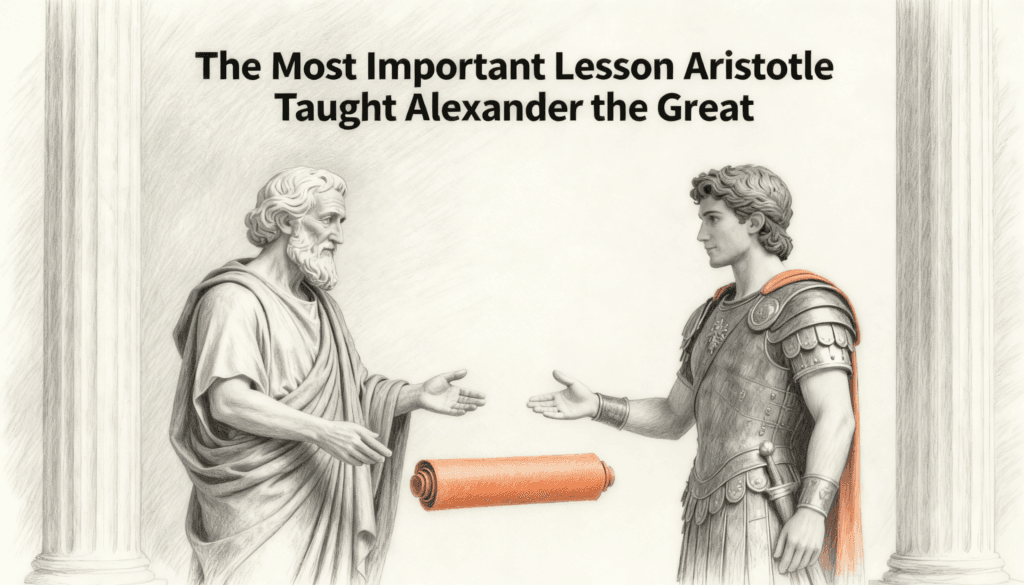
Most people remember Alexander the Great for conquering the known world by the age of thirty. Fewer people remember that before he conquered anything, he spent years sitting in a garden in Macedonia, listening to a middle aged philosopher talk about plants.
That philosopher was Aristotle. And the lesson he taught Alexander was not about military strategy, political manipulation, or the art of war. It was something far stranger and far more powerful. He taught Alexander how to think.
Not what to think. How.
This distinction sounds small. It is not. It is arguably the most consequential transfer of knowledge in Western history, and it shaped the world in ways we are still living with today.
The Odd Couple
Before we get to the lesson itself, it is worth pausing to appreciate just how unlikely this pairing was. Aristotle was the son of a court physician. He had spent twenty years studying under Plato at the Academy in Athens, and he was, by every measure, a man of books and contemplation. He dissected animals. He categorized species of shellfish. He wrote about the mating habits of octopuses.
Alexander was the son of Philip II of Macedonia, a one eyed warrior king who had unified Greece through a combination of military genius and selective brutality. Alexander grew up watching his father negotiate with swords. By the time he was sixteen, he had already commanded a wing of the Macedonian cavalry at the Battle of Chaeronea and helped crush the Sacred Band of Thebes.
So in 343 BCE, when Philip invited Aristotle to tutor his son, it was a bit like hiring a marine biologist to coach a cage fighter. On the surface, these two men had almost nothing in common.
And that was precisely the point.
Philip did not want someone to teach Alexander how to fight. Macedonia already had plenty of people for that. He wanted someone to teach his son how to see the world clearly. And there was no one alive who saw the world more clearly than Aristotle.
The Garden at Mieza
Aristotle set up his classroom in the Nymphaeum at Mieza, a shaded garden with colonnades and stone walkways, about an hour from the royal palace at Pella. It was not a military academy. It was not a war room. It was a garden.
For roughly three years, from the time Alexander was thirteen until he was about sixteen, Aristotle taught him there. The subjects ranged widely: literature, poetry, medicine, biology, philosophy, ethics, and politics. Aristotle reportedly prepared a personal annotated copy of Homer’s Iliad for Alexander, which Alexander later carried with him on every campaign. He supposedly slept with it under his pillow, next to a dagger.
That detail tells you everything. The book and the blade, side by side. The mind and the muscle. Alexander never saw these as separate domains. And that integration is the direct result of what Aristotle taught him.
But the specific subjects were not the real lesson. The real lesson was underneath all of them.
First Principles Thinking Before It Had a Name
Aristotle was, above everything else, a man obsessed with getting to the bottom of things. His entire philosophical method was built around a single habit: do not accept received wisdom at face value. Break things down. Ask what is actually true, not what people say is true. Start from what you can observe and reason upward.
This is what modern thinkers call first principles reasoning, though Aristotle would not have used that phrase in quite the same way. The idea is simple but remarkably difficult to practice. Instead of reasoning by analogy, which means looking at what others have done and copying it, you strip a problem down to its most fundamental truths and build your understanding from there.
Aristotle applied this method to everything. He did not just accept that heavy objects fall faster than light ones because everyone said so. He did not just accept that the earth was the center of the universe because it felt that way. He looked. He tested. He categorized. He was wrong about some things, certainly. His physics was a mess by modern standards. But his method of inquiry was revolutionary.
And this is what he drilled into Alexander: the habit of looking at a situation, stripping away assumptions, and asking what is actually going on here.
Why This Mattered on the Battlefield
Here is where the lesson becomes practical and where Alexander separates from every other talented military commander of his era.
Consider the Battle of Gaugamela in 331 BCE. Alexander faced the Persian Emperor Darius III, who commanded a force that outnumbered Alexander’s army by a ratio that most historians estimate at somewhere between three to one and five to one. Darius had prepared the battlefield in advance. He had flattened the terrain to maximize the effectiveness of his scythed chariots. He had positioned his cavalry to envelop Alexander’s flanks. By every conventional military calculation, Alexander should have lost.
A conventional commander would have looked at this situation through the lens of analogy. Previous battles against superior numbers had been won by defensive positioning, by terrain advantage, by refusing engagement until conditions improved. The standard playbook said: do not attack a larger force on ground they have chosen.
Alexander ignored all of that. He looked at the actual situation in front of him. He noticed that Darius had stretched his line thin to cover the wide, flat battlefield. He noticed that the Persian center, where Darius himself stood, was the hinge point of the entire formation. He noticed that if he could create a gap in that line, he could drive straight through it.
So he did something no one expected. He moved his forces at an oblique angle to the right, pulling Darius’s left wing out of position. When a gap opened in the Persian line, Alexander charged directly through it with his Companion cavalry, heading straight for Darius. Darius fled. The army collapsed.
This was not bravery, though it required bravery. It was not intuition, though it looked like intuition. It was first principles thinking applied to warfare. Alexander did not ask what should I do based on what other generals have done. He asked what is actually happening on this field right now, and what does that make possible.
That habit of mind came from a garden in Mieza.
The Counterintuitive Part
Here is something most accounts of the Aristotle and Alexander relationship miss. The most important thing Aristotle gave Alexander was not a set of answers. It was a tolerance for complexity.
Aristotle was the first major philosopher to take the messy, complicated, contradictory real world seriously on its own terms. Plato, his teacher, had essentially argued that the physical world was a shadow of higher, perfect forms. Reality was an imperfect copy. The goal of philosophy was to look past the mess and see the pure truth behind it.
Aristotle said no. The mess is the point. The particular, concrete, observable world is where truth lives. You have to get your hands dirty. You have to look at the actual octopus, not the ideal form of an octopus.
This sounds like a minor philosophical disagreement. It was not. It was a complete reversal in how to engage with reality.
And Alexander internalized it. He did not govern his empire according to some abstract ideal of kingship. He adapted. When he conquered Persia, he did not simply impose Greek customs on everyone, the way a leader operating from an idealized blueprint might have. He adopted Persian dress. He incorporated Persian nobles into his administration. He married a Bactrian princess. He asked his commanders to do the same.
This drove his Macedonian generals absolutely mad. They had conquered these people. Why were they now bowing to Persian customs? To many of them, it looked like weakness or, worse, betrayal.
But Alexander was not being weak. He was being Aristotelian. He was looking at the actual situation, a massive, multicultural empire that could not possibly be held together by Macedonian customs alone, and reasoning from what was actually true rather than from what felt satisfying.
The tragedy, of course, is that this flexibility had limits. Alexander’s tolerance for complexity did not extend to tolerating dissent from his own officers. Cleitus the Black discovered this when he criticized Alexander at a banquet and Alexander killed him with a spear. The student of the world’s greatest thinker still had the temper of a Macedonian warlord.
Nobody said first principles thinking was a cure for everything.
A Lesson That Echoes in Unlikely Places
There is a fascinating parallel between what Aristotle taught Alexander and what the best founders in Silicon Valley claim to practice today. Elon Musk has spoken repeatedly about first principles reasoning as the foundation of his approach to engineering. When SpaceX was trying to reduce the cost of rocket launches, Musk did not start by looking at what other rocket companies charged. He started by looking at the raw cost of the materials in a rocket and worked upward from there. The result was a rocket that cost a fraction of what competitors charged.
Whether Musk is a faithful practitioner of Aristotelian philosophy is debatable. But the method is recognizably the same. And the fact that it keeps showing up, twenty three centuries later, in completely different domains, tells you something about how powerful it is.
The common thread is this: most people, most of the time, reason by analogy. They look at what has been done before and do something similar. This is efficient. It is usually safe. And it almost never produces anything extraordinary. The people who change the shape of their fields, whether those fields are philosophy, warfare, or rocket engineering, are the ones who have learned to set analogy aside and ask what is actually true.
What Aristotle Got in Return
One detail that often gets overlooked is that the relationship between Aristotle and Alexander was not one directional. After Alexander left for his campaigns, he sent back biological specimens from the lands he conquered. Plants, animals, minerals, all shipped to Aristotle for study and classification. Some believe that Alexander’s conquests were directly responsible for the breadth of Aristotle’s biological and zoological work, which covered hundreds of species from across the Mediterranean, Persian, and Central Asian worlds.
So while Aristotle gave Alexander a method of thinking, Alexander gave Aristotle the world to think about. The philosopher needed the conqueror’s reach, and the conqueror needed the philosopher’s depth. It was a symbiosis that neither of them probably planned, but that benefited both enormously.
There is a quiet irony here. Aristotle spent his life arguing that knowledge comes from observation of the particular and concrete. And it was his most famous student, a man of action rather than contemplation, who provided him with more particulars to observe than any philosopher before or since.
The Real Lesson
So what was the most important lesson Aristotle taught Alexander the Great?
It was not a fact. It was not a strategy. It was not a piece of advice.
It was a way of seeing. A discipline of attention. The practice of looking at what is actually in front of you rather than what you expect to see, what you have been told to see, or what would be convenient to see.
This sounds almost embarrassingly simple. But watch how rarely people actually do it. Watch how often leaders, executives, generals, politicians, and even ordinary people making everyday decisions start from assumptions instead of observations. Watch how often the answer to why did this fail is because nobody stopped to look at what was actually happening.
Alexander looked. Not always wisely. Not always with compassion. But he looked at the real world with extraordinary clarity, and he acted on what he saw rather than on what convention dictated. That habit of mind let a young man from a small kingdom on the edge of the Greek world conquer an empire that stretched from Egypt to India.
He learned it in a garden, from a man who liked to study octopuses.
And that, in the end, is the lesson worth remembering. Not the conquests. Not the battles. Not the empire that fell apart almost immediately after Alexander died at thirty two. What endures is the method. The practice of seeing clearly. The discipline of thinking from the ground up.
It is a lesson that does not require a genius to teach it or a conqueror to apply it. It just requires the willingness to set aside what you think you know and start from what you can actually see.
Twenty three centuries later, that is still the hardest thing in the world to do.