Table of Contents
You would think the greatest mind of ancient Greece would hand the crown to physics. Or maybe mathematics. Or at least astronomy, the science that literally studies the heavens. But no. Aristotle looked at every field of inquiry available to him and decided that politics sits above them all. Not beside them. Above them.
This is the man who dissected animals, classified logical fallacies, wrote treatises on the soul, and basically invented biology as a discipline. He had options. And he chose politics as the master science. That should make us pause.
It sounds almost absurd to modern ears. We live in an era where politics is associated with attack ads, gridlock, and cable news shouting matches. Calling it the “master science” feels like calling a food fight the pinnacle of cuisine. But Aristotle was not talking about what we mean when we say “politics.” He was talking about something far more ambitious, and once you understand what he meant, his claim starts to look not just reasonable but almost impossible to argue against.
What Aristotle Actually Meant by ‘Science’
Before we can understand why politics gets the top spot, we need to clear up what Aristotle meant by “science” in the first place. The Greek word is episteme, and it does not map neatly onto our modern concept of white coats and laboratories. For Aristotle, a science was any systematic body of knowledge organized around causes and principles. It was a disciplined way of understanding why things are the way they are.
So medicine is a science. Rhetoric is a science. Ethics is a science. Military strategy is a science. Each one investigates a particular domain and tries to understand the principles that govern it. This is a much wider net than what we cast today when we use the word.
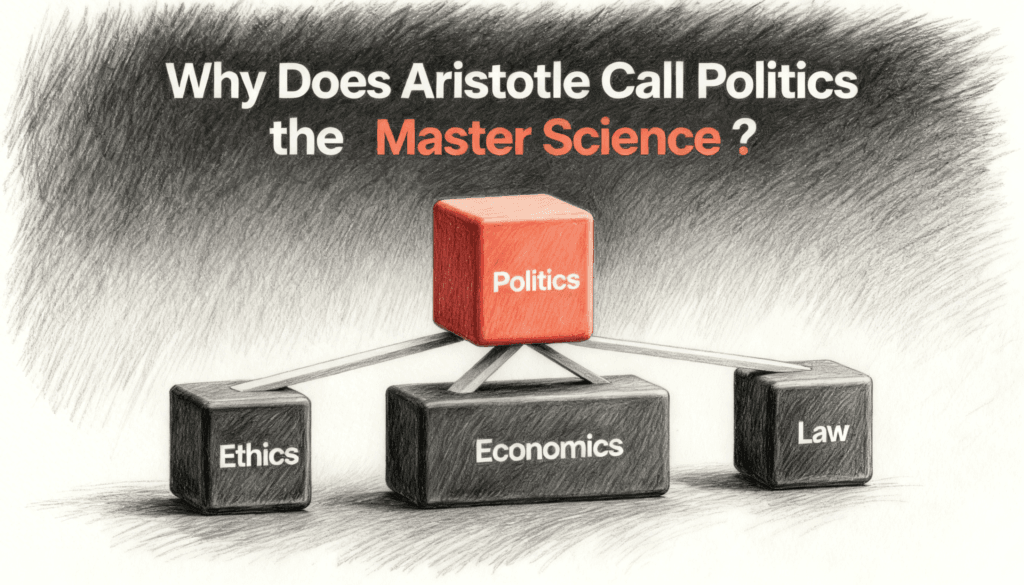
Now, if you have dozens of sciences all investigating different corners of reality, the obvious question arises: is there a hierarchy? Does one of them organize the others? Aristotle thought the answer was yes, and he laid this out right at the opening of the Nicomachean Ethics. He argued that some sciences are subordinate to others. Bridle making serves horsemanship. Horsemanship serves military strategy. And so the chain goes upward until you reach a science that is not subordinate to anything else, one that sets the goals for everything below it.
That science is politics.
The Argument: Everything Serves the City
Here is the core of Aristotle’s reasoning, and it is deceptively simple. Every art, every inquiry, every skill aims at some good. The doctor aims at health. The shipbuilder aims at a seaworthy vessel. The economist aims at wealth. But none of these goods is the final good. Health is good, but good for what? So that a person can live and act well. Wealth is good, but good for what? So that a person can live without deprivation and participate in the community.
All these partial goods eventually point toward a comprehensive good: the good life for human beings. And the discipline that concerns itself with the overall good life for human beings living together is politics.
Politics, in Aristotle’s framework, is the science that determines which other sciences should exist in the city, who should learn them, and to what extent. It is not just one field among many. It is the field that arranges all the other fields. The general decides military tactics, but politics decides whether to go to war at all. The economist manages resources, but politics decides how resources should be distributed across the community. The educator teaches the young, but politics decides what they should be taught.
Think of it like this: if every other science is a musician in an orchestra, politics is the conductor. The conductor does not play the violin better than the first violinist. The conductor does not play any instrument at all. But without the conductor, the orchestra is just a collection of talented people making noise.
Why Not Ethics?
This is where things get interesting, because it would seem like ethics should be the master science. After all, ethics is about the good life. Ethics is about virtue and happiness. If the ultimate goal is human flourishing, should the science of individual flourishing not reign supreme?
Aristotle considered this and rejected it, for a reason that reveals something deep about his entire worldview. He believed that the good of the individual, while important, is smaller and less complete than the good of the city. A single person living well is admirable. An entire community living well is something grander, something more beautiful, something more self sufficient.
This is not just a matter of scale, as if politics wins simply because it covers more people. Aristotle’s point is more subtle. Humans are, by nature, political animals. We are not designed to flourish in isolation. The good life for a human being is inescapably tied to life in a community. So ethics, which studies what it means for an individual to live well, is actually a branch of politics, which studies what it means for a community to live well. Ethics is a chapter. Politics is the whole book.
This might rub individualists the wrong way. We are trained to think of the self as the fundamental unit of moral concern. But Aristotle would say that this gets things backwards. The self is formed by the community. Your virtues, your character, your very capacity for reason are all shaped by the laws, customs, education, and institutions of the city you inhabit. You cannot study the chapter in isolation from the book.
The Counterintuitive Claim: Politics Is More Important Than Philosophy
Here is where Aristotle might surprise even his fans. In the Nicomachean Ethics, he famously argues that the contemplative life, the life of philosophical reflection, is the highest form of human activity. The philosopher, gazing at eternal truths, reaches the peak of human happiness. So how can politics be the master science if philosophy is the highest activity?
The answer involves a distinction that Aristotle drew with surgical precision. Politics is the most authoritative practical science. Philosophy, or what he called theoretical wisdom, occupies a different category altogether. The theoretical sciences (physics, mathematics, metaphysics) are in one sense “higher” because they study more fundamental and eternal objects. But they do not direct human action. They do not tell cities how to organize themselves. They do not determine the shape of human life in the community.
Politics is the master of all sciences that deal with action. And since human beings are creatures who must act, who must live together, who must make collective decisions about justice and education and war and peace, the science that governs all of this is, practically speaking, supreme.
It is a bit like the difference between a philosopher who understands the theory of nutrition and a chef who feeds an entire city. The philosopher may have deeper knowledge in some abstract sense. But the chef is the one keeping everyone alive. Aristotle, in this case, gives the chef the title.
What This Means for How We Think About Knowledge
Aristotle’s claim is not just a quirky ranking. It implies something radical about the nature of knowledge itself. In our modern world, we tend to treat knowledge as if it exists in separate, self contained boxes. Physics is over here. Biology is over there. Economics has its own department. Political science has its own department. And no one is in charge.
Aristotle would find this absurd. For him, knowledge without integration is incomplete. What good is advanced medicine if the political system does not ensure that people have access to it? What good is economic theory if the laws of the city allow a handful of people to hoard all the wealth while the rest starve? What good is military expertise if there is no political wisdom to determine when fighting is just and when it is foolish?
Every specialized science becomes fully meaningful only when it is directed toward its proper place in the larger project of human flourishing. And the science that does this directing, this ordering, this architectonic work, is politics.
There is a fascinating parallel here with modern systems theory and complex adaptive systems. In those frameworks, you cannot understand the behavior of a system by studying its components in isolation. The interactions between the parts, the feedback loops, the emergent properties, these are what matter. Aristotle, without the vocabulary of systems theory, was making essentially the same point twenty four centuries earlier. The city is not just a collection of individuals any more than a body is just a pile of cells. Something organizes the whole. And studying that organizing principle is what politics does.
The Dark Side of the Claim
We should be honest about the dangers lurking in this idea. If politics is the master science, and if it determines which other sciences exist and who practices them, then politics has the power to suppress knowledge it does not like. And history is littered with regimes that did exactly that. Soviet biology under Lysenko. Book burnings. Censorship of inconvenient research. The master science, in the wrong hands, becomes a master of suppression and 6 million people dead to famine.
Aristotle was not naive about this. His Politics contains extensive discussions of how regimes go wrong, how tyrannies arise, how democracies can devolve into mob rule. He knew that political authority could be abused. But he would argue that this does not diminish the claim. It actually reinforces it. The very fact that bad politics can corrupt every other domain of life shows just how powerful and important the political art really is. If politics were just one science among many, its corruption would be contained. The fact that its corruption spreads everywhere proves that it is, indeed, the master.
This is a bit like saying that because the brain can go catastrophically wrong, causing the whole body to fail, it proves that the brain really is the organ in charge. The capacity for spectacular failure is, paradoxically, evidence of supreme importance.
What Aristotle Gets Right That We Get Wrong
Modern liberal democracies tend to be suspicious of the idea that politics should direct everything. We have built elaborate systems to keep politics out of science, out of the economy, out of private life. And for good reasons. We have seen what happens when political authority has no limits.
But Aristotle would point out that these limits are themselves political decisions. The choice to separate church and state is a political choice. The choice to let markets operate with relative freedom is a political choice. The choice to protect individual rights from government interference is a political choice. Even anti politics is politics. You cannot escape the master science by pretending it does not exist.
This is perhaps the most useful insight Aristotle offers on this subject. We often talk as though “keeping politics out of it” is a real option. It never is. The question is not whether politics will shape our collective life. The question is whether it will shape it well or badly, wisely or foolishly, with an eye toward human flourishing or with an eye toward the interests of the powerful.
The Enduring Relevance
Aristotle’s claim that politics is the master science is ultimately a claim about what matters most. It is a claim that the central question of human life is not “How do I become wealthy?” or “How does the natural world work?” or even “How do I become virtuous?” The central question is: “How should we live together?”
Every other question feeds into that one. And the discipline that takes on that question directly, that tries to answer it comprehensively, that organizes all the other disciplines in service of a shared human good, that discipline deserves to be called the master science.
We may not like the sound of it. We may prefer to think of politics as a grubby, necessary evil. But Aristotle would say that this attitude is itself a symptom of political failure. When politics works as it should, it is the noblest of practical pursuits.
It is the art of making it possible for human beings to live not just together, but well together.