Table of Contents
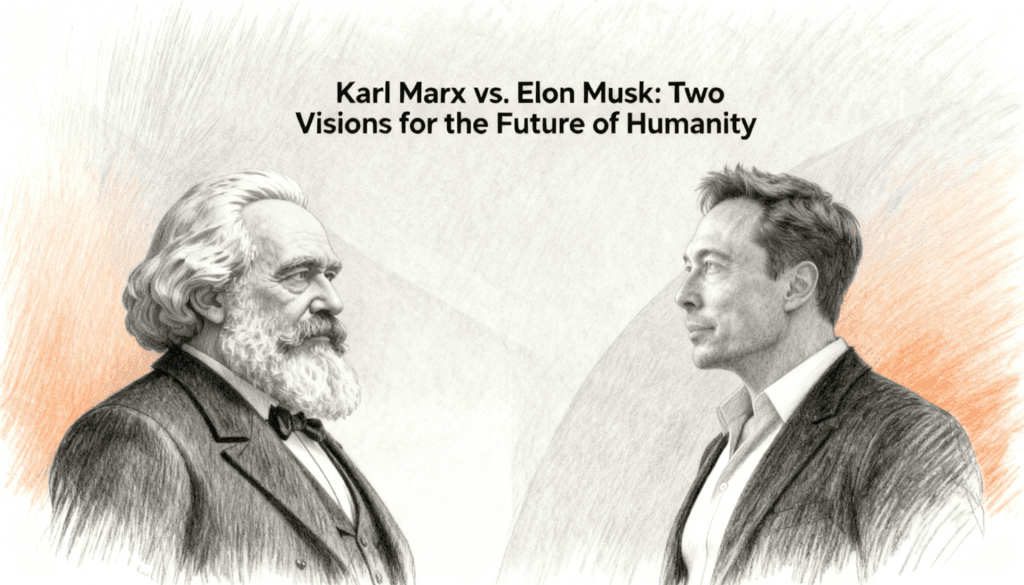
There is something almost comedic about placing Karl Marx and Elon Musk in the same sentence. One died in 1883 with barely enough money to cover his funeral. The other could buy a small country and still have enough left over to launch a car into orbit. And yet, both men share something unusual: an obsessive, almost religious conviction that they understand where humanity is headed. They just disagree on everything else.
Marx believed the future belonged to the workers. Musk believes it belongs to whoever builds the best technology. Marx wanted to abolish private property. Musk wants to privatize space. Marx wrote manifestos in cramped London apartments. Musk writes tweets from what one can only assume is a throne made of lithium batteries.
But here is the thing most people miss. These two are not as far apart as they appear. Strip away the aesthetics, the century and a half of history, the beard versus the memes, and you find two thinkers grappling with the same fundamental question: What happens when machines do all the work?
That question, more than any other, is the one that will define the next hundred years. And the answers Marx and Musk offer are worth examining not because either one is completely right, but because the tension between them reveals something important about the world we are building right now.
Marx and the Machine Problem
Most people know Marx as the guy who inspired communism, which then inspired bread lines, secret police, and a lot of gray architecture. This is not entirely unfair. But it is also not the whole picture.
What Marx actually spent most of his time doing was studying capitalism. Not from the outside, as a hostile critic throwing stones. From the inside, as someone genuinely fascinated by how the system worked. He read every economics textbook he could find. He spent years in the British Museum library, buried in reports about factory conditions and trade statistics. He was, in many ways, capitalism’s most dedicated student.
And what he concluded was not that capitalism was evil. It was that capitalism was brilliant but unstable. It was a machine that produced enormous wealth while simultaneously creating the conditions for its own destruction.
The core of his argument was simple. Capitalists make profits by paying workers less than the value those workers create. This is not a moral judgment. It is an observation about how the math works. If you pay someone ten dollars an hour and they produce twenty dollars of value per hour, the difference is your profit. Marx called this surplus value, and he saw it as the engine that drives the entire system.
The problem, as Marx saw it, was that this engine had a design flaw. As technology improved, capitalists would replace workers with machines. This makes perfect sense from the perspective of any individual business owner. Machines do not ask for raises. They do not form unions. They do not call in sick on Mondays.
But here is where it gets interesting. If everyone replaces their workers with machines, who is left to buy the products? You cannot sell cars to robots. You cannot rent apartments to algorithms. The very process that makes individual businesses more efficient makes the overall system less stable.
Marx predicted that this contradiction would intensify over time, leading to increasingly severe economic crises, growing inequality, and eventually a breaking point where workers would seize control of the means of production.
He got the timeline wrong. He got the revolution wrong. But the underlying observation about technology displacing labor and wealth concentrating at the top? Walk into any Amazon warehouse where robot staff is equal to humans and tell me that part was wrong.
Musk and the Escape Velocity Theory
Elon Musk does not spend much time reading Marx. One suspects he would find it slow going. Musk is not a theorist. He is a builder. And his vision for the future is not based on class struggle or historical materialism. It is based on something closer to engineering logic.
Musk’s worldview can be summarized roughly as follows: humanity faces a series of existential threats. Climate change. Artificial intelligence gone wrong. Resource depletion. Asteroids, maybe. The solution is not to redistribute what we have. It is to build our way out. Better energy. Better transportation. Better rockets. And ultimately, a backup copy of civilization on Mars, just in case Earth does not work out.
There is a seductive clarity to this vision. It sidesteps the messy, contentious questions about who owns what and who owes whom. It replaces politics with engineering. Instead of arguing about how to divide the pie, just bake a bigger pie. Then bake another one on Mars.
Musk’s companies reflect this philosophy. Tesla does not ask whether car ownership is equitable. It asks whether cars can run on electricity. SpaceX does not question whether space exploration benefits the working class. It asks whether reusable rockets are possible. Neuralink does not wonder if brain implants will create a cognitive elite. It asks whether the technology works.
This is the Silicon Valley mindset at its purest. Technology as the answer to every question. Innovation as a moral good in itself. The implicit assumption being that progress lifts all boats, even if some boats are superyachts and others are inflatable rafts.
And to be fair, there is real evidence for this view. The smartphone in your pocket gives you access to more information than the president of the United States had in 1990. Medical advances have doubled life expectancy in many parts of the world. Even the poorest people in wealthy nations live better, by many material measures, than kings did three centuries ago.
But there is a catch, and it is one Marx would have recognized immediately.
The Convergence Nobody Talks About
Here is where things get genuinely interesting. Because if you look closely, Marx and Musk are circling the same black hole from different directions.
Marx worried about what happens when machines replace workers. Musk is actively building the machines that replace workers. Marx predicted that automation would concentrate wealth in fewer and fewer hands. Musk is one of the hands.
This is not an accusation. It is an observation. And Musk, to his credit, seems at least partially aware of it. He has spoken publicly about the need for universal basic income as artificial intelligence displaces more jobs. Which is a fascinating position for a billionaire to take. It is essentially an admission that the system he is helping to build will not distribute its benefits on its own. That some form of redistribution will be necessary.
In other words, Musk the capitalist has arrived, through pure engineering logic, at a conclusion that Marx the communist reached through economic theory a hundred and fifty years earlier: when machines do the work, you have to rethink how people get paid.
This convergence is remarkable and almost entirely ignored in public discourse. We are so busy sorting people into teams, capitalist versus socialist, tech bro versus activist, that we miss the moments when the opposing sides are actually saying the same thing in different languages.
There is a parallel here to something that happened in physics. For decades, general relativity and quantum mechanics seemed completely incompatible. Two frameworks that each worked brilliantly in their own domain but could not be reconciled. Physicists spent careers trying to find a unified theory. The Marx versus Musk divide feels similar. Two models that each capture something real about how the world works, but that seem impossible to combine.
What Marx Got Wrong
Intellectual honesty requires acknowledging where each thinker falls short. Marx’s failures are well documented, but they are worth revisiting because they are often misunderstood.
Marx did not fail because he was stupid. He failed because he was too certain. He treated his theory as a science, complete with iron laws of historical development. He believed the revolution was inevitable. That capitalism would collapse under its own contradictions. That workers would naturally develop class consciousness and seize control.
None of this happened the way he predicted. Capitalism proved far more adaptable than Marx expected. It bent without breaking. It absorbed shocks, reformed itself, created welfare states and consumer credit and entertainment industries that made people just comfortable enough to not overthrow anything.
Marx also underestimated the power of nationalism, religion, and identity to override class solidarity. Workers in France did not unite with workers in Germany. They shot at each other. Twice.
And the regimes that claimed to implement his ideas produced some of the worst atrocities of the twentieth century. Marx cannot be held personally responsible for Stalin’s gulags, any more than Jesus can be blamed for the Inquisition. But the pattern is worth noting. Grand theories about human liberation have a disturbing tendency to produce new forms of oppression when someone actually tries to implement them.
What Musk Gets Wrong
Musk’s blind spots are different but equally significant. His most fundamental error is the assumption that technological solutions can substitute for political ones.
Climate change is a perfect example. Yes, electric cars are better for the environment than gasoline cars. But the climate crisis is not primarily a technology problem. It is a coordination problem. We already have most of the technology we need. What we lack is the political will to deploy it, because doing so would threaten the profits of powerful industries.
Musk’s Mars vision has a similar flaw. Even if we could build a self sustaining colony on Mars, which is a staggering engineering challenge, it would not solve the problems facing eight billion people on Earth. It would create a lifeboat for a tiny elite. Which, come to think of it, is exactly the kind of outcome Marx would have predicted.
There is also something troubling about the concentration of power that Musk represents. One person controls a significant chunk of the world’s electric vehicle production, satellite internet infrastructure, social media discourse, and space launch capacity. Whatever you think of Musk personally, this level of influence in a single pair of hands is historically unprecedented for a private citizen. And history suggests that unprecedented concentrations of power rarely end well for everyone else.
The Question Neither Can Answer
Both Marx and Musk offer visions of the future that are compelling, internally consistent, and incomplete. Marx gives us a powerful diagnosis of capitalism’s contradictions but no workable prescription. Musk gives us dazzling technological capabilities but no framework for ensuring they benefit everyone.
The real question, the one that neither of them adequately addresses, is this: How do you build a society where advanced technology serves human flourishing rather than just generating returns for whoever owns the machines?
This is not an abstract philosophical puzzle. It is the most practical question of our time. As artificial intelligence, robotics, and automation continue to advance, the displacement of human labor will accelerate. The wealth generated by these technologies will flow, by default, to the people who own them. Without deliberate intervention, the result will be a world that is technologically magnificent and socially unbearable.
Marx would say the answer is collective ownership of the means of production. But we have seen what that looks like in practice, and the results were not encouraging.
Musk would say the answer is to keep building, keep innovating, and let universal basic income handle the fallout. But UBI funded by whom? Governed by whom? Distributed by what mechanism? These are political questions, and Musk’s framework has no tools for answering them.
Why This Matters Now
We are living in the early stages of the most significant economic transformation since the Industrial Revolution. The rise of artificial intelligence is not just another technological shift. It is a fundamental change in the relationship between human labor and economic production.
Within our lifetimes, possibly within the next two decades, machines will be capable of performing most of the cognitive and physical tasks that humans currently get paid to do. This is not science fiction. It is the explicit goal of companies like OpenAI, Google DeepMind, and yes, Musk’s own ventures.
When that happens, the arguments of both Marx and Musk will become impossible to ignore. The question of who owns the machines will become the defining political issue of the century. The question of what people do when there is no work will become the defining social issue.
We will need Marx’s analytical rigor, his willingness to look at the system as a whole and ask who benefits. And we will need Musk’s engineering ambition, his refusal to accept that problems are unsolvable.
What we will not need is the dogmatism of either camp. The future will not be built by people who have all the answers. It will be built by people who are willing to sit with the discomfort of having none, and who keep working anyway.
Marx died convinced he had discovered the laws of history. Musk lives convinced he can engineer the future. The truth, as usual, is less dramatic and more interesting than either story. The future is not written. It is not designed. It is argued into existence, one difficult conversation at a time.
And that conversation, between the ghost and the rocket, between the theory and the machine, is just getting started.