Table of Contents
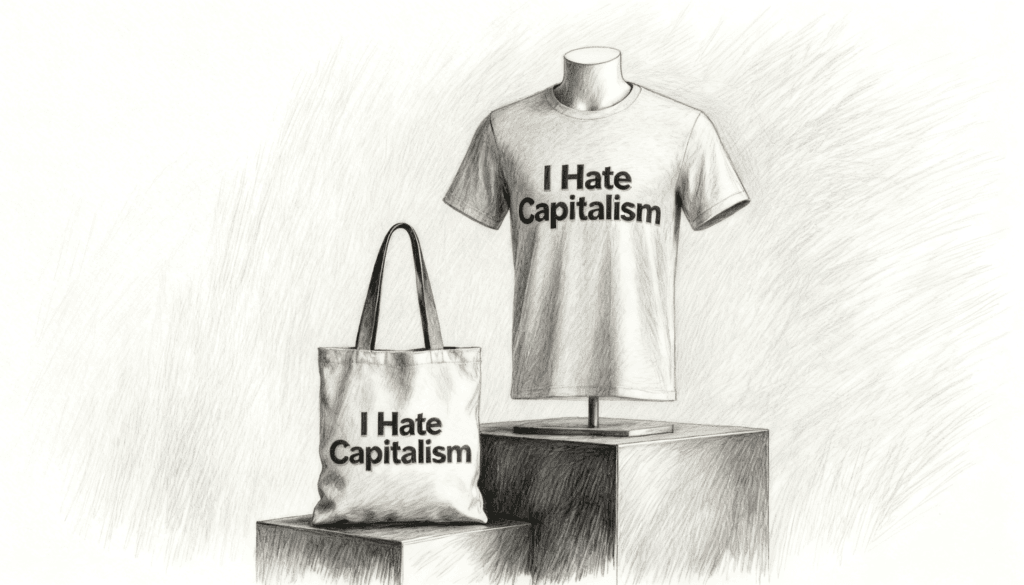
You can buy a Karl Marx t-shirt on Amazon for $19.99. It ships in two days if you have Prime. The shirt says something like “I Hate Capitalism” or features Marx’s bearded face screen printed in red, and it arrives in a plastic mailer produced in a factory overseas, sold by a third party vendor who is almost certainly not redistributing the profits to the working class.
Nobody involved in the production chain made that shirt to dismantle capitalism. They made it to participate in capitalism. And the person who buys it is not overthrowing anything. They are adding to cart.
This is not a small irony. It is the central comedy of our era. The market has figured out how to sell rebellion back to the rebels, and the rebels keep buying it.
The Product Is the Contradiction
Let us start with the obvious. An “I Hate Capitalism” shirt is a commodity. It has a price. It was manufactured, marketed, distributed, and sold through every mechanism that capitalism provides. Cotton was sourced. Labor was employed, likely at wages Marx himself would have found offensive. A brand or seller listed it on a marketplace designed to maximize consumer spending. Algorithms promoted it. A credit card processed the transaction.
At no point in this chain did anyone seize the means of production. The means of production seized the moment.
This is not a new observation. Plenty of people have pointed out the surface level irony. But the deeper question is more interesting. Why does capitalism not just tolerate this kind of dissent but actively encourage it? Why does the machine sell wrenches labeled “throw me into the machine”?
The answer is unsettling. Capitalism does not care what the shirt says. It only cares that the shirt sells. The message is irrelevant to the transaction. Whether the shirt reads “I Love Free Markets” or “Smash the State,” the profit margin is roughly the same. The system is indifferent to the content. It is only interested in the exchange.
This is what makes capitalism so resilient and, frankly, so strange. It can absorb its own critique and turn it into a product line. No other economic system in history has had this ability. The Soviet Union did not sell “I Miss the Tsar” coffee mugs. But Amazon will sell you a hammer and sickle phone case and recommend a matching laptop sleeve.
Marx as Brand Ambassador
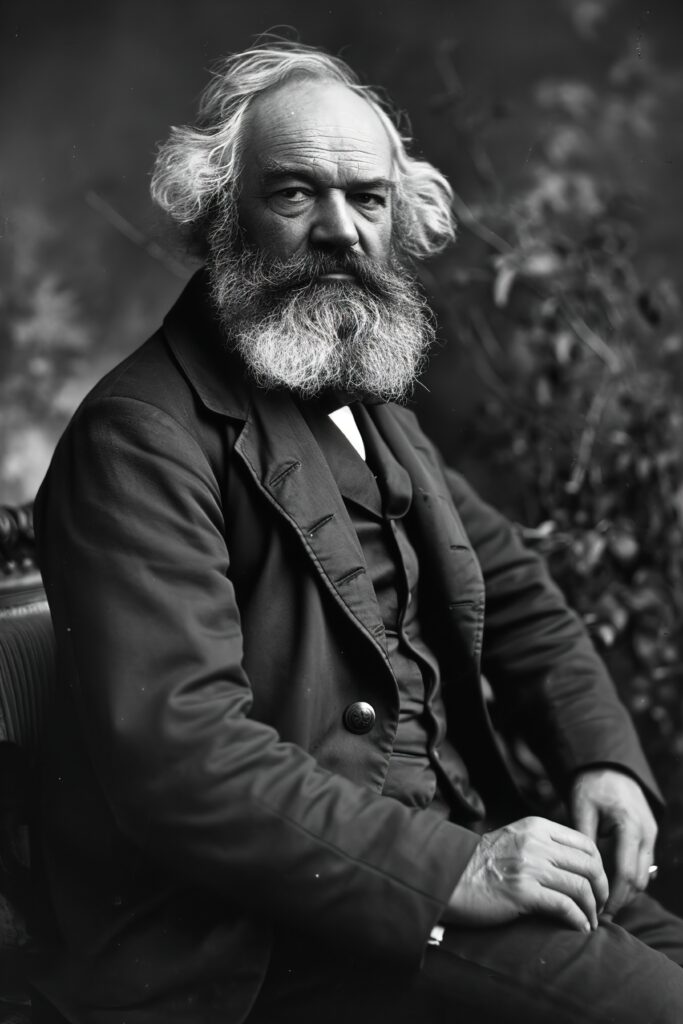
Karl Marx would be a fascinating case study for a modern marketing class. Not because of his economic theories, but because of what happened to his image. Marx has become a brand. His face is recognizable. His beard is iconic. He sits on merchandise next to Che Guevara, another revolutionary whose image was commodified so thoroughly that you can find his face on bikinis.
Consider what this means. Marx spent his life arguing that capitalism alienates workers from the products of their labor and reduces human relationships to transactions. His entire intellectual project was about exposing how the market strips meaning from everything it touches. And now his face is the product. His critique is the commodity. The thing he warned about is the thing that happened to him.
There is a term for this in philosophy. Recuperation. It describes the process by which radical ideas are absorbed by the dominant culture and neutralized. The idea does not get defeated. It gets sold. It goes from dangerous to decorative. From manifesto to merchandise.
Guy Debord wrote about this in “The Society of the Spectacle” in 1967. He argued that modern capitalism turns everything, even opposition, into a spectacle to be consumed. The revolution will not be televised, Gil Scott Heron said. But he was wrong about that too. The revolution will be televised, livestreamed, and available for purchase with next day delivery.
Why People Buy It Anyway
Here is where things get psychologically interesting. The people buying “I Hate Capitalism” merch are not stupid. Most of them are aware of the contradiction. Many find it funny. Some wear the shirt specifically because of the irony. They are in on the joke.
But there is something deeper happening. The purchase is not really about the shirt. It is about identity. In a consumer economy, we express who we are through what we buy. This is one of capitalism’s most clever tricks. It made consumption the language of self expression. You do not just buy a shirt. You buy a signal. You are telling the world something about your values, your politics, your sense of humor.
The person wearing the Marx shirt is performing anti capitalism through the very mechanism capitalism provides. They are using the master’s tools to critique the master’s house. And the master is charging them $19.99 for the privilege.
This connects to something broader about how modern identity works. We live in an era where beliefs are increasingly performed rather than practiced. Wearing the shirt is easier than reading “Das Kapital.” Posting the meme is easier than organizing a labor union. The aesthetic of resistance has been separated from the act of resistance. You can look like a revolutionary without doing any of the revolutionary work.
This is not unique to the left, by the way. The same dynamic plays out across the political spectrum. Patriotism gets sold as flag themed merchandise. Environmentalism becomes a reusable tote bag. Every conviction can be purchased, worn, and displayed without requiring any actual change in behavior.
The Capitalism of Anti Capitalism
There is an entire economy built around opposing capitalism. This is worth sitting with for a moment.
Anti capitalist books are bestsellers. Anti capitalist podcasts run ads. Anti capitalist influencers have sponsorship deals. Anti capitalist documentaries are distributed by major studios on subscription platforms. The critique of the system funds the system.
Some of this is unavoidable. You cannot exist outside of capitalism while living within it. You need to eat, pay rent, and probably own a phone. Critics of capitalism are not hypocrites for participating in the economy. That argument is lazy and reductive. You can criticize a system you are forced to operate within.
But there is a difference between participating in the economy and enthusiastically merchandising your opposition to it. There is a line between “I live under capitalism and I think it has serious problems” and “buy my anti capitalism hoodie, available in four colors, use code REVOLT for ten percent off.”
That line is where the irony stops being funny and starts being instructive. Because it reveals something important about how dissent functions in a consumer society. Dissent becomes a market segment. The system does not crush opposition. It monetizes it. And in doing so, it removes its teeth.
A protest sign is a threat. A protest t-shirt is a purchase.
The Historical Joke Marx Did Not See Coming
Marx predicted that capitalism would eventually destroy itself. The internal contradictions would become too great. The workers would rise up. The system would collapse under the weight of its own exploitation.
What he did not predict was that capitalism would develop a sense of humor about itself. He did not anticipate a system so flexible that it could incorporate its own funeral arrangements as a product category. He imagined a fragile system. What he got was one made of something closer to rubber.
This flexibility is arguably capitalism’s greatest strength. It adapts. It absorbs. It finds a way to profit from everything, including the prediction of its own demise. There are hedge funds that bet against the market. There are companies that profit from economic downturns. There are entire industries built around the idea that the current system is broken, selling solutions within the framework of that same system.
Marx thought the contradiction between capital and labor would be fatal. But capitalism found a way to make contradictions profitable. The “I Hate Capitalism” shirt is not a bug. It is a feature.
What This Tells Us About Culture
Step back from the economics for a moment and look at what this phenomenon says about culture more broadly.
We live in a time when sincerity is difficult. Everything gets absorbed into a layer of irony so thick that it is hard to tell what anyone actually believes. The Marx shirt could be sincere. It could be ironic. It could be both at the same time. The wearer might genuinely oppose capitalism. They might also think the contradiction is hilarious. They might not have thought about it at all. They might have just liked the design.
This ambiguity is characteristic of life in a highly commercialized society. Meaning is unstable. Symbols float free from their origins. A revolutionary’s face becomes a fashion choice. A political statement becomes a conversation starter at a barbecue. Everything is simultaneously serious and not serious, meaningful and meaningless.
It is like knowing that scrolling social media is bad for you and continuing to scroll. The knowledge does not change the behavior. If anything, it becomes part of the behavior. “I know this is bad,” you think, as you keep doing it. The awareness becomes its own form of participation.
The Uncomfortable Question
Here is the question that sits at the bottom of all of this, the one nobody selling Marx merchandise wants to confront.
If capitalism can absorb and profit from anti capitalism, what does effective opposition actually look like?
This is not a rhetorical question. It is a real strategic problem for anyone who genuinely believes the current economic system needs fundamental change. If every critique gets turned into a commodity, if every movement gets merchandised, if every radical idea gets a logo and a product line, then how do you actually challenge the system?
The answer might be that the most radical act in a consumer society is not buying something. Not performing your beliefs. Not signaling your identity through purchases. The most subversive thing you can do might be nothing. No shirt. No meme. No brand. Just the quiet, unglamorous work of organizing, voting, building alternatives, and refusing to let your politics become a product.
But that does not make for a very good Instagram post. And it definitely does not come with free shipping.
The greatest irony of the “I Hate Capitalism” merchandise is not that it exists. It is that it works. Not as a tool of revolution, but as a product. It sells. People buy it. They feel something when they wear it. They feel like they are part of something. They feel like they are expressing a truth about the world.
And they are. Just not the truth they think. The truth they are expressing is not that capitalism is bad. The truth is that capitalism is so deeply embedded in how we think, communicate, and express ourselves that we cannot even oppose it without feeding it. The shirt does not critique the system. It demonstrates the system. It is the system, wearing a disguise, looking at itself in the mirror, and smiling.
Marx once wrote that history repeats itself, first as tragedy, then as farce. He probably did not imagine that the farce would be available in sizes small through triple XL, with a thirty day return policy.
But here we are. Adding to cart.