Table of Contents
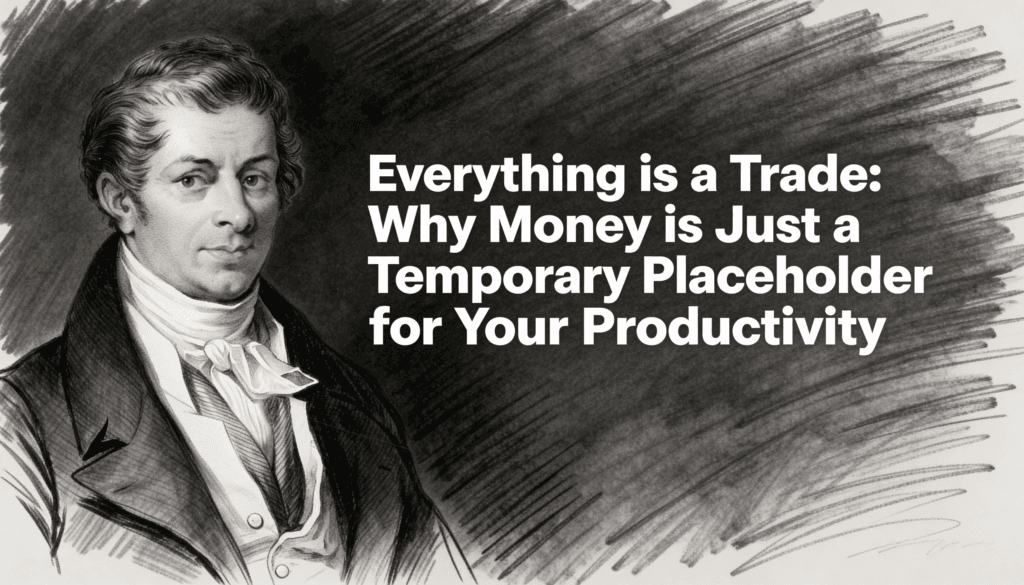
There is a French economist most people have never heard of who figured out something about money that most people still do not understand. His name was Jean-Baptiste Say. He lived through the French Revolution, watched empires rise and collapse, and somewhere in the chaos, he landed on an idea so simple it almost sounds stupid.
Here it is: products are paid for with products.
That is it. That is the whole thing. When you buy a coffee, you are not really paying with money. You are paying with whatever you produced to earn that money. The dollar bill is just the middleman. A go-between. A temporary placeholder that lets you exchange your work for someone else’s work without the logistical nightmare of direct barter.
Say published this idea in 1803 in his Treatise on Political Economy. More than two centuries later, most people still think of money as the thing itself rather than what it represents. And that confusion is quietly shaping how they work, how they spend, and how they think about wealth.
The Barter Problem Nobody Thinks About
To understand why Say’s insight matters, you have to go back to the original problem money was invented to solve.
Imagine you are a shoemaker in a medieval village. You need bread. The baker needs a chair. The carpenter needs shoes. In theory, everyone has something someone else wants. In practice, getting those trades to line up is a logistical disaster. You would spend more time finding the right trading partner than actually making shoes.
Economists call this the “double coincidence of wants.” Both parties need to want exactly what the other has, at the same time, in the right quantity. It almost never works cleanly.
So humans invented money. Not because money has value in itself, but because it solves the coordination problem. Money lets you sell your shoes to anyone, hold the value temporarily, and buy bread whenever you want. The trade still happens. It just happens in two steps instead of one.
Say looked at this and realized something most people overlook. The money in the middle does not change what is actually happening. You are still trading shoes for bread. The coins in your pocket are just a receipt for productivity you have already delivered and productivity you have not yet claimed.
You Are Always Trading Time
Once you internalize this, your relationship with money starts to shift.
Every price tag becomes a conversion rate. When you see a jacket for $200, the real question is not “can I afford this?” The real question is “how many hours of my life did I trade to produce enough value to claim this jacket?”
If you earn $40 an hour, that jacket costs you five hours. Not five hours of sitting at a desk. Five hours of your finite, irreplaceable, never-coming-back life converted into productive output.
This is not a new observation. Henry David Thoreau made a similar point in Walden when he wrote that the cost of a thing is the amount of life you exchange for it. But Say’s framing adds a layer Thoreau missed. It is not just about your time. It is about the productive output of that time and how it connects to everyone else’s productive output in an enormous web of exchange.
You are not just spending hours. You are trading your productivity for someone else’s productivity, with money serving as the translation layer between the two.
Say’s Law
Say’s idea eventually got compressed into a soundbite that economists call “Say’s Law.” The shorthand version goes like this: supply creates its own demand.
This is one of the most misunderstood phrases in the history of economics.
Critics, most notably John Maynard Keynes, attacked this idea by arguing that it implies overproduction is impossible and recessions cannot happen. But that is not what Say actually meant. Say was not claiming that every product automatically finds a buyer. He was making a more subtle point.
When you produce something valuable, you create the means to purchase other things. Your production is your demand. The act of creating a good or service generates the purchasing power to acquire other goods and services. Money just keeps the ledger balanced between these exchanges.
The confusion comes from treating Say’s Law as a prediction about markets always clearing perfectly. Say was describing the underlying mechanics of exchange, not promising that everything works out smoothly. Markets can still get stuck. People can still produce things nobody wants. The insight is about the nature of trade itself, not about whether every trade goes well.
It is a bit like saying “every conversation is an exchange of ideas.” That does not mean every conversation is a good one.
The Illusion of Money as Wealth
If money is just a placeholder for productivity, then accumulating money without producing anything is a kind of illusion. You are holding receipts for value, but you are not generating new value. The receipts only work because other people are out there making things, growing things, building things, and serving things.
This is why inflation feels like theft. When governments print money without a corresponding increase in production, they are issuing more receipts for the same amount of stuff. Each receipt becomes worth less. Your placeholder loses its holding power.
Say understood this intuitively. He argued that the wealth of a nation is not its money supply but its productive capacity. A country with enormous natural resources and skilled workers is wealthy. A country that simply prints more currency is not.
This also explains why lottery winners so frequently go broke. They receive a massive pile of placeholders without developing the productive capacity to sustain or replace them. The money flows out because nothing is flowing in. The placeholders were not backed by an ongoing engine of production.
Compare that to someone who builds a business over twenty years. Their wealth is not really the number in their bank account. It is the productive system they have built, the skills they have developed, and the ongoing exchange relationships they maintain. The money is just the scoreboard.
Why This Matters for How You Think About Work
Career advice often focuses on earning more money. Say’s framework suggests a different question: are you becoming more productive?
Not busy. Productive. There is a difference so large you could park a cruise ship in it.
Busy means answering emails for nine hours. Productive means creating something someone else values enough to trade their own productivity for. The person who writes code that saves a company ten thousand hours of manual work is wildly more productive than the person who manually does ten thousand hours of that work. Both are busy. Only one has multiplied their output.
Say would argue that the first person deserves more of those placeholder tokens not because of some abstract notion of fairness, but because they have contributed more to the pool of goods and services that everyone else draws from. Their production has created more demand, more exchange, more wealth in the system.
This is also why technology tends to increase wealth over time, even when it displaces individual jobs. A tractor does not just replace farmworkers. It multiplies the productive capacity of agriculture so dramatically that food becomes cheaper, freeing up human labor to produce other things. The web of exchange gets bigger. More trades become possible. More products get paid for with more products.
What This Means for Your Wallet, Right Now
Let us bring this back to the personal level, because theory is only useful if it changes behavior.
If money is a temporary placeholder for your productivity, then three things follow.
First, your earning potential is tied to the value of what you produce, not the hours you put in. Two people can work identical hours and earn vastly different amounts because the market values their output differently. This is not always fair. But understanding it lets you focus on increasing the value of your output rather than just the volume of your effort.
Second, saving money is really just storing your past productivity for future use. This reframe matters because it changes how you think about spending. Blowing your savings on something pointless is not just wasting money. It is wasting the hours and effort your past self invested in creating value. Your savings account is a warehouse full of your previous work. Treat it that way.
Third, investing is lending your stored productivity to someone else’s productive venture, hoping their output will grow your claim on future goods and services. When you buy stock in a company, you are saying: “I produced value in the past, I am going to let you use those placeholders, and I expect your production to generate even more placeholders in return.” Every investment is, at its core, a bet on someone else’s productivity.
The Uncomfortable Flip Side
There is a less comfortable implication here that is worth sitting with.
If products are paid for with products, then people who cannot produce are in trouble. Say’s framework has no built-in safety net. It describes a world of exchange, and if you have nothing to exchange, you are on the outside looking in.
This is where pure market logic bumps into moral philosophy. Most modern societies have decided that basic human dignity requires some provision for people who cannot produce, whether due to age, disability, illness, or circumstance. Say’s insight tells us how economies work. It does not tell us how they should treat the people who fall outside the production loop.
Recognizing this tension is important. You can appreciate the elegance of Say’s model while also acknowledging that an economy is not just a machine for maximizing exchange. It is also a social arrangement between people who have agreed, however imperfectly, to look after one another.
The Takeaway That Sticks
Jean-Baptiste Say gave us a lens that strips away the mystique of money and shows the gears underneath.
Money is not wealth. It is a tool for moving wealth around. The real wealth is what you produce, what you know how to produce, and the systems you build that keep producing after you stop.
Every purchase you make is a trade. You are swapping your productive output for someone else’s. The dollars are just keeping score.
Once you see the economy this way, you stop chasing money and start chasing capability. You stop asking “how do I get more?” and start asking “how do I produce more value?” The money follows. It has to. Because in the end, products are always paid for with products.
Say figured this out in 1803, watching a nation tear itself apart and rebuild. The specifics of his world are long gone. But the mechanic he identified is still running underneath every transaction you will make today, tomorrow, and for the rest of your life.
The dollar in your pocket is not yours to keep. It is just passing through on its way from one act of production to another. Use it wisely. Or better yet, make sure you are producing something worth trading for.