Table of Contents
You have probably lost an argument to someone who was completely wrong. Not because they had better evidence. Not because their logic was sharper. But because they knew how to fight dirty with words while you were busy trying to be reasonable.
Arthur Schopenhauer knew this would happen to you. In fact, he wrote an entire manual about it.
In the early 19th century, while most philosophers were building grand systems to explain the universe, Schopenhauer sat down and did something far more useful. He catalogued the ways people cheat in arguments. He called it “The Art of Being Right,” and it reads less like philosophy and more like a field guide to every frustrating conversation you have ever had with a coworker, a relative, or someone on the internet.
The genius of Schopenhauer was not that he invented these tricks. They had existed for thousands of years. His genius was admitting, with remarkable honesty, that truth and persuasion are often two completely different games. And most people do not even realize which game they are playing.
What follows are five phrases rooted in Schopenhauer’s thinking that can dismantle nearly any argument. Not because they reveal the truth. But because they expose the machinery people use to avoid it.
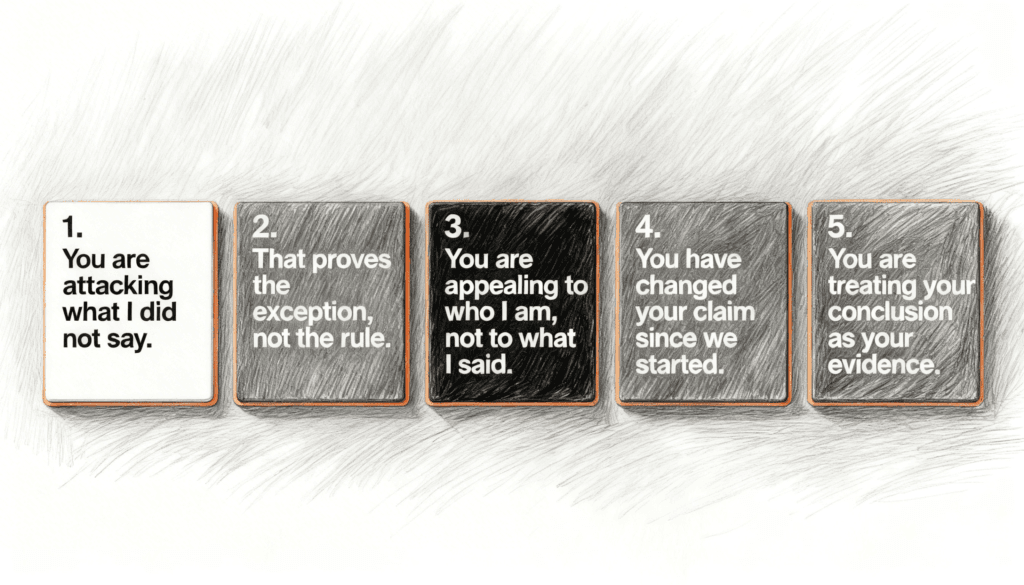
1. “You are attacking what I did not say.”
This is Schopenhauer’s Stratagem Number 1, and he put it first for a reason. It is the most common trick in every argument you will ever have.
Here is how it works. You make a specific, measured claim. Your opponent takes that claim, stretches it into something extreme, and then attacks the exaggerated version. They are no longer arguing against your position. They are arguing against a cartoon of your position. And somehow, to everyone watching, it looks like they are winning.
You say, “I think we should be more careful about how we spend the marketing budget.” They respond with, “So you want to cut all marketing and let the company die?”
Nobody said that. Nobody even hinted at that. But now you are on the defensive, explaining what you did not mean instead of advancing what you did mean. You have been moved from offense to defense without a single legitimate point being scored against you.
Schopenhauer understood that this works because audiences are lazy. Not stupid. Lazy. It is easier to react to a bold, extreme claim than to sit with a nuanced one. Your opponent knows this instinctively, even if they could not articulate it.
The phrase “You are attacking what I did not say” works because it does something rare in arguments. It slows everything down. It forces the conversation back to what was actually stated. It sounds calm, which makes the person who distorted your words look frantic by comparison.
There is a reason trial lawyers are trained to say “Objection: mischaracterizes the testimony.” It is the same move, dressed in a suit.
What makes this phrase particularly effective is that it requires no cleverness from you. You do not need a counter argument. You do not need data. You just need to point at reality and say, “That is not what happened.” The burden shifts entirely to them.
2. “That proves the exception, not the rule.”
Schopenhauer noticed that people love to argue with examples. One example, to be specific. They find a single case that supports their position and present it as though it settles the matter entirely.
Your uncle did this at Thanksgiving. Someone mentions that starting a business is risky, and he brings up Steve Jobs dropping out of college. Case closed. Argument over. Except it is not, because for every Steve Jobs there are ten thousand dropouts whose names nobody will ever know.
This is what Schopenhauer called the trick of using a single instance to establish a universal rule. It sounds convincing because stories are more persuasive than statistics. Our brains are wired for narrative, not probability. One vivid example lights up the mind in ways that a thousand data points never will.
When you say “That proves the exception, not the rule,” you are doing two things at once. First, you are acknowledging their example. You are not dismissing it. This is important because dismissing someone’s evidence, even bad evidence, makes you look arrogant. Second, you are pointing out that a single case cannot carry the weight of a general claim.
This connects to something psychologists discovered much later. Daniel Kahneman and Amos Tversky spent decades showing that humans are terrible at understanding probability because we overweight vivid examples. Schopenhauer did not have their data, but he had their conclusion. He saw that people confuse “it happened once” with “it happens often,” and he knew how to exploit the gap.
The beauty of this phrase is that it does not deny the example. It simply puts it in its proper place. And once an example is in its proper place, it usually looks much smaller than it did a moment ago.
3. “You are appealing to who I am, not to what I said.”
This was one of Schopenhauer’s most damning observations about human nature. When people cannot defeat your argument, they come after you instead.
The technical term is ad hominem, but you do not need Latin to recognize it. It is what happens when someone says, “Well, you are not a scientist, so your opinion on this does not count.” Or, “Easy for you to say, you have never dealt with this.” Or the modern classic, “You are just saying that because of your political bias.”
Notice what has happened. The argument itself has vanished. It has been replaced by a trial of the person making it. And trials of character are much easier to win than trials of logic, because everyone has flaws and everyone has biases. You do not even need to prove the flaw is relevant. You just need to mention it.
Schopenhauer pointed out that this trick is devastatingly effective with audiences. Because once people start thinking about who you are instead of what you said, the argument is functionally over. You could be making the most airtight case in history, and it will not matter if everyone is busy evaluating your credentials or your motives.
The counter phrase works because it names the move explicitly. “You are appealing to who I am, not to what I said.” It forces the conversation back to the actual content. It also carries an implied challenge: if the argument is wrong, show me where it is wrong. Do not tell me why I am the wrong person to make it.
Here is the counter intuitive part. Sometimes the person attacking your character is technically right about you. Maybe you are not a scientist. Maybe you do have a bias. But that does not make your argument wrong. A broken clock is right twice a day, and a biased person can still make a valid point. Schopenhauer knew this. Truth does not care about the resume of the person who speaks it.
4. “You have changed your claim since we started.”
Arguments are slippery. Not because logic is slippery, but because people are.
Schopenhauer documented a move that is so subtle most people never catch it in real time. Your opponent starts with one position. As you challenge that position, they quietly shift it. Not dramatically. Just enough to dodge your strongest points. By the end of the conversation, they are defending something slightly different from what they originally said, but they act as though their position has been consistent the whole time.
It is like trying to nail jelly to a wall. Every time you think you have pinned them down, the claim moves half an inch.
This happens constantly in professional settings. A manager says, “We need to ship this feature by Friday.” You explain why Friday is impossible. The manager then says, “Well, I just meant we need significant progress by Friday.” That was not what they said. But now the original demand has disappeared, and you look unreasonable for pushing back against a much softer request.
Politicians have turned this into an art form. They make a bold prediction, and when it does not come true, they reinterpret their original statement so thoroughly that it becomes unfalsifiable. “I did not mean it literally,” they say, as though everyone who heard them was simply confused.
The phrase “You have changed your claim since we started” is powerful because it introduces accountability into the conversation. It says: words matter, and you do not get to revise them in real time without anyone noticing.
This requires you to actually remember what was said at the beginning. Which is harder than it sounds. In the heat of an argument, most people are so focused on their next response that they forget the opening moves entirely. This is why Schopenhauer’s observation is not just about logic. It is about attention. The person paying closer attention almost always has the advantage.
5. “You are treating your conclusion as your evidence.”
This is perhaps the most elegant trick Schopenhauer exposed, and it is everywhere once you start looking.
Circular reasoning is the act of assuming the very thing you are supposed to be proving. “This company is the best because it produces superior results, and superior results are what the best companies produce.” Sounds impressive. Says nothing.
The reason this trick works is that circles feel complete. When you hear a statement that loops back on itself, your brain registers a kind of closure. It feels like the argument has arrived somewhere, when in reality it has gone nowhere at all. It just walked in a circle and ended up where it started.
Schopenhauer noticed that people disguise circular arguments by using different words for the same concept. They state their conclusion, then restate it in slightly different language and call it evidence. If you are not listening carefully, you miss the loop entirely.
This shows up in debates about taste and quality all the time. “That movie is a masterpiece because it is brilliant filmmaking.” The word masterpiece and the phrase brilliant filmmaking are doing the same job. One is not evidence for the other. They are the same claim wearing different outfits.
When you say “You are treating your conclusion as your evidence,” you are pulling back the curtain on an illusion. And the remarkable thing is that often, the person making the circular argument does not even realize they are doing it. They genuinely believe they have made a case when all they have done is make an assertion twice.
This phrase also works because it is educational rather than aggressive. You are not calling someone a liar. You are pointing out a structural flaw in their reasoning. Most people can hear this without feeling personally attacked, which means the conversation can actually continue productively. And productive continuation is the rarest outcome in any argument.
Why These Phrases Matter Now More Than Ever
Schopenhauer wrote about argument tactics in an era of salon debates and philosophical letters. He could not have imagined social media, cable news, or the comment section under a recipe for banana bread that somehow becomes a political battlefield.
But his observations have aged embarrassingly well. Every trick he documented is not just alive. It is thriving. The platforms we use to communicate are practically engineered to reward the very tactics he warned us about. Exaggeration gets more clicks than nuance. Character attacks generate more engagement than careful reasoning. And circular arguments sound fantastic in a headline.
The five phrases above are not magic spells. They will not make you win every argument. They are not even about winning. They are about something more valuable: clarity.
When you name a trick, it loses its power. The moment you say, “You are attacking what I did not say,” the distortion becomes visible. When you point out that someone has changed their claim, the shift can no longer hide in the flow of conversation. When you identify circular reasoning, the loop breaks.
Schopenhauer was a famously gloomy philosopher. He believed life was suffering, desire was a trap, and happiness was an illusion. But in his work on arguments, there is an odd thread of optimism. He seemed to believe that if people could see the tricks being used on them, they might stop falling for them. That awareness itself was a kind of freedom.
He was probably too optimistic about that. But the phrases still work.
The next time you find yourself losing an argument to someone who is clearly wrong, do not panic. Do not raise your voice. Do not match their tricks with tricks of your own.
Just name what they are doing.
It is the most disarming thing you can possibly say.