Table of Contents
There is a particular kind of advice that sounds wise until you actually try to follow it. “Be yourself.” “Follow your passion.” “Live your best life.” These phrases decorate coffee mugs and Instagram bios, and they cost nothing to repeat. But when a Roman Stoic philosopher who survived exile, political conspiracy, and the mood swings of Emperor Nero says something similar, it tends to carry a different weight. Seneca did not put his philosophy on a mug. He put it in letters written while the empire burned around him.
And what he had to say about the good life was, frankly, insulting to almost everyone who heard it.
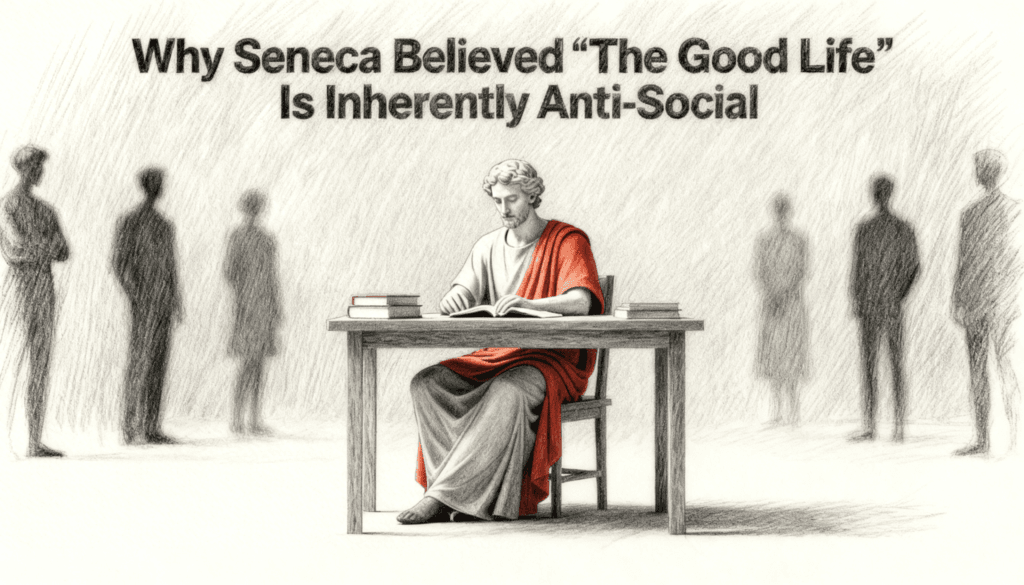
Seneca believed that living well required a strategic withdrawal from the very thing most people spend their entire lives chasing: social approval, social participation, and the endless performance of being a functioning member of society. He did not think the good life was anti-social in the way a teenager slamming a bedroom door is anti-social. His version was more deliberate, more philosophical, and far more uncomfortable. He argued that the crowd is not just distracting. It is actively dangerous to your character. And if you want to live with any kind of moral seriousness, you need to treat social life the way a recovering addict treats an open bar.
The Crowd as a Moral Hazard
Seneca’s seventh letter to Lucilius opens with a line that has no interest in being polite. He tells his friend that he came home from the games worse than when he left. Not physically worse. Morally worse. He had gone to the arena expecting entertainment, maybe even some light philosophical reflection on human nature. Instead, he found himself swept into the bloodlust of the crowd, cheering for violence he would have found repulsive in private.
This was not a minor observation for Seneca. It was evidence of something he considered a universal law of human psychology: people in groups become worse versions of themselves. Not occasionally. Reliably. The crowd does not bring out your best qualities. It drowns them. You walk in with principles and walk out with none, and you do not even notice the exchange happening.
Modern psychology, for what it is worth, agrees with him more than it disagrees. Solomon Asch’s conformity experiments in the 1950s demonstrated that people will deny the evidence of their own eyes to match the opinion of a group. Stanley Milgram showed that ordinary individuals will administer what they believe are painful electric shocks to strangers when an authority figure tells them to. These studies were treated as revelations in the twentieth century. Seneca had already written the field notes two thousand years earlier, without the funding or the lab coat.
What makes Seneca’s position genuinely radical, though, is not just that he noticed groupthink. It is that he considered it reason enough to restructure your entire life. Most people hear “crowds can be bad” and nod politely before heading to the next networking event. Seneca heard it and concluded that the default mode of human social existence is a threat to your soul.
Solitude as a Moral Technology
If the crowd corrupts, then solitude repairs. That was the operating logic. But Seneca was not naive about solitude either. He knew that being alone with a bad mind just gives the bad mind more room to work. In his essay “On Tranquility of Mind,” he warns against the kind of withdrawal that is really just depression wearing a toga. Running away from people because you are miserable is not philosophy. It is avoidance.
The solitude Seneca prescribed was active, not passive. It was supposed to be filled with reading, writing, self-examination, and the kind of ruthless internal honesty that most people reserve for three in the morning after a regrettable decision. He wanted you to audit your own thoughts the way an accountant audits a company suspected of fraud. Every assumption gets questioned. Every inherited belief gets tested. And the results, more often than not, reveal that most of what you think you want was planted there by someone else.
This is where Seneca starts to sound less like a Roman senator and more like a cognitive behavioral therapist. The Stoic practice of examining your impressions, checking whether your emotional reactions are based on reality or on habit, is structurally identical to what modern therapy calls cognitive restructuring. The difference is that Seneca did not charge by the hour and his office had better columns.
But here is the part that makes his position genuinely anti-social, not just introverted. Seneca was not saying you should take a break from people and then return refreshed. He was saying that the default state of social engagement is corruption, and that you should only re-enter social life after you have built enough internal fortification to resist it. Most of us treat socializing as the norm and solitude as the exception. Seneca wanted to flip that ratio entirely.
The Problem with Ambition
One of the sharpest edges of Seneca’s philosophy cuts directly at ambition. Not the quiet ambition of wanting to improve yourself. The loud kind. The kind that requires an audience.
Roman public life in the first century was, in many ways, a preview of modern professional culture. Status was everything. Your reputation was your currency. Political careers were built on public displays of generosity, oratory, and strategic friendship. Seneca participated in all of this. He was a senator, a tutor to Nero, one of the wealthiest men in Rome. And then he wrote letters telling everyone that the entire system was a trap.
The contradiction is obvious, and his critics have never let him forget it. How can the richest philosopher in Rome lecture anyone about the dangers of social ambition? It is a fair question. But Seneca’s answer was more interesting than the accusation. He did not claim to have escaped the trap. He claimed to be describing it from the inside. He was a man who had climbed the ladder and was now reporting back that the view from the top was not worth the climb.
His argument was not that ambition is inherently wrong. It was that socially directed ambition, the kind that depends on other people’s approval and recognition, is a form of voluntary slavery. You hand the keys to your mental state to whoever happens to be watching. If they applaud, you feel good. If they ignore you, you feel worthless. This is not freedom. It is a leash with a longer chain.
There is something almost prophetic about this critique when you apply it to the current era. Social media has turned socially directed ambition into a 24-hour operation. The Roman forum has been replaced by the timeline, and the applause of the crowd has been replaced by metrics that update in real time. Seneca would have looked at a person checking their notifications every three minutes and recognized the condition immediately. He just would have called it something different. He would have called it bondage.
Friendship as the Exception
It would be easy to read Seneca as a misanthrope, but that reading would be wrong. He did not hate people. He was deeply suspicious of what people do to each other in groups, but he considered genuine friendship one of the highest goods a person can experience.
The distinction he drew was between social life and friendship. Social life is broad, noisy, and largely performative. Friendship is narrow, quiet, and demanding. You can have a rich social life and no real friends. You can have one real friend and no social life. Seneca clearly preferred the second arrangement.
His letters to Lucilius are themselves evidence of this. They are not public speeches or crowd-pleasing performances. They are intimate, sometimes rambling, occasionally contradictory conversations between two people trying to figure out how to live. Seneca shares his fears, his failures, his physical ailments. He admits when he does not know something. This is not the behavior of someone who has rejected human connection. It is the behavior of someone who has rejected the counterfeit version of it.
What Seneca demanded from friendship was what he demanded from philosophy itself: honesty severe enough to be useful. A friend who only tells you what you want to hear is not a friend. That person is a mirror that lies. A real friend tells you that your plan is foolish, that your anger is unjustified, that the thing you are chasing is not worth having. This kind of friendship is rare precisely because it is uncomfortable, and most social interaction is designed to avoid discomfort at all costs.
Leisure as a Radical Act
The Romans had a concept called “otium,” which is usually translated as leisure but means something closer to purposeful withdrawal from public duties. Seneca wrote an entire essay defending it, and in doing so, he made an argument that remains counter intuitive today: that doing nothing useful by society’s standards might be the most useful thing you can do.
His reasoning went like this. Public life demands compromise. Every political act, every social obligation, every professional duty requires you to bend your principles at least a little. Over time, these small compromises accumulate until you no longer remember what your principles were in the first place. Withdrawal is not laziness. It is preservation.
This is a genuinely difficult idea for modern readers to accept. We live in a culture that treats busyness as a moral virtue. If you are not productive, you are not valuable. If you are not networking, you are falling behind. The idea that stepping away from all of it might make you a better person, not a less successful one, cuts against nearly everything we are taught from childhood.
But Seneca was not talking about lying on a couch watching the Roman equivalent of reality television. His version of leisure involved constant intellectual work. Reading philosophy. Writing. Studying nature. Reflecting on death, which he considered the ultimate teacher of priorities. He wanted you to be busy, just not busy with the things society considers important. The distinction is everything.
The Paradox of Influence
Here is the part that Seneca himself never fully resolved, and the honesty of that failure is part of what makes him worth reading. If the good life requires withdrawal from social life, then how do you share that insight with anyone? The moment you write a letter, give a lecture, or publish a book arguing for anti-social virtue, you have re-entered the social arena. You are performing for an audience. You are seeking influence.
Seneca was aware of this contradiction. His letters sometimes read like a man arguing with himself about whether the arguing itself is part of the problem. He resolved it, to the extent that he did, by distinguishing between seeking influence and accepting it. He did not go looking for students. Lucilius came to him. He did not write for the public. He wrote for one friend and allowed others to read over their shoulder.
Whether this distinction holds up under pressure is debatable. But the tension itself is instructive. It reveals something true about the relationship between wisdom and communication. The deepest insights about how to live tend to be the ones that resist being shared at scale. They require context, relationship, trust. They lose something essential when they are broadcast. Seneca understood this, which is why his philosophy took the form of letters rather than treatises. He chose the most intimate literary form available to him.
What This Means Now
Seneca is not going to help you optimize your morning routine or build a personal brand. If anything, he would consider most modern self-improvement culture to be exactly the kind of socially driven performance he warned against. The entire concept of “living your best life” in public would have struck him as a contradiction in terms.
What he offers instead is a harder, less marketable proposition. That the good life is quiet. That it requires saying no to most of what the world considers important. That the people who look the happiest in public are often the most enslaved by the need to appear that way. And that the real work of becoming a decent human being happens in private, in the space between you and your own mind, where there is no audience to impress and no reputation to maintain.
This is not comfortable advice. It was not meant to be. Seneca lived under the rule of an emperor who eventually ordered him to kill himself, and he complied with a calmness that suggests he had been preparing for it his entire philosophical life. A man who can face his own death with that kind of composure has probably earned the right to tell you that your dinner party is not as important as you think it is.
The good life, in Seneca’s view, is not something you perform. It is something you practice. And practice, by its nature, happens when nobody is watching.