Table of Contents
You probably believe that when you speak, you are transmitting your thoughts to another person. That words are little vehicles carrying meaning from your mind to theirs. That language is, at its core, a window into what you are thinking.
Willard Van Orman Quine spent most of the twentieth century explaining why that belief is almost entirely wrong.
Quine was an American philosopher and logician who worked at Harvard for decades, publishing work that shook the foundations of how we understand meaning, translation, and the relationship between words and the world. He was not interested in making philosophy feel comfortable. He was interested in making it accurate. And accuracy, as it turned out, was far more unsettling than comfort.
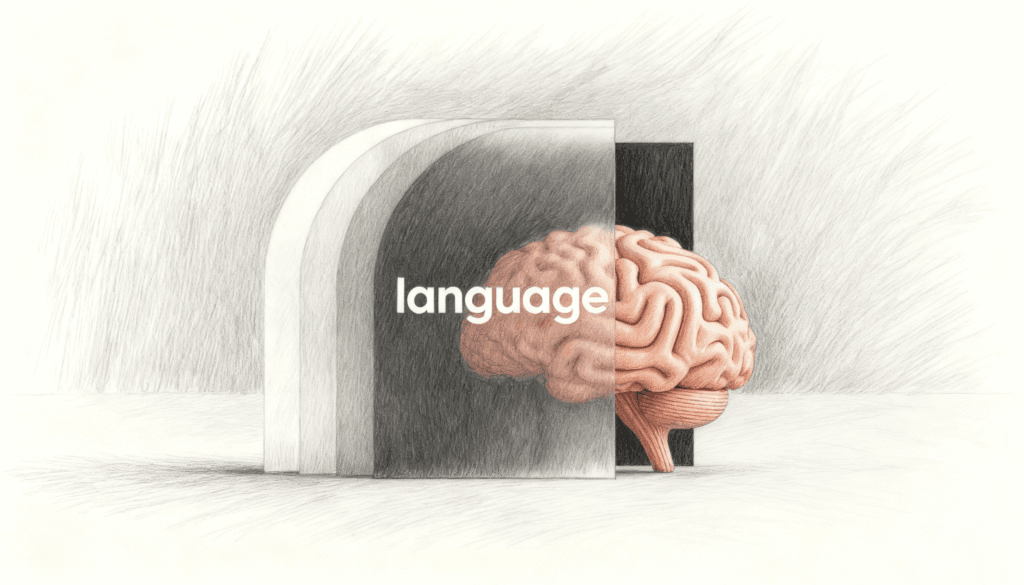
His central provocation was this: language does not reveal our thoughts. It conceals them. Not because we are liars or because words are imprecise, but because the entire machinery of language works in a way that makes transparent communication structurally impossible. The gap between what you think and what your words convey is not a bug in the system. It is the system.
The Myth of the Mental Museum
Most people walk around with what Quine would call a “museum myth” of meaning. The idea goes something like this: inside your head, there is a mental museum. Each word you know is a label attached to an exhibit. When you say “dog,” you are pointing at your internal exhibit of dogness. When your listener hears “dog,” they walk through their own mental museum, find their exhibit of dogness, and now you are both looking at the same thing.
It is a beautiful picture. It is also, according to Quine, nonsense.
The problem is not that we lack inner experiences. The problem is that there is no way to verify that your exhibit and my exhibit are the same thing. We both use the word “dog.” We both point at the same animals in the street. But whether the internal concept attached to that word is identical in your mind and mine is something neither of us can ever confirm. Language gives us the illusion of shared meaning while quietly making shared meaning impossible to prove.
This is not a minor technical complaint. It is a demolition of the most basic assumption we make every time we open our mouths.
Radical Translation and the Linguist in the Jungle
Quine made his case most vividly through a thought experiment he called radical translation. Imagine a linguist who arrives in a completely unknown land. The people there speak a language that has never been documented. There are no dictionaries, no bilingual speakers, no shared cultural references. The linguist must figure out what these people mean from scratch.
One day, a rabbit runs past. A native speaker points and says “gavagai.” The linguist writes down: gavagai equals rabbit.
But does it? Quine pointed out that the native could mean any number of things. Gavagai might mean “rabbit.” It might mean “undetached rabbit parts.” It might mean “temporal stage of a rabbit.” It might mean “dinner is here.” It might refer to a universal rabbit essence that manifests whenever a rabbit appears. All of these interpretations are perfectly consistent with the evidence available.
The linguist can ask more questions, run more tests, observe more situations. But every additional piece of evidence is itself a piece of language that needs interpretation. You cannot escape the circle. You are using language to decode language, and at no point do you ever touch the raw, unmediated thought of the other person.
This is what Quine called the indeterminacy of translation. There is no fact of the matter about what gavagai “really” means. There are only different translation manuals, each internally consistent, each compatible with all the evidence, and each producing different results. The idea that one of them is the “correct” translation is an article of faith, not a conclusion of reason.
You Are the Linguist, and So Is Everyone Else
Here is the part that tends to make people uncomfortable. Quine did not think this problem was limited to exotic field linguistics. He believed it applies to every conversation you have ever had. Including conversations with people who speak the same language as you.
When your friend says “I believe justice matters,” you think you understand what they mean. But what exactly is the content of that belief? What does “justice” refer to in their mental world? What does “matters” feel like from the inside of their experience? You map their words onto your own conceptual framework and assume the fit is close enough. Usually it is. Sometimes it catastrophically is not.
Quine was making a structural point, not a psychological one. He was not saying people are bad at communicating. He was saying that communication, as we idealize it, is a fiction. What we actually do is something more like coordinated behavior. We act as though we understand each other, and most of the time our actions align well enough that nobody notices the gap. But the gap is always there.
Think about how many arguments between couples, coworkers, or nations come down to someone eventually saying, “That is not what I meant.” We treat these as failures of communication. Quine would say they are the norm. The surprise is not that misunderstanding happens. The surprise is that we manage to coordinate as well as we do despite the fact that perfect understanding is a philosophical impossibility.
The Web of Belief
Quine offered another insight that deepens the problem. He argued that no sentence has meaning in isolation. Words and statements get their meaning from their position in an entire web of beliefs. Change one part of the web, and the meaning of every other part shifts.
This idea, sometimes called holism, has a startling implication. When you say “the cat is on the mat,” the meaning of that sentence depends on everything else you believe about cats, mats, spatial relationships, physical objects, and the nature of reality itself. Two people can say the exact same sentence and mean subtly different things, because the webs of belief behind those words are never identical.
Language, in this view, is not a set of labels stuck to the world. It is a vast, interconnected structure where every piece depends on every other piece. And because no two people have the exact same web, no two people ever mean the exact same thing by the same words.
What About Science?
You might think science escapes this trap. Surely scientific language is precise, objective, and free from the indeterminacy that plagues everyday conversation. Quine had thoughts about this too, and they were not reassuring.
In one of his most famous arguments, Quine attacked the distinction between analytic and synthetic statements. Analytic statements are supposed to be true by definition. “All bachelors are unmarried men” is the classic example. Synthetic statements are true because of how the world is. “There is a cat on the mat” can be checked against reality.
Quine argued that this distinction does not hold up. There is no clean line between what is true by definition and what is true by observation. Even supposedly definitional truths depend on a network of background assumptions that are themselves open to revision. If we discovered a culture where a specific form of ceremonial partnership did not count as “marriage” in our sense, the statement about bachelors would suddenly become less clear. Definitions are not fixed anchors. They float on the same sea of interpretation as everything else.
For science, this means that no observation ever conclusively confirms or refutes a single hypothesis in isolation. When an experiment produces unexpected results, you can always adjust some other part of your belief system to accommodate them. The data underdetermines the theory. There are always multiple theories compatible with the same evidence, just as there are always multiple translations compatible with the same linguistic behavior.
This is not an argument against science. Quine was a great admirer of science. But he saw it as our best method, not as a pipeline to absolute truth. Science works not because it gives us the world as it really is, but because it gives us a highly effective way of organizing our experience. The map is extraordinarily useful. But it is still a map, not the territory.
The Uncomfortable Freedom
There is something liberating in all of this, even if it does not feel that way at first. If language does not perfectly capture thought, then we are not prisoners of our vocabularies. The words available to us shape what we can easily express, but they do not determine what we can think. You have almost certainly had the experience of knowing something you could not put into words. Quine gives you philosophical permission to trust that experience. The thought is real. The limitation is in the language, not in you.
This also means that when someone says something you find offensive, confused, or wrong, there is always the possibility that their thought was better than their words. We are all working with imperfect tools. Charitable interpretation is not just a social nicety. It is a philosophically justified response to the structural limitations of human communication.
Of course, charity has limits. Some people are genuinely confused, and some are genuinely dishonest. But Quine would remind us that we can never be entirely sure which case we are dealing with, because we never have direct access to another person’s thoughts. We only have their words, and words are unreliable narrators of the minds that produce them.
Why This Matters Now
We live in an era of unprecedented communication. Billions of messages fly across the planet every day. Social media has turned language into a performance art, where what matters is not what you think but what your words signal to your audience. Political discourse has become a competition to control the meaning of key terms. “Freedom,” “justice,” “rights,” “security” – these words mean radically different things to different people, and entire political movements are built on the assumption that there is one correct meaning.
Quine would have found this predictable but also instructive. The fights over language are not fights over truth. They are fights over which translation manual will dominate. And because there is no fact of the matter about which manual is correct, these fights can never be resolved by appealing to the “real” meaning of words. They can only be resolved, if at all, by negotiation, power, or exhaustion.
This connects to a practical point that anyone who writes for a living already senses intuitively. The best writing does not try to transmit a thought directly. The best writing creates conditions under which the reader constructs a thought of their own that is close enough to the writer’s intention to feel like understanding. Great writers are not transparent. They are strategic. They know that language hides, and they use that hiding to their advantage, guiding the reader through a carefully designed experience rather than dumping raw meaning on the page.
The Thought Behind the Words
Quine died in 2000, but his ideas are more relevant now than they were during his lifetime. In a world saturated with language, his warning is worth remembering: do not confuse fluency with understanding. Do not mistake the smoothness of a sentence for the accuracy of a thought. And do not assume that because someone speaks clearly, they are thinking clearly, or that because someone stumbles over words, they are thinking poorly.
Language is not a window. It is a wall with paintings on it. The paintings are often beautiful, sometimes convincing, occasionally masterful. But they are not the thing on the other side. They are representations, and representations always leave something out.
Every conversation you have is a collaboration between two people who can never fully verify that they are talking about the same thing. Every sentence you read is an invitation to construct meaning, not a delivery of meaning. Every word you speak is an approximation of a thought that your language is not quite equipped to carry.
This is not a tragedy. It is the human condition. And recognizing it, as Quine spent his career trying to show us, is not a reason for despair. It is the beginning of intellectual honesty.