Table of Contents
There is something almost comedic about the fact that one of the most influential thinkers in modern ethics had a nervous breakdown at twenty. John Stuart Mill, the man who would go on to write the definitive text on liberty and reshape how we think about happiness, fell apart before he was old enough to rent a car. And what pulled him out of it was not medication, not rest, not a change of scenery. It was poetry. It was Wordsworth, of all people. The man who wrote about daffodils helped save the architect of utilitarianism.
This is not a small biographical detail. It is the key to understanding everything Mill believed about the human mind, about suffering, and about what we owe ourselves when life becomes unbearable. If Mill were alive today, walking through a world saturated with SSRIs and cognitive behavioral therapy apps and wellness influencers selling gratitude journals, he would have opinions. Strong ones. And the core of those opinions would be this: you cannot medicate your way out of a life that lacks meaning.
The Breakdown That Built a Philosophy
To understand why Mill would reach for Plato before Prozac, you have to understand what happened to him. Mill was, by any modern standard, a child prodigy manufactured in a laboratory. His father, James Mill, decided to raise the perfect utilitarian mind. John Stuart was reading Greek at three, Latin at eight, and political economy by thirteen. He had no childhood in any recognizable sense. He had a curriculum.
By twenty, he had internalized the entire utilitarian project. He could argue it, defend it, extend it. And then one day he asked himself a simple question: if everything you have worked for were achieved, if the reforms you care about all came to pass, would you be happy? The answer, arriving with the force of a quiet catastrophe, was no.
This was not depression in the way a pharmaceutical company might define it. It was not a chemical imbalance. It was a crisis of meaning, and the distinction matters enormously. Mill was not experiencing a malfunction. He was experiencing a revelation. The operating system he had been given, pure Benthamite calculation of pleasure and pain, could not account for the thing he most needed. It had no room for depth.
Pleasure Is Not a Single Currency
Here is where Mill parts company with both his father and with modern psychiatry in one elegant move. Classical utilitarianism, the kind Jeremy Bentham designed, treated pleasure as a single measurable quantity. All pleasures were the same in kind. They only differed in amount. A game of push pin was as good as poetry, provided it produced the same sum of pleasure.
Mill looked at this framework and recognized it as the source of his suffering. A philosophy that cannot tell the difference between the satisfaction of solving a crossword puzzle and the satisfaction of understanding your own mortality is a philosophy that will eventually leave you stranded. So Mill introduced a radical distinction: there are higher pleasures and lower pleasures, and they are different not just in degree but in kind.
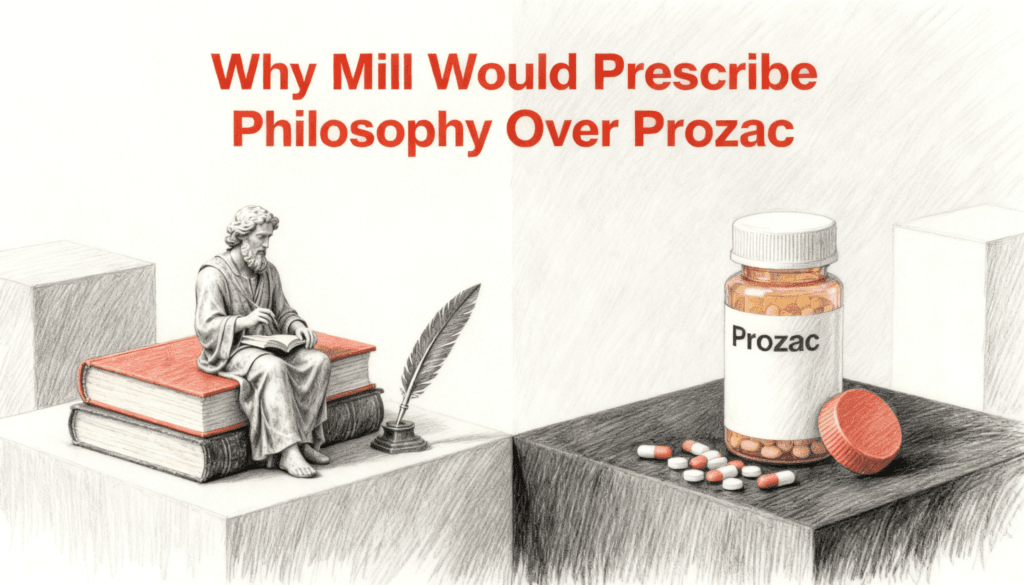
This is the move that would make him suspicious of any solution to human misery that operates only at the level of neurochemistry. Prozac, whatever its genuine medical value, works on the lower machinery. It adjusts serotonin levels. It smooths out the valleys. And for people with clinical depression rooted in genuine neurological dysfunction, this is not trivial. Mill was not a fool and he was not cruel. He would not have told someone in the grip of a biochemical crisis to simply read more Aristotle.
But he would have noticed, with considerable alarm, how quickly we have expanded the territory of that biochemical explanation to cover forms of suffering that are not biochemical at all. The person who feels empty because their work is meaningless, the person who feels anxious because they live in a society that treats them as a unit of productivity, the person who cannot sleep because they sense that something fundamental about their life is misaligned. These people do not have a serotonin problem. They have a philosophy problem.
The Competent Judge
Mill had a brilliant device for settling disputes about which pleasures were higher. He called it the competent judge. A competent judge is someone who has experienced both kinds of pleasure and can therefore compare them from the inside. The person who has known both the pleasure of physical comfort and the pleasure of intellectual discovery is qualified to rank them. And Mill was confident about what that person would say. No one who has tasted both would trade the life of the mind for the life of mere sensation.
This idea has a surprisingly sharp edge when you point it toward modern mental health culture. Consider the implicit promise of pharmacological treatment at its most reductive: we will restore you to a state where you feel fine. Not transformed. Not awakened. Not deepened. Fine. Functional. Able to go back to work and stop troubling anyone.
Mill would find this goal offensively modest. Feeling fine is not the point of being alive. The point, if Mill is right, is to cultivate the capacity for higher pleasures, for experiences that engage the full range of human faculties. Understanding, empathy, aesthetic sensitivity, moral seriousness. These are the things that make a life worth living, and they are also, not coincidentally, the things that make a person more vulnerable to suffering. Mill knew this. He said it plainly. It is better to be Socrates dissatisfied than a fool satisfied. The dissatisfaction is not a bug. It is a feature.
When the Cure Becomes the Disease
There is something deeply Millian about the observation that our current approach to mental health can function as a mechanism of social control, even when no one intends it that way. Mill wrote On Liberty precisely because he understood that societies do not need tyrants to enforce conformity. Social pressure, the weight of collective opinion, the quiet insistence that everyone should feel and behave in roughly the same way, these are enough.
Now consider what happens when an entire culture decides that sadness is a medical condition. The range of acceptable emotional experience narrows. The person who responds to a dehumanizing job with despair is told they have a disorder. The person who cannot find meaning in a consumer economy is offered a pill. The message, never stated so baldly but always implied, is that the problem is inside you. Your brain. Your chemistry. Not the world you live in. Not the ideas you have been given. Not the absence of anything worth believing in.
Mill would recognize this pattern instantly. It is the tyranny of the majority wearing a lab coat. And he would insist, as he always insisted, that the individual has a right to their own suffering when that suffering is telling them something true.
This connects, in a way that might seem unlikely, to what the economist Albert Hirschman called “exit, voice, and loyalty.” When people are unhappy in an organization, they can leave, speak up, or stay quiet and endure. Medicating distress functions as a loyalty mechanism. It keeps people in systems that are failing them by adjusting their internal experience until the system feels tolerable. Mill, the great champion of individual liberty, would have seen this for exactly what it is.
The Examined Life as Treatment
So what would Mill actually prescribe? Not nothing. And certainly not some romantic notion that suffering is inherently noble. Mill was too practical for that, too shaped by his utilitarian inheritance to glorify pain for its own sake. But he would prescribe something that modern mental health culture largely ignores: the serious, sustained, difficult work of thinking about your own life.
Philosophy, in the sense Mill would mean it, is not an academic discipline. It is not something that happens only in seminar rooms. It is the practice of asking yourself what you actually value, why you value it, and whether the life you are living reflects those values. It is the refusal to accept someone else’s answer to the question of what makes a good life. It is, in the deepest sense, the exercise of liberty applied to your own mind.
Mill discovered this during his breakdown. The analytical habits his father had given him were not the disease. They were incomplete tools. When he added poetry, when he added emotional education, when he allowed himself to feel and not merely calculate, the analysis became richer. It became capable of grasping things that pure logic could not reach. He did not abandon reason. He expanded it.
This is exactly the opposite of what happens when you reduce a crisis of meaning to a chemical problem. The reduction does not expand anything. It narrows. It takes the most interesting question a person can ask, why does my life feel wrong, and replaces it with a question that requires no courage at all: which medication works best?
The Counter Argument Mill Would Respect
It would be dishonest to pretend Mill would dismiss modern psychiatry entirely. He would not. Mill was deeply committed to empirical evidence, and the evidence that certain forms of depression have a biological basis is substantial. He would respect the science. He would acknowledge that some people need medication the way a diabetic needs insulin, not as a philosophical choice but as a medical necessity.
But he would draw a line, and he would draw it here: when medication is used not to treat a disease but to avoid a question, it becomes an obstacle to human flourishing. When it substitutes for the hard work of self examination, it makes people smaller. And when an entire society begins to treat existential distress as a pathology, that society has lost something it cannot afford to lose. It has lost the ability to take its own suffering seriously.
Mill understood, from the inside, that the worst kind of misery is the misery of a person who has everything except a reason to care about any of it. That person does not need their brain chemistry adjusted. They need to sit with the discomfort long enough to hear what it is saying. They need, in a word that Mill would not have been embarrassed to use, wisdom.
The Daffodil Paradox
There is a beautiful irony in the fact that Mill, the hyper rational child of hyper rational parents, was rescued by flowers. By Wordsworth’s daffodils, by poetry, by the parts of human experience that cannot be reduced to a formula. It is the kind of irony that makes you suspect the universe has a sense of humor about intellectual projects that try to explain everything.
But the irony has a serious point. Mill learned that the pursuit of happiness defeats itself when it becomes too direct. You cannot aim at happiness and hit it. You can only aim at something else, something meaningful, something difficult, something beautiful, and find that happiness arrives as a side effect. He called this the paradox of hedonism, and it remains one of the most important ideas in the history of moral philosophy.
Prozac, at its best, removes obstacles. It clears the fog so a person can see the road. But it does not tell you where to go. It does not give you a destination. And without a destination, clarity is just a different kind of emptiness.
Mill would tell you to find your daffodils. Not the literal flowers, but the thing that breaks through the deadness and reminds you that you are a creature capable of awe. And then he would tell you to think about why it worked. To analyze it, to understand it, to build a life around the insight. Because feeling is not enough on its own. Thinking is not enough on its own. But together, guided by a genuine concern for what makes a life worth living, they are the closest thing we have to a cure for the particular disease of being human.
That is not a prescription any pharmacy can fill. But Mill would argue, with the quiet confidence of a man who nearly lost everything and thought his way back, that it is the only one that actually works.