Table of Contents
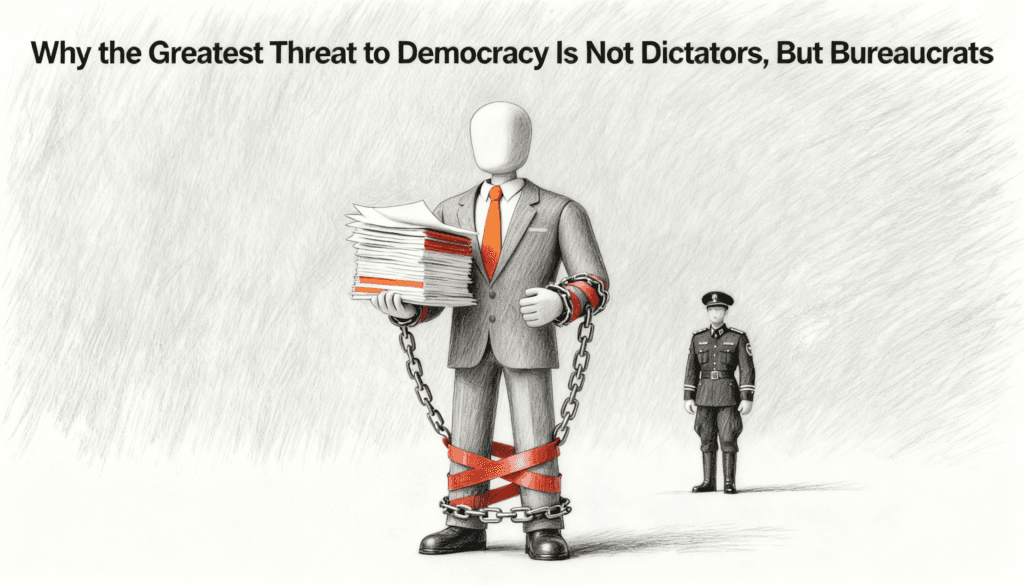
We have been trained to fear the strongman. The dictator in military dress, the demagogue at the podium, the authoritarian who suspends elections and locks up journalists. Every generation gets its cautionary tale. Hitler. Stalin. Mussolini. The lesson seems obvious: democracy dies when a tyrant seizes power.
But what if the real danger is quieter than that? What if democracy does not end with a bang but with a form submitted in triplicate?
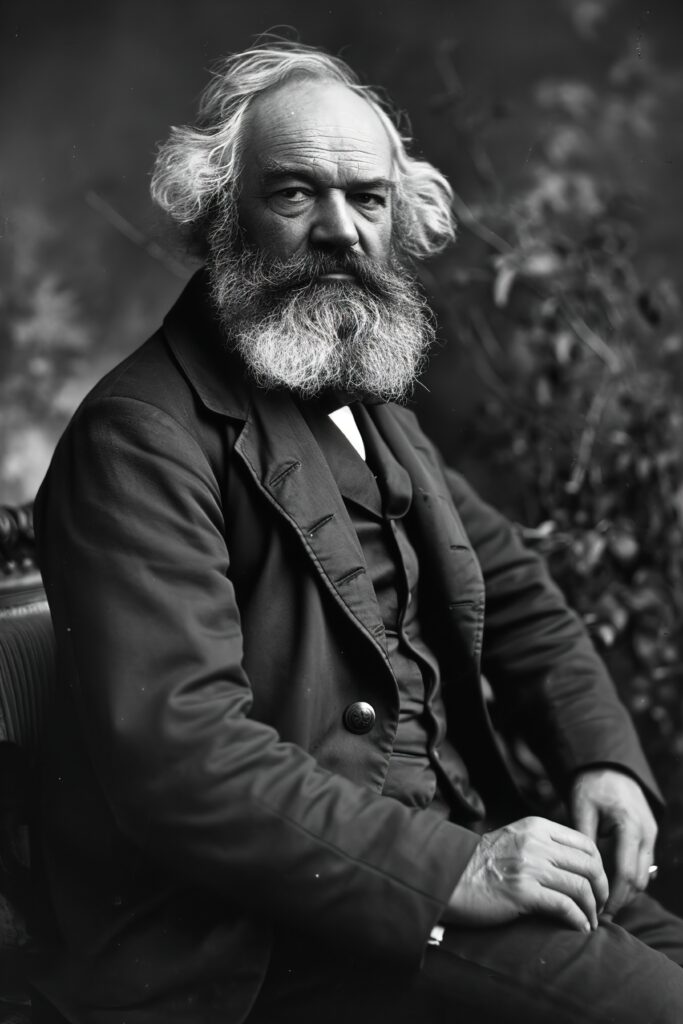
Max Weber might suggest such insight. The German sociologist, writing in the early twentieth century, saw something that most political thinkers missed. He was not worried about revolutionaries storming the gates. He was worried about the gates being replaced by a series of checkpoints, each staffed by someone who is just following protocol. Weber believed the greatest threat to democratic life was not the concentration of political power in a single leader but the creeping, invisible expansion of bureaucratic authority into every corner of human existence.
More than a century later, his warning has aged better than most.
The Iron Cage Nobody Talks About
Weber coined a term that should be more famous than it is: the iron cage. He used it to describe what happens when rational systems of organization, designed for efficiency and fairness, become so dominant that they begin to imprison the very people they were supposed to serve.
Think about that for a moment. The systems we build to make life orderly start to dictate what life can be.
Bureaucracy, in Weber’s view, was the ultimate expression of rationalization. It replaced the arbitrary whims of kings and feudal lords with standardized rules, hierarchies, and procedures. On paper, this was progress. No more decisions based on bloodline or bribes. Instead, everything would be handled through formal channels, by trained officials, according to written guidelines.
The problem is that bureaucracies, once created, develop their own logic. They do not exist to serve the public. They exist to perpetuate themselves. A government agency established to solve a specific problem will, almost without exception, outlive that problem and find new reasons to justify its continued existence. Weber saw this clearly. The bureaucratic machine, once set in motion, is almost impossible to stop.
This is not a conspiracy. It is something far more dangerous. It is a structure.
Why Bureaucrats Are More Durable Than Dictators
Here is something counterintuitive. Dictators are actually fragile. They depend on personal loyalty, military support, and public fear. Remove any one of those pillars and the regime collapses. History is full of dictators who fell. Ceausescu and the Soviet Union dissolved. Strongmen come and go.
Bureaucracies do not.
The tax code survives every administration. Regulatory agencies persist through revolutions. The paperwork endures. Weber understood that bureaucratic power is not personal. It is institutional. And institutional power is far harder to challenge than individual power because there is no single throat to choke, no palace to storm, no face on the poster to tear down.
When a dictator is removed, people celebrate in the streets. When a bureaucratic regulation is removed, another one takes its place by Tuesday.
This is the core of Weber’s warning. Democratic societies congratulate themselves on preventing tyranny while failing to notice that a different kind of domination has taken root. It is not the domination of one person over many. It is the domination of a system over everyone, including the people who run it.
The Specialist Without Spirit
Weber had a phrase for the kind of person that bureaucratic society produces. He called them “specialists without spirit, sensualists without heart.” It is one of the most devastating descriptions of modern humanity ever written.
What he meant was this. When every aspect of life is managed by technical expertise and procedural rules, people stop thinking about meaning. They stop asking whether something should be done and focus only on how to do it efficiently. The bureaucrat does not ask whether a policy is just. The bureaucrat asks whether the correct form has been filed.
This creates a peculiar moral vacuum. Nobody is responsible because everyone is just doing their job. Hannah Arendt later explored this same territory in her work on the banality of evil, observing how ordinary administrators carried out monstrous acts not because they were monsters but because they were obedient functionaries. The paperwork was in order. The procedures were followed. The trains ran on time.
Weber saw this coming decades before Arendt. He recognized that bureaucratic systems do not need cruel people to produce cruel outcomes. They just need compliant ones.
Democracy as a Checkbox
Consider how democratic participation actually works in most modern nations. You vote every few years. You select from a menu of candidates who were filtered through party machinery long before you saw their names. The winner takes office and immediately confronts a permanent bureaucratic apparatus that was there before them and will be there after them.
Elected officials come and go. The civil service remains.
This is not inherently sinister. Continuity in government has real value. You do not want every road project canceled because a new president prefers a different asphalt supplier. But Weber’s point was about the balance of power. When the permanent apparatus becomes more powerful than the elected representatives who are supposed to direct it, democracy becomes a performance. The audience votes. The stage crew runs the show.
In the United States, for example, the federal government employs more than two million civilian workers. Most of them are protected by civil service rules that make them nearly impossible to fire. They write regulations, interpret laws, and make countless discretionary decisions that affect millions of lives. The president, by contrast, gets to appoint about four thousand political positions. Do the math. The elected layer of government is a thin film floating on top of an ocean of permanent administration.
Weber would not have been surprised.
The Efficiency Trap
One of the most seductive aspects of bureaucracy is that it works. At least in the narrow sense. Bureaucratic organization is genuinely efficient at processing large volumes of standardized tasks. It is how you run a postal service, a military, a tax collection system. Weber acknowledged this freely. He called bureaucracy the most rational form of authority.
But here is the trap. Efficiency is not the same thing as freedom. In fact, they are often in tension.
A perfectly efficient society would not need democratic deliberation at all. Debates are messy. Elections are expensive. Public participation slows everything down. If your only metric is getting things done, democracy looks like a design flaw.
This is precisely the logic that bureaucratic thinking promotes. Every problem becomes a technical problem. Every solution becomes a procedural solution. The question is never “what do the people want” but “what does the data suggest” or “what does the regulation require.” The language of expertise quietly replaces the language of citizenship.
You can see this playing out in real time across Western democracies. Decisions that were once made through political debate are increasingly delegated to regulatory agencies, central banks, international bodies, and expert panels. The European Union is perhaps the purest example. It is a bureaucratic structure of extraordinary complexity that makes decisions affecting 450 million people, most of whom could not name a single member of the European Commission. The democratic deficit is not a bug. It is the architecture.
The Strange Alliance of Left and Right
Something interesting happens when you take Weber’s critique seriously. It scrambles the usual political categories.
The political left traditionally favors a strong state that provides services, regulates markets, and protects vulnerable populations. All of this requires bureaucracy. The political right traditionally favors limited government and individual freedom. But in practice, conservative governments have expanded bureaucratic power just as eagerly as progressive ones, especially in areas like defense, law enforcement, and immigration control.
Weber’s warning does not fit neatly into either camp. It suggests that the growth of bureaucratic power is not a left wing or right wing project. It is a structural tendency of modern governance itself, regardless of which party holds office. Every new law creates new administrators. Every crisis justifies new agencies. Every reform adds new layers of oversight.
The left builds welfare bureaucracies. The right builds security bureaucracies. The iron cage gets bigger either way.
This might be the most uncomfortable implication of Weber’s thought. The problem is not bad policy. The problem is the organizational form that all policy now takes.
What Darwin Can Teach Us About Bureaucracy
There is a useful analogy from evolutionary biology. In nature, organisms sometimes develop traits that were originally adaptive but become harmful over time. A peacock’s tail is the classic example. It evolved because it attracted mates. But it also makes the bird slower, more visible to predators, and less able to fly. The trait that once provided an advantage begins to threaten the survival of the species.
Bureaucracy is democracy’s peacock tail. It evolved because it solved real problems. Standardized rules prevented corruption. Formal procedures ensured fairness. Professional civil services replaced patronage systems. These were genuine achievements. But the trait has become so exaggerated that it now threatens the organism that produced it.
We have reached the point where the administrative apparatus designed to implement democratic decisions has become so large and so autonomous that it effectively makes those decisions itself. The tail is wagging the bird.
Can the Cage Be Opened?
Weber was not optimistic. He saw bureaucratization as an irreversible historical process, as inevitable as industrialization or urbanization. Once a society reaches a certain level of complexity, it requires bureaucratic management. And once bureaucratic management is established, it resists all attempts at reduction.
But Weber was writing before the digital revolution. And this is where his analysis, brilliant as it is, might need updating.
Technology has introduced new possibilities for organizing collective action that do not require traditional bureaucratic structures. Blockchain systems can enforce rules without administrators. Open source communities coordinate thousands of contributors without hierarchies. Digital platforms enable direct participation in ways that Weber could not have imagined.
Of course, these alternatives come with their own problems. Silicon Valley’s dream of replacing government with code has produced its own forms of unaccountable power. An algorithm that denies your loan application is not fundamentally different from a bureaucrat who denies your permit. The iron cage can be digital too.
Still, the existence of alternatives matters. Weber’s iron cage felt inescapable because there was no other way to organize a complex society. That assumption is now being tested.
The Warning We Keep Ignoring
The reason Weber’s warning matters today is not that bureaucracy is evil. It is that bureaucracy is invisible. We have entire cultural narratives about the dangers of dictatorship. We have movies, books, monuments, and holidays dedicated to the triumph of freedom over tyranny. We have almost nothing that helps us see the slow, structural erosion of democratic agency by administrative systems.
Nobody makes a blockbuster about a regulatory agency quietly expanding its jurisdiction. There is no villain. There is no dramatic confrontation. There is just a growing pile of rules, each one individually reasonable, that collectively produce a world in which most of the important decisions affecting your life are made by people you did not elect, cannot name, and have no way to remove.
Weber saw this over a hundred years ago. He told us exactly what was coming. We built statues to the people who defeated dictators and ignored the sociologist who warned us about the filing cabinet.
Perhaps that is the final irony. In a world obsessed with dramatic threats to democracy, the most dangerous one is so boring that we cannot bring ourselves to pay attention. The strongman is terrifying. The bureaucrat is just tedious. And that, Weber would say, is precisely why the bureaucrat wins.
The iron cage does not need to lock you in. It just needs to make you forget there was ever anything outside it.