Table of Contents
Marcus Tullius Cicero spent most of his life trying to save the Roman Republic from itself. He watched senators trade principle for popularity. He saw demagogues whip crowds into frenzy with half truths and theatrical outrage. He fought, sometimes brilliantly and sometimes desperately, to preserve a system of governance built on reasoned debate, civic duty, and the slow, unglamorous work of persuasion.
He failed. The Republic fell anyway.
But if you could drag Cicero forward two thousand years and sit him down in front of a smartphone, he would not be confused by what he saw. He would be horrified, certainly. But not confused. Because social media would look familiar to him. It would look like the exact disease that killed the Republic, except now it operates at a scale and speed that would make even Julius Caesar jealous.
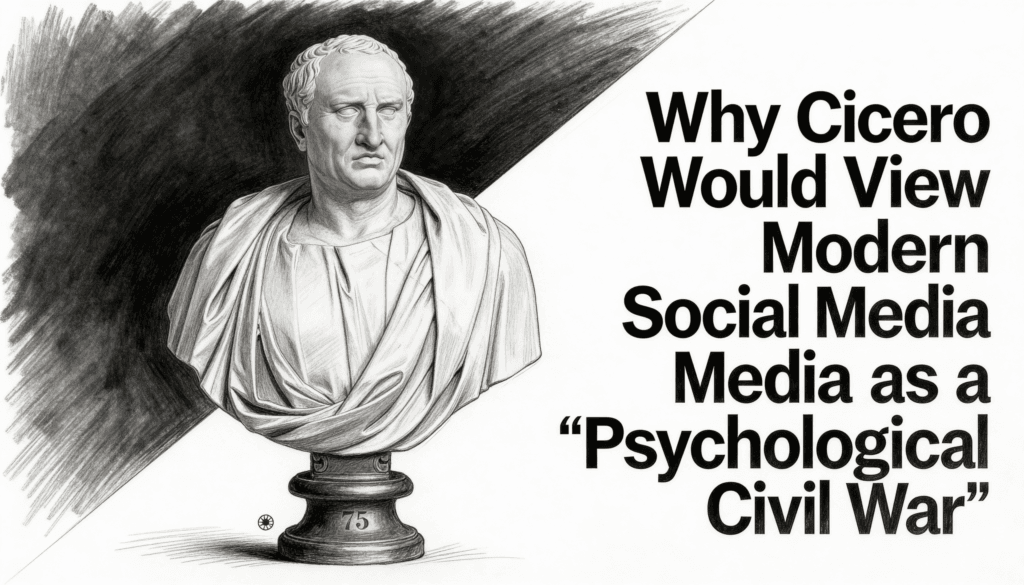
Cicero would not call it a marketplace of ideas. He would call it a psychological civil war. And he would have very specific reasons for saying so.
The Forum Without Walls
To understand how Cicero would see social media, you first need to understand how he saw speech itself. For Cicero, rhetoric was not decoration. It was the central technology of civilization. In his dialogue De Oratore, he argued that the ability to speak well and reason publicly was what separated organized society from barbarism. The forum was not just a place where people talked. It was the mechanism through which a free society governed itself.
But Cicero was no naive optimist about speech. He understood, better than most of his contemporaries, that rhetoric was a weapon. It could build consensus or destroy it. It could reveal truth or bury it under an avalanche of emotional manipulation. The difference between a statesman and a demagogue, in Cicero’s framework, was not talent. Both could be brilliant speakers. The difference was intent and restraint.
Social media is a forum without walls, without moderators in the Roman sense, and most critically, without the social costs that once restrained the worst impulses of public speech. In the Roman Forum, if you lied flagrantly, people remembered your face. Your reputation followed you to every future debate. There was a feedback loop between what you said and who you were.
Online, that feedback loop is shattered. You can say the most inflammatory thing imaginable, watch it spread to millions, and never once look into the eyes of someone it harmed. Cicero would recognize this immediately. He spent years arguing that the health of the Republic depended on dignitas and auctoritas, concepts roughly translating to earned respect and moral authority. These were not abstract ideals. They were social technologies that kept public discourse tethered to accountability.
Strip those away, and you do not get more freedom. You get chaos wearing the mask of freedom.
The Weaponization of Emotion
Cicero was a master of emotional appeal. He knew how to make a jury weep. He knew how to make a crowd roar with indignation. But he also wrote extensively about the ethics of emotional persuasion, and this is where his critique of social media would cut deepest.
In De Officiis, his treatise on moral duty, Cicero drew a sharp line between arousing emotion to illuminate truth and arousing emotion to obscure it. A good orator, he argued, uses pathos to help an audience feel the weight of a genuine injustice. A demagogue uses pathos to bypass rational thought entirely, to make people act before they think, to make them feel so strongly that they mistake the intensity of their feeling for the validity of their position.
Social media platforms are, by design, demagogic machines. Their algorithms do not optimize for truth, nuance, or civic health. They optimize for engagement. And decades of behavioral research have confirmed what Cicero intuited two millennia ago: the fastest route to engagement is emotional provocation. Outrage travels faster than analysis. Contempt spreads more efficiently than understanding. Fear is more clickable than context.
Cicero would see this not as a bug but as a structural feature. The platforms are designed to do exactly what he spent his career warning against. They reward the demagogue and punish the statesman. A thoughtful, carefully reasoned post about tax policy will reach a few hundred people. A furious, misleading post about the same topic will reach millions. The system itself selects for the worst kind of rhetoric.
This is what makes the “civil war” metaphor so precise. In an actual civil war, the goal is not to persuade your opponent. It is to defeat them. Social media increasingly trains people to approach every disagreement as a battle to be won rather than a problem to be solved. Cicero watched this exact dynamic consume Rome. He saw the Senate transform from a deliberative body into a theater of performative hostility, where senators cared more about dominating their rivals than governing well.
The parallels are not subtle.
The Death of Deliberation
Cicero belonged to the Academic Skeptic tradition in philosophy. This did not mean he doubted everything. It meant he believed that wisdom required holding multiple perspectives simultaneously, testing ideas against each other, and maintaining a degree of intellectual humility about complex questions. In his philosophical works, he frequently presented arguments from opposing schools of thought and refused to declare a definitive winner. He thought the process of weighing competing views was itself the point.
Social media does the opposite. It sorts people into camps and then relentlessly reinforces whatever that camp already believes. The algorithmic feed is a confirmation engine. It does not show you what you need to see. It shows you what will keep you scrolling. And what keeps you scrolling is content that validates your existing worldview while demonizing the alternative.
Cicero would find this terrifying, and not for the obvious reasons. The danger is not simply that people become misinformed. The danger is that they lose the cognitive habit of deliberation itself. They forget what it feels like to genuinely consider the possibility that they might be wrong. They lose the muscle memory of changing their mind.
In the Roman Republic, deliberation was institutionalized. The Senate debated. The courts heard opposing arguments. The assemblies voted after public discussion. These institutions were imperfect, sometimes spectacularly so. But they forced citizens and leaders to at least go through the motions of engaging with opposing views. Social media has no such requirement. You can live your entire intellectual life in a space where disagreement has been algorithmically filtered out.
The Paradox of Connection
There is a deep irony here that Cicero, who loved irony, would appreciate. Social media promises connection. It promises to bring people together, to shrink distances, to create community. And in some narrow, specific cases, it delivers on that promise. People do find genuine support, friendship, and belonging online.
But the broader effect is fragmentation. And Cicero would understand why, because he saw the same paradox play out in Rome.
In the late Republic, Rome was more connected than ever before. Roads stretched across the known world. Trade networks linked distant provinces. Information traveled faster than at any previous point in human history. And yet the Republic was tearing itself apart. The same networks that connected people also accelerated the spread of propaganda, conspiracy, and factional hatred.
Cicero wrote about this phenomenon in his letters to Atticus, his closest friend. He observed that the expansion of Rome’s reach had not produced a more unified citizenry. It had produced a more fragmented one, because the same channels that carried commerce and culture also carried grievance and manipulation. The more connected people became, the more efficiently they could organize around their resentments.
Social media replicates this dynamic at a scale Cicero could barely imagine. We are more connected than any civilization in history. We can communicate instantly with billions of people. And we are using that miraculous capacity primarily to sort ourselves into hostile tribes and scream at each other.
This connects to a concept from game theory that Cicero did not have the formal vocabulary for but instinctively grasped: the difference between positive sum and zero sum interactions. Deliberative discourse is positive sum. Both parties can walk away having learned something, having refined their positions, having built mutual understanding. Performative outrage is zero sum at best and often negative sum. One party “wins” the exchange, but the shared epistemic commons that makes productive discourse possible has been degraded for everyone.
Social media, by its structural incentives, converts positive sum interactions into zero sum ones. It takes the naturally cooperative act of communication and turns it into competition.
What Cicero Would Actually Advise
It would be easy to conclude that Cicero would simply tell everyone to log off. But that is too simple, and Cicero was never simple. He was a pragmatist wrapped in the vocabulary of idealism. He understood that you cannot fight structural problems with individual virtue alone.
His actual advice would likely be institutional. In Rome, he fought for the preservation of republican norms, the informal rules and customs that constrained behavior even when laws did not. He believed that the health of a political system depended less on its formal rules and more on the shared commitment of its participants to behave with some minimal degree of good faith.
Applied to social media, Cicero would probably argue that the platforms need something analogous to republican norms. Not censorship, which he would view with suspicion, but structural incentives that reward deliberation over domination. He would want the algorithmic equivalent of the Roman practice of requiring senators to listen to opposing speeches before voting. Some mechanism, built into the architecture of the platforms, that slows down the rush to judgment and creates space for reflection.
Whether this is technically possible is another question. But Cicero would insist that it is necessary. He would point out, with some bitterness, that the Romans had similar debates about whether their republican institutions could be reformed in time to save them. The Republic fell because the forces tearing it apart moved faster than the forces trying to hold it together.
He would see the same race playing out now. The psychological civil war of social media is eroding the habits of mind that democratic self governance requires. The question is whether we can redesign the battlefield before the damage becomes irreversible.
The Warning He Already Gave Us
Near the end of his life, with the Republic crumbling around him, Cicero wrote something that reads like a message addressed directly to the present moment. In De Officiis, he argued that the greatest threat to any free society is not external enemies but the internal decay of civic character. When citizens stop seeing each other as fellow participants in a shared project and start seeing each other as enemies to be defeated, the republic is already dead. The formal collapse is just a matter of time.
Social media did not create this dynamic. Humans have been tribalizing and demonizing each other for as long as we have had language. But social media has industrialized it. It has taken the worst tendencies of human psychology, the ones Cicero spent his career trying to restrain through rhetoric and institutional design, and built a global infrastructure to amplify them.
Cicero would not be surprised by any of this. He would be sad. He would be angry. And he would probably write a very long, very eloquent treatise about it that almost nobody in power would read.
Some things, it turns out, do not change across two thousand years.
The real question is not whether Cicero would view social media as a psychological civil war. He obviously would. The real question is whether we are going to learn from Rome’s example or repeat it. Cicero already gave us the diagnosis.
The treatment plan is up to us.