Table of Contents
You have probably been told, at some point in your life, that you should be well rounded. Read widely. Learn to code and to cook. Pick up a language. Play an instrument. Get comfortable with public speaking. Maybe even start a podcast.
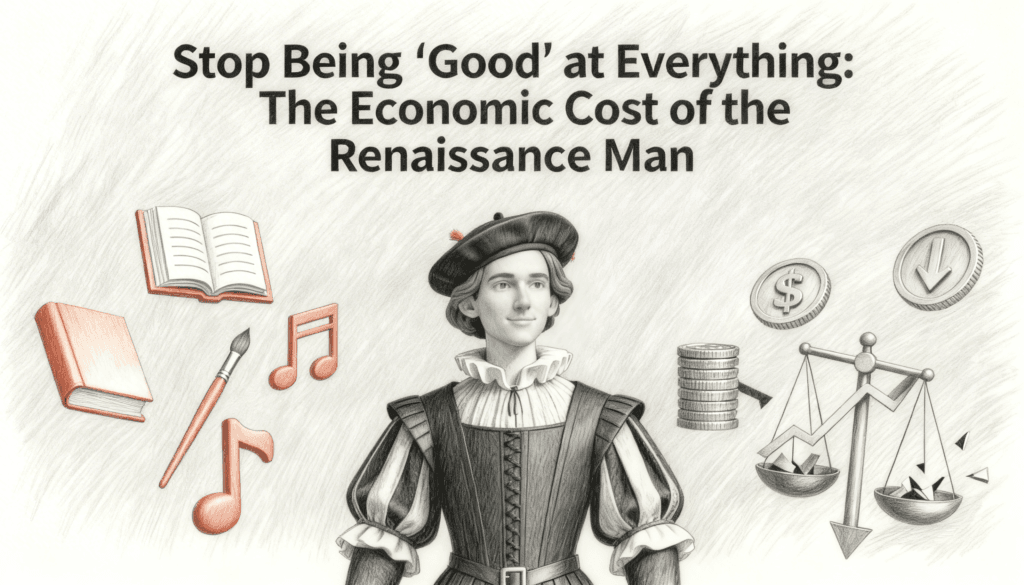
The advice sounds reasonable. It even sounds noble. After all, Leonardo da Vinci painted and engineered and dissected cadavers. Benjamin Franklin invented bifocals and helped invent a country. Surely the path to a remarkable life is to become remarkable at many things.
Here is the problem. You are not Leonardo. And even if you were, the economy you live in does not reward you the way Renaissance Florence rewarded him. The world has changed in a specific, measurable, and ruthless way. A man named David Ricardo explained exactly how, over two hundred years ago. Almost nobody who gives career advice seems to have read him.
The Tailor and the Economist Walk Into a Trade Deal
Ricardo was a British economist working in the early 1800s. He is best known for a concept called comparative advantage, which is one of those ideas that sounds dry until you realize it quietly governs your entire financial life.
The standard textbook example involves two countries. Say England is better than Portugal at making both cloth and wine. England is simply more productive at everything. Common sense says England should make both products and Portugal should sit in the corner and feel bad about itself.
Ricardo said no. What matters is not whether you are better than someone else at a given task. What matters is what you give up by choosing one task over another. England might be twice as good at making cloth but only slightly better at making wine. In that case, England should focus on cloth and let Portugal handle the wine. Both countries end up richer. Not because Portugal is great at making wine in some absolute sense, but because the cost of Portugal making wine, measured in cloth it does not produce, is lower.
This is not intuitive. It asks you to accept that being worse at something can still make it your best option. It asks you to accept that being good at everything is not a strategy. It is a trap.
Now Replace “Countries” With “You”
Ricardo was talking about nations and trade. But the logic does not care about scale. It applies with equal force to a single person making decisions about how to spend Tuesday afternoon.
Every hour you spend getting moderately good at graphic design is an hour you did not spend getting excellent at the thing that earns you the most per unit of effort. Every evening spent learning conversational Japanese, unless you are moving to Tokyo or it genuinely lights you up, is an evening not spent deepening the skill where your returns are highest.
This is not about money alone. Returns can be measured in satisfaction, in impact, in creative output. The point is that your time is finite and everything you do has a cost that is invisible until you learn to look for it. Economists call this opportunity cost. Normal people call it “I do not know where my twenties went.”
The Renaissance Man ideal tells you to spread yourself across many disciplines. Ricardo tells you to ask a harder question: compared to what?
The Myth of the Generalist Premium
There is a popular counterargument. Generalists, we are told, are more creative. They connect dots that specialists cannot see. They are the ones who innovate.
This is partly true and mostly misleading.
Yes, some of the most celebrated thinkers in history were polymaths. But survivorship bias is doing enormous heavy lifting in that sentence. For every Leonardo, there were thousands of reasonably talented people in Renaissance Italy who painted a little, sculpted a little, studied anatomy a little, and left behind exactly zero works that anyone remembers. They were not geniuses spreading their gifts across domains. They were dilettantes spreading their time too thin.
The generalists who succeed tend to have a deep anchor skill. They are T shaped. The vertical bar of the T is a domain where they are genuinely world class, or at least excellent. The horizontal bar is broad familiarity with adjacent fields. Steve Jobs understood technology deeply and had taste in design. He was not moderately good at twelve things. He was exceptional at the intersection of two.
Ricardo would approve. The comparative advantage was clear. The surplus from that advantage funded the breadth.
Why Your Brain Lies to You About This
There is a psychological reason why the Renaissance Man ideal is so seductive, and it has nothing to do with economics. It has to do with ego protection.
Being a generalist means you never have to find out how good you really are at any one thing. If you spread across five disciplines, you can always tell yourself that you would be great at any of them if you just focused. The possibility stays alive. It is Schrödinger’s talent. As long as you never fully commit, you never fully fail.
Specialization, on the other hand, is terrifying. It means closing doors. It means saying “this is the thing I am betting on” and then discovering, perhaps, that you are not as gifted as you hoped. That takes a kind of courage that collecting hobbies does not.
Ricardo did not write about psychology. But his framework implies something uncomfortable. The person who refuses to specialize is not making a bold intellectual choice. They are making an expensive emotional one. And they are paying for it in output they will never produce.
The Cooperation Economy
Here is where Ricardo’s insight gets really interesting when applied to modern life. Comparative advantage is not just about what you should do. It is about what you should let other people do for you.
In Ricardo’s world, England does not need to make its own wine. It trades cloth for wine and ends up with more of both. In your world, you do not need to do your own bookkeeping, build your own website, edit your own videos, or learn to fix your own plumbing. You need to find what you do at the lowest relative cost and then trade, hire, collaborate, or delegate the rest.
The gig economy, for all its problems, is essentially a giant machine for enabling comparative advantage at the individual level. You can hire a specialist for almost any task, often for less than your time is worth if you spent it on your core skill. The person who insists on doing everything themselves is not being resourceful. They are being Ricardo’s nightmare.
This connects to something that the biologist E.O. Wilson observed about ant colonies. No individual ant tries to be good at everything. The colony succeeds because each ant does what it does best, and the system coordinates the rest. Human economies work the same way, except we have the unique disadvantage of reading blog posts that tell us we should all be full stack everything.
The Surprising Cost of Being “Pretty Good”
Let us put some rough numbers on this to make it concrete.
Imagine two people. Person A is a software developer who earns $150 an hour when focused on their best work. They also spend ten hours a week on tasks they are merely competent at: designing marketing materials, managing their own social media, handling invoices. They save maybe $50 an hour by not hiring those tasks out.
Person B is an equally skilled developer who outsources everything that is not core development. They spend those ten hours on additional development work or on getting better at development.
Over a year, Person A “saves” roughly $26,000 by doing everything themselves. But they forgo roughly $78,000 in potential development income. The net cost of being well rounded is $52,000. Per year. Every year. Compounding, because the specialist is also improving faster in their domain.
These numbers are made up, but the structure is real. And it gets worse over time, because skill development has increasing returns. The tenth thousand hours of practice in a domain produce far more value than the first thousand hours in a new one. The generalist is perpetually restarting at the bottom of learning curves. The specialist is perpetually climbing.
When Ricardo Is Wrong
It would be dishonest to present this as a universal law with no exceptions. Ricardo’s model assumes a few things that do not always hold.
First, it assumes you know what your comparative advantage is. Many people, especially young ones, do not. Exploration has real value. You sometimes need to try seven things to discover that the eighth is your thing. The problem is not exploration itself. The problem is never stopping.
Second, it assumes stable conditions. If your specialized skill becomes obsolete (ask typewriter repairmen or Blockbuster Video employees), you are in trouble. Some breadth is genuine insurance against a changing world. The question is how much. Probably less than you think, because the ability to go deep in one domain is itself transferable. A person who has mastered one complex skill knows how to master another. The meta skill of depth is portable even when the specific skill is not.
Third, and this is the most interesting exception, Ricardo’s model does not fully account for the value of creative recombination. Some insights only emerge at the boundaries between fields. The economist who reads evolutionary biology. The musician who studies mathematics. These collisions can produce genuine breakthroughs.
But notice something. Even creative recombination requires depth. You cannot combine two fields you only superficially understand. The insights come from deep knowledge in at least one domain meeting serious engagement with another. Shallow familiarity with eight subjects does not produce breakthrough thinking. It produces cocktail party conversation.
The Practical Upshot
So what does Ricardo’s ghost want you to do with your Monday morning?
First, figure out what you do at the lowest relative opportunity cost. Not what you are best at in some absolute sense. What you are best at relative to everything else you could be doing. This might surprise you. Maybe you are a good writer and a good analyst, but your writing is in the top five percent while your analysis is in the top twenty. Ricardo says write.
Second, get comfortable with being bad at things. Not in a self help “embrace your flaws” way. In a hard economic “it is rational to be terrible at tasks where your comparative advantage is low” way. Being a bad cook who orders takeout while finishing a project is not laziness. It is resource allocation.
Third, stop admiring the Renaissance Man as a career template. Admire Leonardo for what he actually was: a person of extraordinary gifts operating in a pre industrial economy with almost no division of labor. His context is not your context. In a world of eight billion people with broadband connections and same day delivery, the returns to specialization are higher than they have ever been in human history.
Fourth, invest your breadth strategically. Read widely, yes. Be curious, absolutely. But do it to feed your depth, not to replace it. The best specialists are informed by broad reading. They do not abandon specialization because of it.
Ricardo offers a less flattering but more useful frame. You are an economic agent with finite time, finite energy, and a unique profile of relative abilities. The question is not how many things you can be decent at. The question is what you are giving up to maintain that comfortable mediocrity across domains.
The answer, almost always, is more than you think.
The real irony is this. The people we celebrate as Renaissance figures were not trying to be generalists. Leonardo did not wake up thinking “I should be well rounded today.” He followed obsessive curiosity wherever it led, and his depth in drawing, in observation, in mechanical thinking, created a gravitational pull that drew other disciplines toward him. The depth came first. The breadth was a byproduct.
If you want to be a modern Renaissance person, Ricardo’s advice is paradoxically the best path. Go deep. Get so good at one thing that your surplus, in money, in time, in credibility, funds your exploration of everything else. Do not spread yourself thin and call it intellectual range.
Call it what it is. An expensive habit you have not yet done the math on.