Table of Contents
Here is a thought experiment. Imagine two people apply for the same job. One spent four years at a prestigious university, studying economics, pulling all nighters before exams, and graduating with honors. The other spent those same four years reading every economics textbook ever written, taking free online courses from MIT and Stanford, attending public lectures, and building a portfolio of independent research.
Who gets the job?
You already know the answer. And if you sit with that answer long enough, it starts to feel deeply strange.
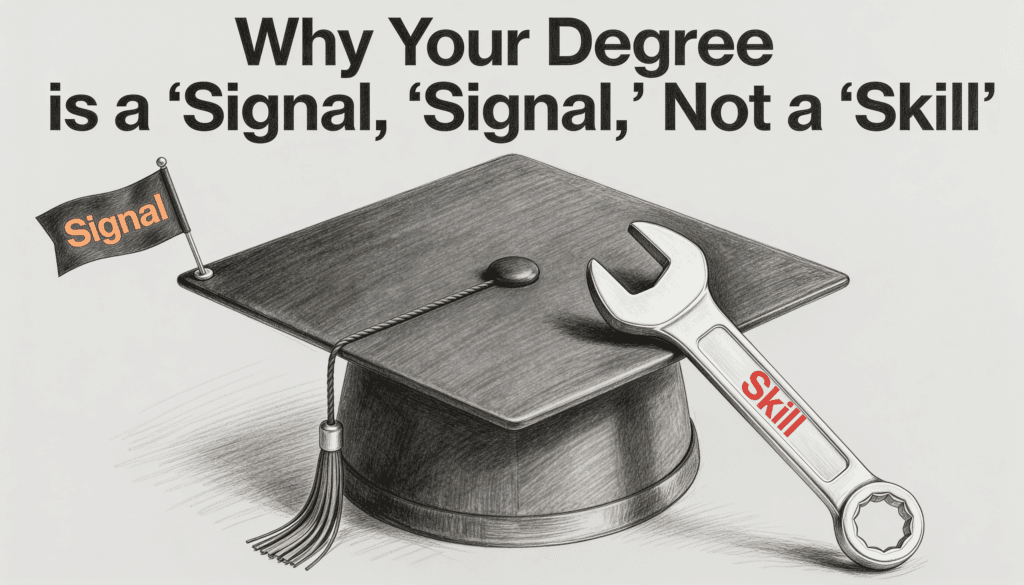
The person with the degree gets the call back. Not because they necessarily know more. Not because they are more competent. But because they have something the other person does not: a credential. A stamp. A signal.
This is the core insight of signaling theory in education, an idea most associated with the economist Gary Becker and later sharpened by Michael Spence. And once you understand it, you will never look at a diploma the same way again.
The Becker Framework: Human Capital and Its Discontents
Gary Becker won the Nobel Prize in Economics in 1992, largely for his work on human capital theory. His argument, in its simplest form, was that education is an investment. You put in time and money. You come out the other side more productive. Employers pay you more because you can do more. Clean, elegant, satisfying.
There is just one problem. The theory works beautifully on paper and gets messy in practice.
Becker was not naive. He understood that education serves multiple functions. But his framework opened a door that other economists walked through with far less optimism. If education is supposed to make you more productive, why do so many graduates end up in jobs that have nothing to do with what they studied? Why does a philosophy major end up in management consulting? Why does a history graduate work in tech sales?
The standard human capital answer is that education teaches you “how to think.” Critical reasoning. Analytical frameworks. Communication skills. And there is some truth to that. But it is also suspiciously convenient. It is the kind of answer that works as a justification for almost anything. You could use the same logic to argue that four years of playing chess would make you a better marketing manager. Maybe it would. But nobody is charging you $200,000 for the privilege.
Enter Signaling: The Peacock’s Tail of the Labor Market
Michael Spence, who won his own Nobel in 2001, formalized what many people had quietly suspected. In his job market signaling model, the degree does not primarily make you more skilled. It tells employers something about you that they cannot easily observe on their own.
Think of it like a peacock’s tail. The tail does not help the peacock fly. It does not help it find food. In purely functional terms, it is a burden. But that is exactly the point. Only a strong, healthy peacock can afford to carry around such an elaborate, impractical appendage. The tail is a signal of underlying fitness precisely because it is costly.
Your degree works the same way.
Getting through four years of university requires a specific combination of traits: intelligence, discipline, the ability to tolerate boredom, conscientiousness, some baseline level of social competence, and enough executive function to navigate bureaucratic systems. These are exactly the traits employers want. But they are hard to measure directly in a job interview. The degree acts as a proxy. It does not prove you have these traits. But it makes it a reasonable bet.
This is why the specific content of your degree often matters less than the fact that you have one. It explains the otherwise baffling observation that English literature majors get hired at investment banks. The bank does not need someone who can analyze Victorian poetry. It needs someone who can demonstrate that they are the kind of person who can grind through difficult, sometimes tedious material for years and come out the other side with a credential to show for it.
The Sheepskin Effect: The Smoking Gun
Perhaps the most compelling piece of evidence for signaling theory is what economists call the “sheepskin effect.” This refers to the observation that completing a degree produces a disproportionate jump in earnings compared to simply attending college for almost the same amount of time without finishing.
Consider two people. One completes 3.5 years of college and drops out. The other finishes four years and gets the diploma. The difference in actual learning between them is minimal. Maybe one extra semester of courses. But the difference in lifetime earnings is enormous.
If education were purely about skill accumulation, you would expect earnings to increase smoothly with each additional year of schooling. Instead, there is a sharp discontinuity at the point of degree completion. The diploma itself, independent of the knowledge behind it, carries massive economic value.
This is signaling in its purest form. The piece of paper matters more than what it represents. And if that does not make you pause and think about the system we have built, nothing will.
The Game Theory Underneath
There is a game theoretic dimension to signaling that makes the whole situation even more interesting. Signaling works because it is costly. But notice who bears the cost.
In a signaling equilibrium, talented people invest in expensive signals to distinguish themselves from less talented people. But the system only works if the signal is too costly for the less talented to fake. This means that the cost of the signal must be calibrated to be a genuine burden. If college were free and easy, it would stop functioning as a signal.
This creates a perverse incentive. The system actually benefits from being expensive and somewhat grueling. Making education cheaper and more accessible is wonderful from a social justice perspective, but it potentially undermines the signaling value of the degree. This is one of those places where individual rationality and collective welfare point in opposite directions, a hallmark of game theoretic dilemmas.
It is similar to what happens in an arms race. Each individual actor is behaving rationally by investing more in signals. But collectively, everyone would be better off if they could agree to stop escalating. The problem is that no one wants to be the first to disarm.
What This Means for You
If you are a student or recent graduate, this analysis might feel discouraging. You spent years and possibly took on significant debt to acquire a signal? That feels like a raw deal.
But understanding the signal is actually empowering. It changes how you think about your education and your career.
First, it means you should stop feeling guilty about not remembering everything you learned in college. You were never really supposed to. The knowledge was the vehicle. The signal was the destination.
Second, it means that if you are going to play the signaling game, you should play it strategically. The prestige of the institution matters more than your specific GPA in most fields. The name on the diploma is itself a signal within a signal. This is unfair. It is also true.
Third, it opens up the possibility of finding alternative signals. In the tech industry, this is already happening. Portfolio projects, open source contributions, coding bootcamps, and demonstrable skills are increasingly accepted as substitutes for traditional degrees. The degree is the dominant signal, but it is not the only one. And in a world where credential inflation is making traditional degrees less distinctive, finding alternative ways to signal your abilities becomes increasingly valuable.
Where This Leaves Us
Gary Becker gave us the framework to think about education as an economic decision. Spence showed us that the returns to that decision might come from a different place than we assumed. And the tension between their views is not just academic. It has real implications for how we structure education, how we hire, and how we think about merit and opportunity.
The honest answer is that education is both signal and skill, in proportions that vary wildly depending on context. But the signaling component is almost certainly larger than most people are comfortable admitting. And until we reckon with that honestly, we will continue to build a system that is simultaneously one of the greatest achievements of modern civilization and one of its most elaborate and expensive sorting mechanisms.
Your degree told your employer something about you. Whether it also taught you something is a separate question entirely. And the distance between those two truths is where a lot of wasted money, wasted time, and wasted potential lives.
The peacock does not choose its tail. But you chose your degree. The question is whether you understood what you were really buying.