Table of Contents
Most people misunderstand strength. They think the goal is to become stronger than whatever stands in their way. Lift more. Push harder. Outmuscle the obstacle. Miyamoto Musashi, the most legendary swordsman in Japanese history, thought this was a fine way to die young.
Musashi won over sixty duels before the age of thirty. He killed trained warriors, armed soldiers, and entire schools of swordsmanship. He did not do this by being the strongest person in every room he walked into. He did it by making strength irrelevant when it belonged to someone else, and devastating when it belonged to him.
The principle is deceptively simple. When your opponent is powerful, do not meet that power head on. Redirect it. Let it become the very thing that defeats them. This idea did not originate with Musashi alone. It echoes through judo, through aikido, through centuries of strategic thinking. But Musashi articulated it with a clarity that still cuts.
And it applies to far more than sword fights.
The Trap of Opposing Force With Force
There is a deep human instinct to respond to pressure with equal and opposite pressure. Someone pushes you, you push back. A competitor lowers their prices, you lower yours further. A critic attacks your position, you fortify it with louder arguments. It feels strong. It feels like the right thing to do.
It is often the worst thing you can do.
Musashi understood something about direct opposition that most people learn too late. When you meet force with force, you are playing on your opponent’s terms. You have accepted their framing of the conflict. You are now in a contest of raw power, and in a contest of raw power, the stronger party wins by definition. If that is you, congratulations. If it is not, you have just volunteered for your own defeat.
This is why small businesses that try to outspend large corporations on advertising tend to go bankrupt. It is why amateur boxers who try to trade punches with heavier opponents tend to be outmuscled. The instinct to match force is natural. It is also, in many situations, suicidal.
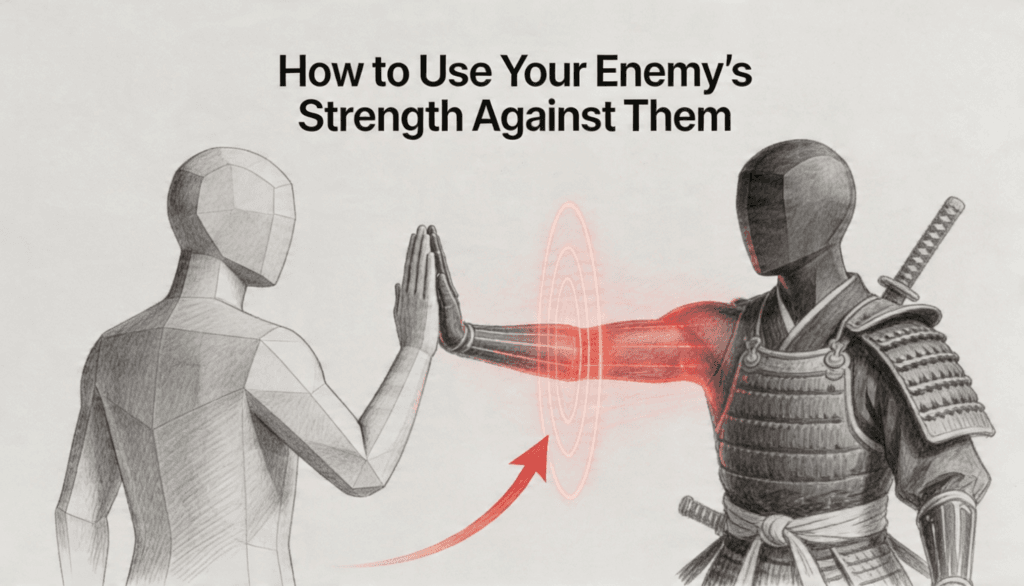
Musashi’s alternative was not passivity. He was not suggesting you lie down and accept being overpowered. He was suggesting something far more dangerous to the opponent. Use the energy they are already generating. Turn their momentum into your weapon.
The Duel at Ganryu Island
The most famous example from Musashi’s life is his duel with Sasaki Kojiro on Ganryu Island in 1612. Kojiro was considered one of the finest swordsmen alive. He was known for a signature technique called the “Swallow Cut,” a devastatingly fast downward strike named after the motion of a swallow’s tail in flight. His sword was unusually long, giving him superior reach. In a straightforward contest of technique against technique, Kojiro had every advantage.
Musashi arrived late. Hours late. This was deliberate.
Kojiro stood on the beach, waiting, his frustration building with every passing minute. By the time Musashi finally rowed to shore, Kojiro was emotionally compromised. His greatest strength, that precise and disciplined technique, was now wrapped in anger. Anger makes you faster but less accurate. It makes you commit to strikes you should not commit to.
Musashi had carved a wooden sword from a spare oar during the boat ride over. When Kojiro attacked with his famous Swallow Cut, Musashi did not try to match the speed of the strike. He stepped into the arc of the swing at an angle where Kojiro’s extra reach became a liability rather than an advantage. The longer sword overshot. Musashi’s wooden blade found its target.
Kojiro died on that beach. His greatest strengths, the long sword, the fast technique, the aggressive commitment, were exactly what killed him. Musashi did not defeat those strengths. He simply rearranged the situation so those strengths would do his work for him.
Strength as a Structural Weakness
Here is the counterintuitive truth that Musashi built his entire philosophy around. Every strength contains the seed of a corresponding weakness. Not sometimes. Always.
A person who is physically powerful has committed to a frame that requires physical engagement. Remove that engagement and their power has nothing to act on. A company that dominates through massive scale is inherently slow to change direction. A debater who overwhelms with data is vulnerable to a simple question that reframes the entire discussion.
Musashi wrote in The Book of Five Rings that you must study the strengths of your opponent not to admire them, but to understand the shape of the vulnerability they create. Strength is never neutral. It always points somewhere. And where it points, it cannot simultaneously defend.
The Principle of the Void
In The Book of Five Rings, Musashi dedicated an entire section to what he called the Book of the Void. This is perhaps the most misunderstood part of his writing. People read “void” and think he was getting mystical, going soft, drifting into vague philosophy. He was not.
The void, for Musashi, was the space where your opponent’s strength does not exist. It is the gap in their posture. The timing they cannot cover. The angle their weapon cannot reach at the speed required. Every strong position creates a void, and the void is where you win.
Think of it this way. A fortress with walls thirty feet high and ten feet thick is enormously strong from the front. But that strength requires resources. Stone, labor, attention. The resources committed to the front wall are resources not committed somewhere else. The void is the back door that was left unfinished because all the budget went to the impressive front gate.
Musashi did not charge the front gate. He spent his career finding back doors.
This is why he frequently used unusual weapons, unconventional timing, and psychological disruption. Not because he enjoyed being theatrical, but because these approaches let him fight in the void, in the spaces where his opponent’s considerable strengths simply could not operate.
Why Strong Opponents Beat Themselves
There is a pattern that repeats across every competitive domain. The most dangerous opponents are rarely defeated from the outside. They defeat themselves.
Musashi understood this with the calm precision of a surgeon. A strong opponent has invested heavily in their strength. They have trained it, refined it, built their identity around it. This investment creates attachment. And attachment, in a fight, is a leash.
When Kojiro stood on that beach, he was not just holding a long sword. He was holding years of reputation, thousands of hours of practice with that specific weapon, and an identity as the master of the Swallow Cut. He could not abandon any of that. He could not suddenly decide to fight in a way that negated his own expertise. His strength had become a cage.
Musashi simply had to find the shape of the cage and position himself outside of it.
This principle is visible in business strategy to an almost eerie degree. Kodak invented digital photography but could not adopt it because their strength, film processing, would be destroyed by the transition. Blockbuster could not embrace streaming because their strength was a network of physical stores. Nokia could not pivot to smartphones because their strength was in hardware engineering and they could not reimagine themselves as a software company quickly enough.
In each case, the organization’s greatest strength became the structural reason they could not adapt. They did not need an external enemy to destroy them. Their own strength handled it. All the competition had to do was step into the void.
Applying This to Your Own Conflicts
So how do you actually use this? Most of us are not fighting duels with swords. But the principle translates into any situation where you face a stronger opposing force.
First, stop admiring the strength. Most people spend far too long being impressed or intimidated by what their opponent can do. Musashi would consider this a waste of time. Instead, study the shape of the strength. What does it require? What does it commit them to? Where does it leave them exposed?
Second, refuse to engage on terms that favor the strength. If your competitor is bigger, do not try to be bigger. If your opponent is faster, do not try to be faster. Find the dimension where their advantage does not apply. Speed does not help in a contest of patience. Size does not help in a contest of precision. Resources do not help in a contest of creativity.
Third, create conditions that turn the strength into a liability. This is the part that requires genuine strategic thinking. Musashi did not just avoid Kojiro’s long sword. He created a specific situation, the late arrival, the emotional provocation, the angle of approach, where the long sword became a disadvantage. The strength was not merely neutralized. It was inverted.
Fourth, move when the opponent is committed. Musashi wrote extensively about timing, about attacking at the moment when your opponent has committed to a course of action and cannot reverse. This is the moment of maximum vulnerability for a strong opponent, because the stronger the action they have committed to, the harder it is to redirect.
The Patience Problem
There is a catch. This approach requires patience, and patience is something most people are spectacularly bad at.
Meeting force with force is fast. It is decisive. It provides immediate emotional satisfaction. Studying your opponent, finding the void, creating conditions that invert their strength, none of this feels heroic. It feels like waiting. It feels like losing, right up until the moment you win.
Musashi was reportedly a mess of a human being. He rarely bathed. He wandered Japan without stable housing for most of his life. He was not living a glamorous existence. But he was alive, which is more than could be said for the sixty or so opponents who chose to fight him directly.
The willingness to look like you are doing nothing while you are actually doing everything is perhaps the hardest part of this strategy. It requires ego suppression on a level that most people cannot sustain. You have to be comfortable being underestimated. You have to be comfortable being mocked for not fighting back in the way people expect. You have to trust the process while everyone around you thinks you are losing.
Then, when the moment arrives, you have to act with absolute commitment. Musashi was not patient in the way a passive person is patient. He was patient the way a predator is patient. There is a significant difference.
The Deeper Lesson
Musashi died in 1645, alone in a cave, having spent his final years writing and painting. He had won every fight that mattered. But the deeper lesson of his life was not about fighting at all.
The real insight is about the nature of strength itself. We live in a culture that worships strength in its most obvious forms. Power, speed, size, resources, volume. Musashi spent his life demonstrating that obvious strength is the most exploitable kind. The thing everyone can see is the thing everyone can plan around.
True advantage comes from understanding the relationship between strength and weakness, from seeing that they are not opposites but two expressions of the same commitment. Every time you pour energy into one capability, you are necessarily withdrawing it from another. This is not a flaw in the universe. It is the structure of the universe.
The person who understands this will never be truly overpowered, because they will never accept the framing that makes overpowering possible. They will slip the angle, find the void, and let the opponent’s own momentum write the ending.
Musashi put it plainly in The Book of Five Rings. Do not attempt to oppose the strength of your enemy directly. Find the rhythm of your opponent, and break it.
Sixty opponents learned this lesson the hard way. You can learn it from reading about them instead. That alone should tell you something about the value of indirect strategy.