Table of Contents
Once, Gary Becker was running late to a student’s oral exam. He needed to park. The legal lot was far away. The illegal spot was right there. So he did what any rational person might do. He weighed the fine, the probability of getting caught, and the time he would save. Then he parked illegally.
Most people would call this a mundane moment. Becker turned it into one of the most influential economic papers of the twentieth century.
His argument was deceptively simple. Criminals are not irrational monsters. They are not possessed by evil or broken by society in ways that place them beyond understanding. They are decision makers. They weigh costs and benefits, just like everyone else. The only difference is that they looked at the math and decided crime was worth it.
This idea made a lot of people uncomfortable in 1968. It still does today.
The Parking Lot Theory of Crime
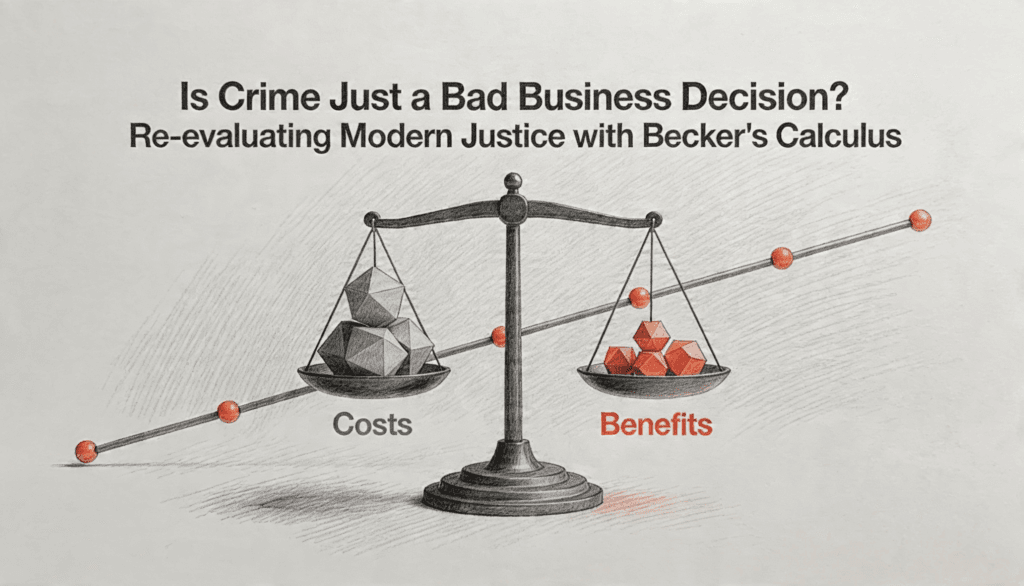
Becker’s framework, laid out in his paper “Crime and Punishment: An Economic Approach,” treats illegal activity the way an economist treats any other market behavior. A potential criminal faces a decision. On one side sits the expected gain from the crime. On the other side sit the expected costs: the probability of getting caught, the severity of the punishment, and whatever legitimate income they are giving up by choosing the illegal path.
If the expected gain outweighs the expected cost, the rational actor commits the crime. If it does not, they walk away.
This is not complicated. That is precisely what makes it so powerful and so disturbing.
Think about it through the lens of a corporate executive considering tax fraud. The savings might be two million dollars. The chance of an audit catching the specific scheme might be five percent. The penalty, if caught, might be a fine of five hundred thousand dollars and a small probability of prison time. Run those numbers and the expected cost of the crime is remarkably low compared to the payoff. Under Becker’s model, the surprising thing is not that some executives cheat. It is that more of them do not.
Now apply the same logic to a teenager in a neighborhood with forty percent unemployment, failing schools, and a drug market that pays better than any job within walking distance. Becker’s calculus does not excuse this teenager. But it does explain him. And explanation, uncomfortable as it may be, is where good policy begins.
When Morality Meets a Spreadsheet
The immediate objection to Becker’s framework is obvious. People do not actually sit down with a calculator before deciding whether to steal a car. Crime is emotional, impulsive, desperate. It is driven by rage, addiction, hopelessness, peer pressure, and a hundred other factors that have nothing to do with rational calculation.
This is true. And Becker knew it was true. He was not claiming that every mugger runs a cost benefit analysis in the alley. He was claiming something more subtle. In aggregate, across large populations, criminal behavior responds to incentives as if people were doing these calculations. Raise the cost of crime and you get less of it. Lower the cost and you get more.
The data has largely supported him. Studies consistently show that increases in policing (which raise the probability of getting caught) reduce crime. Longer sentences (which raise the severity of punishment) have a weaker but still measurable effect. And improvements in legitimate economic opportunities (which raise the opportunity cost of crime) have perhaps the strongest effect of all.
That last finding is the one that deserves the most attention and receives the least.
The Price of Punishment
If crime is a market, then the criminal justice system is essentially a pricing mechanism. It sets the “price” of committing various offenses through some combination of detection probability and punishment severity. Becker’s insight was that society should choose the combination that minimizes the total social cost, which includes not just the damage done by crime, but also the cost of enforcement, courts, prisons, and the lost productive capacity of people we lock up.
This is where things get genuinely interesting.
Consider two approaches to deterring theft. Option one: catch fifty percent of thieves and fine them moderately. Option two: catch ten percent of thieves and punish them severely. Under certain conditions, both approaches can produce the same level of deterrence. But their costs are wildly different. Heavy policing is expensive. Prisons are staggeringly expensive. The United States spends roughly eighty billion dollars a year on incarceration. That is more than the GDP of most countries.
Becker himself leaned toward using fines over imprisonment where possible. His reasoning was purely economic. A fine transfers money from the criminal to the state. It is a wash in terms of total social resources. Imprisonment, on the other hand, destroys resources. The prisoner cannot work. The state must pay to house and feed them. Their families lose income. Their children grow up without a parent. Everyone loses.
This is one of those ideas that sounds cold when you first hear it but looks increasingly wise the longer you sit with it.
The Inconvenient Math of Mass Incarceration
The United States provides a fascinating, if grim, natural experiment in Becker’s framework. Over the past five decades, America has invested massively in one side of the equation: punishment severity. The prison population grew from around three hundred thousand in 1970 to over two million by the early 2020s.
If Becker’s model worked in a simplistic way, this should have eliminated crime. It did not. Crime rates did fall significantly from their peaks in the early 1990s.
What mass incarceration did accomplish was something Becker’s original model somewhat underweighted. It created a self reinforcing cycle. People who go to prison come out with diminished economic prospects. Their legitimate earning potential drops. Under the model’s own logic, this means the opportunity cost of future crime drops too. So the system designed to deter crime can, past a certain point, actually make crime more attractive for those it has already processed.
This is the dark irony at the center of America’s criminal justice system. It tried to raise the price of crime so high that nobody would buy. Instead, it created a class of people for whom the legal economy was barely an option.
What Becker Missed (Or Chose to Ignore)
No framework is perfect, and Becker’s has genuine blind spots. The most significant is the assumption that people have reasonably accurate information about the costs and benefits they face.
In reality, most criminals dramatically overestimate their chances of getting away with it and dramatically underestimate the severity of consequences. Young men in particular display what psychologists call optimism bias. They know, in the abstract, that people get caught. They simply do not believe it will happen to them. This is, incidentally, the same cognitive bias that leads people to text while driving, skip health insurance, and invest their retirement savings in cryptocurrency. Crime is not unique in this regard.
Becker’s model also struggles with crimes of passion, crimes committed under the influence of substances, and crimes driven by mental illness. These categories represent a significant portion of actual criminal behavior, and they do not respond neatly to incentive structures. You cannot deter a man in a psychotic episode by threatening him with a longer sentence. He is not reading the price tag.
There is also the problem of discount rates. Becker’s framework assumes people weigh future costs appropriately against present benefits. But human beings are notoriously bad at this. A hundred dollars today feels more valuable than two hundred dollars next year. For someone living in poverty, this effect is amplified. When you are not sure where dinner is coming from tonight, the threat of prison five years from now is abstract to the point of irrelevance.
The Behavioral Economics Correction
Interestingly, the field that Becker helped inspire has since produced some of the sharpest critiques of his model. Behavioral economists like Daniel Kahneman and Richard Thaler showed that human decision making is riddled with systematic biases that classic rational choice theory misses.
People are loss averse. They fear losing what they have more than they value gaining something new. This means the framing of criminal justice matters enormously. A policy that threatens to take away existing benefits may deter crime more effectively than one that threatens to add punishment. The psychology is different even if the math is the same.
People also respond to social norms more than to formal rules. In neighborhoods where crime is common and normalized, the social cost of criminal behavior is low. No one loses status for having a record when everyone has a record. This is something Becker’s framework captures poorly, because it treats each individual’s decision as independent when it is, in fact, deeply embedded in a social context.
Crime as a Labor Market Problem
Perhaps the most productive way to read Becker today is not as a theory of punishment, but as a theory of alternatives. His model quietly contains an argument that the most effective crime reduction strategy is not better policing or harsher sentences. It is better jobs.
When legitimate opportunities pay well and are accessible, the opportunity cost of crime rises. When the legal economy offers dignity, stability, and a path forward, the calculus shifts. This is not sentimentality. This is the cold logic of Becker’s own framework taken to its honest conclusion.
There is a parallel here to how companies think about employee retention. A business does not primarily retain talent by threatening people who leave. It retains talent by making the current job better than the alternatives. The criminal justice system, by contrast, has spent decades focused almost exclusively on making the “competing offer” of crime less attractive through punishment while doing relatively little to improve the “current offer” of legal life.
The result is about as effective as a company that responds to high turnover by putting locks on the doors instead of raising salaries.
What Would Becker Do?
If we took Becker’s framework seriously, what would a criminal justice system actually look like?
First, it would invest heavily in detection rather than severity. Research consistently shows that the certainty of being caught deters crime far more effectively than the harshness of the sentence. A system where most crimes are solved but punishments are moderate would outperform a system where few crimes are solved but punishments are extreme. Most countries already know this intuitively. The United States has spent decades ignoring it.
Second, it would use fines and restitution instead of incarceration wherever possible. This preserves the deterrent effect while avoiding the enormous social cost of removing productive people from the economy.
Third, and most importantly, it would invest massively in the legitimate side of the equation. Education, job training, economic development in underserved communities. Not because these are nice things to do, but because they are the most cost effective crime reduction tools available.
Becker’s genius was in showing that crime is not a mystery to be moralized about. It is a problem to be solved. And like most problems, it responds better to smart engineering than to righteous anger.
The Uncomfortable Bottom Line
Gary Becker did not set out to excuse criminals or to dismiss the suffering of victims. He set out to understand why crime happens and what, practically, can be done about it. His answer was that crime is, at its root, a response to incentives. Change the incentives and you change the behavior.
This is unsatisfying to people who want crime to be about good and evil. It is unsatisfying to politicians who want to appear tough. It is unsatisfying to anyone who believes that punishment is an end in itself rather than a means to an end.
But Becker was not in the business of satisfaction. He was in the business of results. And more than fifty years after that illegal parking decision, his framework remains one of the most useful tools we have for thinking clearly about a problem that most people would rather feel strongly about instead.
The question was never whether criminals are rational. The question is whether our response to them is.