Table of Contents
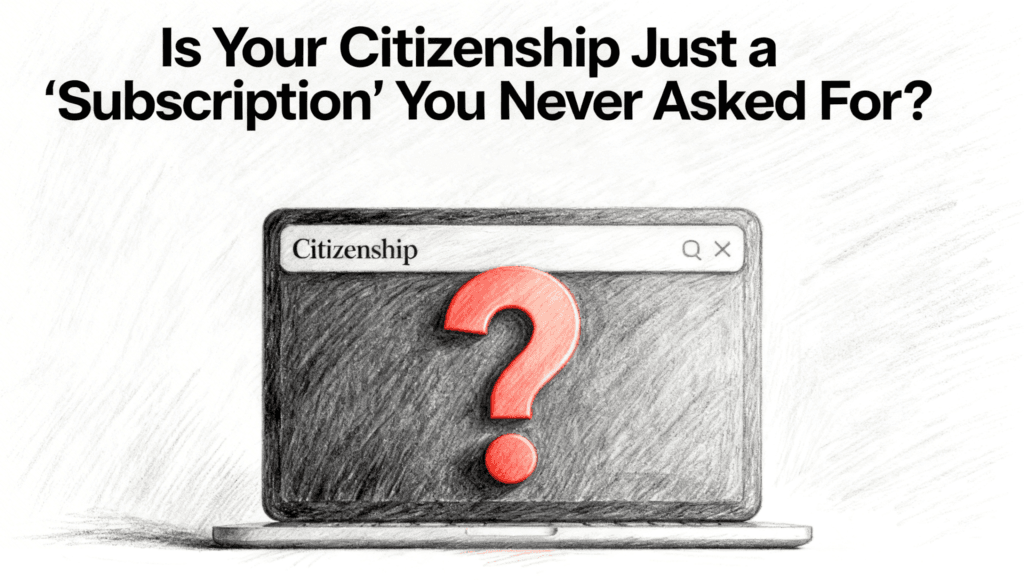
You did not choose your country. You did not read the fine print. You did not click “I agree.” And yet, here you are, a fully enrolled citizen with obligations, tax duties, and a passport that tells the world which government gets to claim you. If this sounds like a subscription service you never signed up for, Murray Rothbard would tell you that is exactly what it is.
Rothbard, the radical libertarian thinker who spent decades dismantling the philosophical foundations of the state, had a simple and devastating observation. The social contract, that grand idea we are all taught to revere, is not a contract at all. No one signed it. No one negotiated its terms. And if you try to cancel, the penalties are unlike anything Netflix would dare to charge.
The Social Contract That Nobody Signed
The idea of a social contract has been floating around since the 17th century. Thinkers like Thomas Hobbes, John Locke, and Jean-Jacques Rousseau each had their own version. The basic pitch goes like this: people in a “state of nature” agreed to give up certain freedoms in exchange for protection and order. Government is the product of that agreement. Therefore, government is legitimate because, well, we all agreed to it.
Rothbard looked at this story and asked the most obvious question in the world. When? When did anyone agree to this? Where is the document? Where are the signatures?
The answer, of course, is that there is no document. There are no signatures. The social contract is a metaphor dressed up as a legal argument. And Rothbard thought that was a serious problem. Because in every other area of life, we understand that a contract requires consent. You cannot wake up one morning to discover that your neighbor has mowed your lawn and now you owe him five hundred dollars a month for life. That is not how agreements work.
Yet this is precisely how citizenship works. You are born into a jurisdiction. You inherit obligations. And the entity on the other side of this “contract” is the one that gets to define what the obligations are, enforce them, and punish you if you resist. Rothbard pointed out that in any other context, we would call this arrangement something far less flattering than a social contract.
Taxation and the Curious Logic of Consent
If citizenship is the subscription, taxation is the monthly fee. And it is here that Rothbard was at his most provocative. He did not see taxation as a necessary evil or even as a regrettable but practical reality. He saw it as theft. Not metaphorical theft. Not theft in a poetic sense. Actual theft.
His reasoning was straightforward. If a person came to your door and demanded a third of your income, threatening imprisonment if you refused, that would be robbery. The fact that this person wears a uniform, operates from a marble building, and claims to represent millions of other people does not change the underlying nature of the transaction. The money is taken without your individual consent. Period.
Now, the standard response to this argument is that taxation is the price we pay for civilization. Roads, schools, hospitals, courts, defense. All of these things cost money, and someone has to pay. Rothbard did not deny that these services have value. What he denied was that a compulsory system is the only way, or even the best way, to provide them. He imagined a world where every service the government provides could be offered by voluntary, competing private entities. You would pay for what you actually use, and you would have the power to switch providers or opt out entirely.
This is where most people start to feel uncomfortable, and that discomfort is worth examining. We have been so thoroughly conditioned to equate government with civilization itself that the mere suggestion of alternatives sounds like a call for chaos. But consider how strange this logic would be in any other domain. Imagine if one company controlled all food production in your country, took a percentage of your income to fund it regardless of whether you ate their food, and then told you this arrangement was necessary because otherwise people would starve. You would rightly find that suspicious.
The Monopoly Problem
Rothbard was deeply influenced by the economic concept of monopoly, but he flipped the usual understanding on its head. Most people think of monopolies as failures of the market. Big corporations that crush competition and exploit consumers. Rothbard argued that the most dangerous monopoly is not a business. It is the state.
Think about what a government actually is in economic terms. It is an organization that claims exclusive control over a geographic territory. Within that territory, it has the sole right to make laws, enforce them, and adjudicate disputes. It can compel payment. It can restrict movement. It can conscript labor. No business in history has ever wielded this kind of power, and when businesses have tried to approach it, we rightly call them criminal enterprises.
The crucial difference, in Rothbard’s view, was that the state had managed to convince people that its monopoly was not just acceptable but noble. It had wrapped itself in the language of democracy, representation, and the common good. And this language was so effective that people would defend the state’s monopoly with the same passion they would use to oppose a corporate one.
There is a parallel here with something behavioral economists have studied extensively. When people receive something as a default, they tend to treat it as the correct or natural state of affairs. This is called the status quo bias. Citizenship is the ultimate default. You did not choose it, but the very fact that it was assigned to you at birth makes it feel like the natural order of things. Rothbard would say that the state depends on this psychological tendency more than it depends on its police force.
But Would It Actually Work?
Here is where intellectual honesty demands we slow down. Rothbard’s vision of a stateless society, what he called anarcho-capitalism, is elegant in theory. Private courts. Private defense agencies. Voluntary associations replacing compulsory government. Every interaction between people governed by consent, contract, and the free market.
It is also, by any practical measure, untested at scale. And the criticisms are not trivial.
The most potent objection is the problem of power vacuums. History suggests that when states collapse, what fills the void is rarely a peaceful marketplace of voluntary cooperation. It is usually warlords, militias, or new states that are even less accountable than the ones they replaced. Somalia in the 1990s is the example critics love to reach for. Rothbard’s supporters counter that a society voluntarily transitioning away from the state is fundamentally different from one experiencing state failure. That may be true, but the counter remains theoretical.
There is also the question of public goods. Some things, like national defense or disease control, benefit everyone regardless of whether they pay for them. Economists call this the free rider problem. If defense is provided by a private company and funded by voluntary payments, what stops people from refusing to pay while still benefiting from the protection? Rothbard had answers to this, involving reputation systems, contractual communities, and social pressure. Whether those answers are sufficient is genuinely debatable.
What is harder to debate is the sharpness of his diagnosis. Even if you reject the prescription, the observation that citizenship involves a staggering amount of unconsented obligation is difficult to dismiss. You did not agree to fund foreign wars. You did not agree to bail out banks. You did not agree to any number of things your government has done in your name. And the mechanism for expressing disagreement, voting, gives you roughly the same influence over outcomes as a single raindrop has over the direction of a river.
The Voting Illusion
Speaking of voting, Rothbard had thoughts about that too. Democratic participation is often held up as the mechanism that legitimizes the entire system. You might not have signed the social contract, but you can vote, and that is supposed to be your consent.
Rothbard found this logic circular. The state sets up a system of voting. It defines who can vote, what can be voted on, and how votes are counted. Then it points to the existence of this system as proof that the state is legitimate. That is like a kidnapper letting you choose between a blue room and a green room and then claiming you consented to being kidnapped because you picked the green one.
This is not just a philosophical parlor trick. There is a genuine problem with treating voting as consent. In democracies, voter turnout hovers around fifty to seventy percent. Of those who vote, many are choosing what they perceive as the lesser evil rather than enthusiastically endorsing a candidate. And the winning candidate typically represents the preferences of perhaps twenty to thirty percent of the eligible population. To call this a mandate is generous. To call it consent is fiction.
Rothbard pushed this further. Even if every single eligible person voted and a candidate won unanimously, that would still not constitute consent to everything the resulting government does over its term. You might vote for a candidate who promises to cut taxes and instead raises them. You might vote for peace and get war. The act of voting for a representative is not a blank check, but the system treats it as one.
What Rothbard Gets Right Even If You Think He Goes Too Far
You do not have to be an anarchist to find value in Rothbard’s framework. In fact, some of his most important contributions are the questions he forces you to ask, not the answers he provides.
Why do we accept obligations we never agreed to? This is not a question that only applies to government. It applies to cultural expectations, institutional norms, and any system that assumes your compliance by default. The habit of questioning assumed consent is healthy in every domain.
Why do we treat the state differently from every other organization? If a corporation behaved the way governments behave, there would be protests in the streets. Rothbard forces you to examine why one form of coercion is considered tyranny and another is considered civic duty.
Why is exit so costly? Renouncing citizenship is a difficult bureaucratic processes a person can undertake. Some countries charge fees. Others make it nearly impossible. The United States, notably, taxes its citizens regardless of where they live in the world. If citizenship were truly a voluntary arrangement, leaving would be as simple as canceling a subscription. It is not. And that asymmetry tells you something.
The Subscription Metaphor Revisited
Let us return to where we started. Is citizenship a subscription you never asked for? In the strictest sense, yes. It is assigned at birth. It comes with mandatory payments. The terms change without your approval. And cancellation is designed to be as painful as possible.
But subscriptions also provide things people value. Stability. Infrastructure. A legal framework that makes commerce and cooperation possible. The question Rothbard raises is not whether these things are valuable. It is whether a compulsory monopoly is the only way to deliver them, and whether the lack of genuine consent should bother us more than it does.
Most people will ultimately conclude that some form of organized governance is necessary. That does not make Rothbard wrong. It makes his challenge all the more important. Because the moment we stop questioning the terms of our involuntary subscription is the moment we have truly consented, not through agreement, but through surrender.
And Rothbard, whatever else you might say about him, never surrendered.