Table of Contents
You spent four years in lecture halls. You wrote essays at 2am fueled by caffeine and quiet desperation. You walked across a stage, shook a hand, and received a piece of paper. And here is the uncomfortable question that George Stigler, the Nobel laureate economist who spent his career studying how information moves through markets, would want you to sit with: Was any of that about learning?
Or was it about proving something to strangers who will never read your transcript?
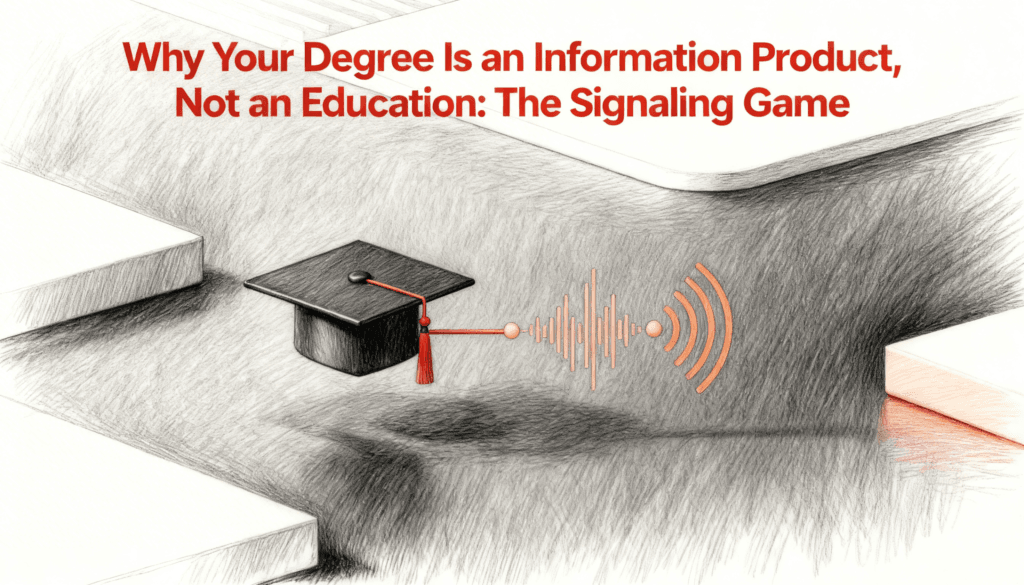
Stigler did not write directly about diplomas as signals. That language came later, most famously from Michael Spence. But Stigler built the intellectual foundation that makes the whole argument possible. His 1961 paper, “The Economics of Information,” changed how economists think about markets by introducing a deceptively simple idea: information is not free, and the cost of acquiring it shapes every decision people make. When you apply that lens to education, the picture gets strange. The degree on your wall starts to look less like a certificate of knowledge and more like a very expensive advertisement for yourself.
Let us walk through how that works.
The Problem of Not Knowing
Imagine you run a company. You need to hire someone. A candidate walks in and tells you she is smart, hardworking, and capable of learning complex material quickly. Great. Everyone says that. The person who will quit after six weeks says that. The person who cannot write a coherent email says that. You have no way to verify any of it without spending enormous amounts of time and money testing each applicant yourself.
This is what Stigler called search cost. In product markets, buyers cannot instantly know which goods are high quality and which are junk. They have to spend time comparing, reading reviews, visiting stores. That effort is not a side effect of shopping. It is a fundamental feature of how markets operate. Stigler argued that people will keep searching for information only up to the point where the cost of one more search equals the expected benefit. After that, they stop and make a decision with whatever incomplete picture they have.
Now apply that to hiring. An employer looking at a stack of resumes is in the same position as a consumer staring at thirty brands of olive oil. They need a shortcut. They need something that compresses a massive amount of uncertain information into a quick, readable signal.
Enter the university degree.
The Degree as Information Compression
A diploma from a reputable university tells an employer several things simultaneously, none of which require the employer to actually understand what you studied. It says you were selected by an institution with a competitive admissions process, which implies some baseline of cognitive ability. It says you managed to persist through four years of structured activity, which suggests tolerance for bureaucracy, deadlines, and doing things you do not particularly want to do. It says you met a minimum threshold of performance across dozens of evaluations by different people over an extended period.
Notice what is missing from that list. Nowhere does the employer need to care whether you remember the content of your Introduction to Microeconomics course. Nowhere does it matter whether your senior thesis changed how you think about the world. The signal works whether or not you learned anything at all.
This is the core insight that makes people uncomfortable. If the primary economic function of a degree is to transmit information about the holder to third parties, then education and credentialing are two different products that happen to be sold in the same package. You can get educated without a degree. You can get a degree without being educated. The market mostly rewards the second.
Stigler’s Fingerprints
Stigler would have recognized this dynamic immediately, because it mirrors the information asymmetries he spent decades analyzing. In his framework, markets are full of actors who know different things. Sellers know more about their products than buyers do. Job candidates know more about their own abilities than employers do. And because acquiring information is costly, these asymmetries do not just vanish through competition. They persist, and they create entire industries whose sole purpose is to bridge the gap.
Think about that. Credit rating agencies exist because lenders cannot cheaply assess every borrower. Restaurant health inspection grades exist because diners cannot test the kitchen themselves. Consumer Reports exists because nobody has time to evaluate every toaster on the market.
Universities, in this light, are information intermediaries. They are in the business of certifying people. The classes, the campus, the football team, the philosophy department: all of it is infrastructure supporting the core product, which is a trusted stamp that says this person cleared our bar. The education that happens along the way is, from a strict market perspective, a byproduct.
That sounds cynical. It is also largely accurate.
The Sheepskin Effect
If degrees were primarily about learning, you would expect the economic return to education to accumulate gradually. Each year of schooling would add roughly the same bump to your earnings, because each year adds roughly the same amount of knowledge. But that is not what the data shows.
Economists have documented what they call the sheepskin effect. Completing the final year of a degree and receiving the diploma produces a wage jump that is significantly larger than the wage gain from any of the preceding years. The twelfth year of schooling is not dramatically more educational than the eleventh. But it is the year you get the piece of paper. And the piece of paper is where the money is.
This is almost impossible to explain if you think education is about human capital accumulation, the idea that schooling makes you more productive by filling your head with useful knowledge. It makes perfect sense if you think education is about signaling. The diploma is the signal. Everything before it is the cost of producing that signal.
Bryan Caplan, an economist who pushed this argument to its logical extreme in his book “The Case Against Education,” estimates that signaling accounts for roughly 80 percent of the financial return to a college degree. You can argue about the exact number. But the direction of the finding is hard to dismiss.
Why the Signal Is So Expensive
Here is where it gets interesting. For a signal to work, it has to be costly. If anyone could send it, it would carry no information.
Think of it this way. If Harvard gave out degrees to anyone who paid tuition regardless of performance, a Harvard degree would immediately become worthless as a signal. The whole point is that not everyone can get one. The difficulty is not a bug. It is the mechanism.
This creates a genuinely strange incentive structure. Students are not just paying for education. They are paying for the difficulty of getting through the system. The all nighters, the brutal exam curves, the arbitrary prerequisites: these are not obstacles to the product. They are the product. The suffering is what makes the signal credible.
Stigler understood this logic at a deep level. In his work on information and advertising, he noted that the cost a company sinks into advertising can itself serve as a signal of product quality. A firm that spends millions on a Super Bowl ad is implicitly saying: we are confident enough in our product to burn this money, because we expect repeat customers to make it worthwhile. The ad does not need to contain useful information. Its mere existence, and its expense, is the message.
A four year degree works the same way. The expense, in both money and time, is the message. You are telling the labor market: I am the kind of person who can afford to burn four years and six figures on this. That alone separates you from people who cannot or will not.
The Uncomfortable Equity Implication
Once you see degrees as signals rather than education, an unsettling consequence follows. The system does not just reward ability. It rewards the ability to afford the signal.
Two equally talented people, one from a wealthy family and one from a poor one, face radically different costs of sending the same signal. The wealthy student can attend a prestigious university with financial support, social capital, and no need to work during school. The poor student may need to work full time, attend a less selective institution, or skip college entirely. The signal they send to the labor market will be different. Not because their ability is different, but because their access to the signaling technology is different.
Stigler’s information economics predicts this. When the cost of transmitting information is high, the people who can afford to transmit it gain a structural advantage. The information market, like any other market, favors those with resources. The degree is not a meritocratic filter. It is a meritocratic filter wrapped inside an economic filter, and the economic filter does most of the heavy lifting.
Why This Has Not Changed
You might expect the internet to have disrupted this by now. After all, if the degree is really just an information product, and the internet is history’s greatest information distribution technology, then surely we should have found cheaper ways to signal ability by now.
We have not. And the reason is instructive.
Stigler wrote extensively about how information markets develop. One of his key observations was that established information intermediaries enjoy enormous advantages of trust. A new credit rating agency, no matter how accurate, struggles to compete with Moody’s and S&P because the entire financial system is built around trusting the incumbents. Switching costs are astronomical. The same is true of universities.
Employers trust degrees from established institutions because other employers trust them. Hiring managers know that a candidate with a degree from a known university has been through a known process. The specific content of that process barely matters. What matters is that everyone agrees on what the signal means. This is a coordination equilibrium, and it is extraordinarily hard to disrupt.
Coding bootcamps, online certificates, portfolio based hiring: all of these represent attempts to create alternative signals. Some have gained traction in specific industries. But none has come close to replacing the four year degree as the default credential in the broader labor market. The incumbents are too entrenched. The coordination problem is too deep. Reliable signals require investment. Cheap signals get ignored.
So What Do You Do With This?
Understanding the signaling game does not mean you should skip college. The signal works. Employers respond to it. The wage premium is real. Ignoring a functional system because you find its logic distasteful is not rebellion. It is self sabotage.
But understanding changes your relationship to the process. If you know the degree is primarily a signal, you can stop agonizing over whether you are learning enough in your classes and start thinking strategically about which signals you are sending and to whom. You can choose a university based on its brand value in your target industry rather than the supposed quality of its curriculum. You can invest in complementary signals, like work experience, projects, and professional networks, that reinforce the credential rather than replace it.
You can also advocate, with clear eyes, for a system that does not force people to spend four years and a small fortune just to tell employers they are competent. The signaling model is not an endorsement of the status quo. It is a diagnosis. And like any good diagnosis, it points toward possible treatments.
Stigler spent his career showing that information problems are real, persistent, and consequential. The labor market’s reliance on degrees is one of the biggest information problems in modern economic life. We have not solved it. But at least, thanks to the framework Stigler helped build, we can see it clearly.
That is worth more than most of what you learned in college. And unlike your degree, it did not cost you a thing.