Table of Contents
There is a French economist who died in 1832 who understands your YouTube channel better than most people running one today. His name is Jean-Baptiste Say, and he had one idea that refuses to age. He believed that production creates its own demand. Not marketing. Not hype. Production itself. The act of making something useful is what generates the desire for it.
If that sounds like an unusual claim, consider what happens every time a creator uploads a video that solves a specific problem. Nobody was searching for that creator. Nobody woke up loyal to their brand. But the video exists, and because it exists, it finds its audience. The supply manufactured its own demand. Say would have nodded quietly and moved on, because to him this was obvious.
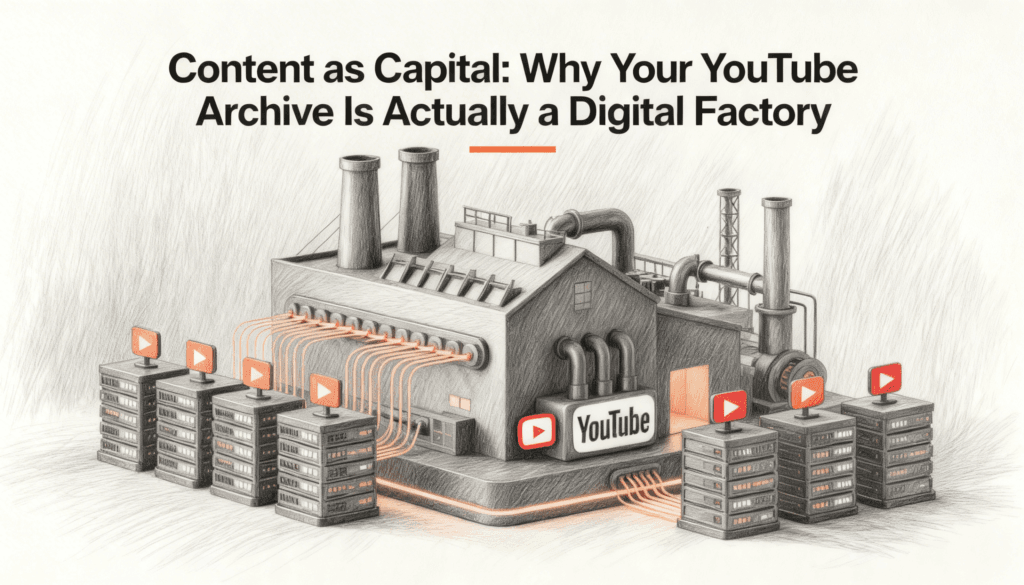
What was not obvious, and what most creators still do not see, is the implication hiding inside that principle. If production creates demand, then a library of production is not just an archive. It is a factory. It does not sit there collecting dust. It runs. Quietly, continuously, without a shift change or a lunch break. Every old video is a machine on the floor of that factory, and each one is producing something: attention, trust, revenue, discovery.
This is not a metaphor stretched beyond usefulness. This is the most accurate way to describe what a YouTube channel actually is once it reaches a certain size. And understanding it this way changes everything about how you should build one.
The Mistake of Thinking in Units
Most creators think in units. One video. One upload. One performance cycle. They release something on Tuesday, watch the analytics spike, watch them fall, and start again. It is the creative equivalent of selling fruit from a cart. You show up, you sell what you have, you go home. Tomorrow you bring more fruit.
There is nothing wrong with selling fruit from a cart. But it is not a factory. A factory produces value even when the owner is asleep. A factory compounds. A factory turns raw inputs into finished goods at scale, and the goods keep moving through distribution long after the production moment ends.
When you think in units, you optimize for the wrong things. You chase the spike. You design for first-week performance. You ask, “How do I make this video go viral?” which is the creator economy version of asking, “How do I win the lottery?” It is not a strategy. It is a wish with a ring light.
When you think in systems, which is what Say was really talking about, you ask different questions. How does this video serve the library? What does this piece produce for the factory six months from now? Which machines on my factory floor are still running, and which ones have broken down? Suddenly you are not a person with a camera. You are an industrialist. A strange, ring-lit industrialist, sure. But an industrialist nonetheless.
Say’s Law and the Evergreen Paradox
Say’s Law, in its simplest form, states that goods are paid for with other goods. Money is just the intermediary. What really happens in an economy is that people produce things of value and exchange them for other things of value. Production is the engine. Everything else is plumbing.
Apply this to YouTube and something counterintuitive appears. The creators who look the most successful in any given week are often not the ones building the most valuable factories. Viral content is spectacular but perishable. It is the economic equivalent of fireworks: bright, loud, gone. What Say would have valued is the creator whose 300 videos each generate a small but steady return. Not because any single video is impressive, but because the aggregate production has created a self-sustaining system of demand.
This is the evergreen paradox. The videos that seem boring to produce are often the ones that matter most to the factory. A tutorial on how to set up a printer does not win awards. Nobody shares it at dinner parties. But it gets searched for every day, for years as printers are in use. It is a quiet machine bolted to the factory floor, doing its job without asking for recognition.
Meanwhile, the hot take about this week’s drama is a sugar rush. It floods the floor with activity for 48 hours and then evaporates. The factory did not gain a new machine. It hosted a party.
This is not an argument against trending content. It is an argument for understanding what each type of content actually produces in factory terms. Some videos are machines. Some are events. Both have value, but confusing one for the other is how factories go bankrupt.
The Means of Production Are a Webcam and Some Audacity
Karl Marx spent a great deal of energy worrying about who owns the means of production. Factories, land, tools, infrastructure. Whoever owned those owned the economy. Workers had their labor. Owners had everything else.
It is worth pausing here to appreciate how thoroughly the internet has scrambled that framework. The means of production for a digital factory are a camera, an editing program, and the willingness to be on the internet. That is it. The capital barrier to entry has collapsed so completely that a teenager in a bedroom can outproduce a media company with a floor of offices.
But here is where it gets interesting. Marx worried about the exploitation that comes from owning the factory. In the creator economy, the person who owns the factory is also the worker. You are both the capitalist and the labor. You exploit yourself, willingly, often on weekends. The alienation Marx described, where workers feel disconnected from the product of their labor, flips entirely. Creators are almost pathologically connected to their product. They check the analytics at 2 AM. They read every comment. They feel physical pain when a video underperforms.
This is not liberation from Marx’s framework. It is a strange new chapter of it. The factory owner and the factory worker share a body, and they disagree constantly about time off.
Distribution Is the New Location
In traditional economics, where you put your factory mattered enormously. Near a river for transport. Close to raw materials. Adjacent to labor markets. Location was not just important. It was the strategy.
YouTube solved this problem so elegantly that most people do not even notice. The platform is the location, the distribution network, the storefront, and the foot traffic all at once. Your factory does not need to be near anything because it is already inside the marketplace.
But this creates a different problem. When everyone’s factory is in the same building, differentiation becomes the new location advantage. It is not about where your content is. It is about what shelf it sits on in the viewer’s mind. A creator who makes clear, consistent content about personal finance occupies a location in the audience’s mental geography. That location is the new riverfront property.
This is why niche content is so disproportionately powerful. It is not just a marketing tactic. It is a location strategy. The more specific your factory’s output, the more defensible your position on the mental map. “Tech reviews” is a crowded district. “Budget tech for teachers” is a neighborhood where you can own every building on the block.
Inventory That Appreciates
Physical factories have an inventory problem. Goods sit in warehouses. They cost money to store. They can spoil, become obsolete, or simply take up space that could be used for something else. Inventory is a liability as much as it is an asset.
Digital factories have the opposite situation. Your inventory, meaning your back catalog of videos, does not cost anything to store. YouTube hosts it for free, forever, as long as the platform exists. And unlike physical goods, content inventory can actually appreciate over time.
A video about fundamental principles in your niche does not become less true. A well-made tutorial does not expire when the calendar changes. A thoughtful analysis ages into a reference point. The factory keeps these goods on the shelf indefinitely, and each one continues to attract new customers who were not even aware of your factory when the product was made.
This is genuinely unusual in economic terms. Almost nothing in the physical world appreciates while costing nothing to store. Real estate appreciates but demands property taxes and maintenance. Gold appreciates but needs a vault. Your YouTube video from 2019 just sits there, quietly paying dividends in watch time and subscriber conversions, asking for absolutely nothing in return.
The exception, of course, is content tied to a moment. Videos pegged to a specific event, trend, or controversy have the shelf life of a banana. They are inventory that spoils. The factory still made them, and they might have generated value at the time, but they will not compound. Understanding this distinction is the difference between building a warehouse of assets and a warehouse of soon-to-be garbage.
The Compound Interest of Trust
There is a concept in finance that everyone respects but almost nobody has the patience to actually use: compound interest. Small returns, reinvested consistently, produce extraordinary results over time. The math is not exciting in year one. It is life-changing in year ten.
A YouTube archive works on exactly the same principle, except the currency is not money. It is trust. Every video that delivers on its promise deposits a small amount of trust with the viewer. The viewer may not subscribe after one video. They may not even remember your name. But if they encounter your content three, four, five times, each time receiving genuine value, the trust compounds.
This is why consistency matters more than brilliance. The factory that produces reliable goods every week will outperform the factory that produces one masterpiece and then goes silent. Not because the reliable goods are better individually, but because the compounding process requires repetition to function. You cannot compound something that only happened once.
Say understood this instinctively. His entire theory of production was built on the idea that sustained output creates sustained demand. It was not about the single brilliant act of creation. It was about the system of creation running consistently over time.
The Factory You Do Not Realize You Are Building
Here is the part that should make you uncomfortable if you have been treating YouTube casually. You are building a factory whether you intend to or not. Every video you upload becomes part of the production floor. Every gap in your catalog is an empty machine bay. Every abandoned series is a production line that went cold.
If you have 50 videos, you have a small factory. If you have 500, you have a serious operation. But the question is not how many machines you have. It is how many of them are still running. A factory full of broken machines is just an expensive building.
This means maintenance matters. Updating old videos, optimizing titles and thumbnails on back catalog content, pruning content that no longer serves the factory. These are not glamorous tasks. Nobody makes a video about updating their metadata. But in factory terms, this is maintenance engineering. It is what keeps the machines running.
The Uncomfortable Truth About Scale
Say believed that production was inherently good. Make useful things, and the economy benefits. But he was writing in an era before overproduction became a recognizable problem. Factories can make too much. They can flood the market. They can produce at a volume that collapses the value of their own output.
The YouTube equivalent of this is the creator who uploads three times a day and wonders why their audience feels exhausted. More machines do not always mean more value. Sometimes they mean more noise. The factory needs to produce at a pace the market can absorb. Otherwise you are not building inventory. You are building landfill.
The best digital factories find their rhythm. They produce enough to compound trust without overwhelming the people they serve. They treat their audience’s attention as a finite resource, not an infinite dumping ground. This is where Say’s optimism needs a modern edit. Production creates demand, yes. But only if the production respects the consumer’s capacity to consume.
The Blueprint Going Forward
Jean-Baptiste Say gave us the blueprint two centuries ago. He just did not know it was a blueprint for YouTube. Production is capital. Output is infrastructure. Your archive is not a graveyard of old content. It is a living, working factory that produces value every hour of every day, provided you built it with intention.
The creators who understand this will build catalogs that outlast trends. They will think in systems instead of spikes. They will maintain their machines, invest in evergreen inventory, and respect the compound math of trust.
The rest will keep selling fruit from a cart, wondering why the factory owners seem to have it so much easier.
They do not have it easier. They just understood what they were building.