Table of Contents
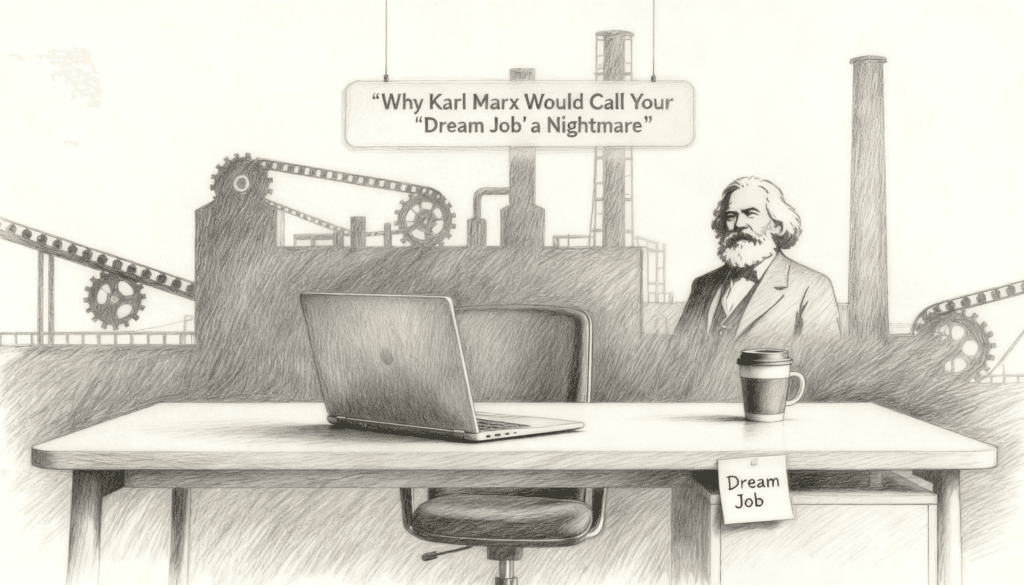
There is a particular kind of modern sermon that gets preached in graduation speeches, LinkedIn posts, and motivational podcasts. It goes something like this: find your passion, do what you love, and you will never work a day in your life. It sounds beautiful. It sounds liberating. Karl Marx would have found it terrifying.
Not because he was against passion or meaning. Quite the opposite. Marx spent his entire life obsessed with the idea that work should be deeply fulfilling. The problem, he would argue, is that telling people to “love their job” inside a system designed to extract maximum value from them is not inspiration. It is a trap with better marketing.
To understand why, we need to spend some time inside Marx’s head. Not the caricature version with the communist manifesto and the angry fist. The philosopher version. The one who wrote thousands of pages trying to answer a deceptively simple question: why does work, something humans are naturally drawn to, make most people miserable?
The Thing You Were Not Supposed to Notice
Marx had a concept he called alienation. Do not let the academic ring of the word put you off. The idea is remarkably intuitive once you see it.
Imagine a carpenter who designs a table from scratch. He selects the wood, envisions the shape, planes the surface, joins the legs, and finishes it by hand. At the end, there is a real object in the world that came from his mind and his effort. He can point to it and say, “I made that.” There is a direct, unbroken line between his intention, his labor, and the result. That, for Marx, is what work is supposed to feel like. It is creative. It is whole. It is human.
Now imagine that same carpenter standing in a factory, feeding wood into a machine eight hours a day. He does not design the table. He does not choose the materials. He does not see the finished product. He performs one motion, repeatedly, and a paycheck appears every two weeks. The table still exists somewhere, but it is no longer his in any meaningful sense. The line between his effort and the outcome has been cut.
That cut is alienation. And Marx identified four layers of it. You are alienated from the product of your work, because someone else owns what you make. You are alienated from the process of working, because someone else dictates how you do it. You are alienated from your fellow workers, because the system puts you in competition with them. And finally, you are alienated from your own human nature, because the thing that should express your creativity becomes a deadening routine you endure for survival.
Read that list again slowly. Then think about your last performance review.
“Do What You Love” and Other Profitable Slogans
Here is where things get interesting for the modern world. Marx was writing about nineteenth century factories. Steam engines. Child labor. Twelve hour shifts in conditions that would make an occupational safety inspector faint. We do not have those problems anymore, at least not in the same visible way. So surely his critique does not apply to the knowledge worker sipping oat milk in a coworking space, right?
Marx would laugh. Or possibly weep.
The modern “dream job” narrative does something far more clever than the old factory model ever did. The factory was honest in its brutality. Nobody pretended that pulling a lever for twelve hours was a spiritual experience. The transaction was transparent: your time and body in exchange for wages. You could hate it openly because nobody asked you to love it.
The dream job reverses this. It says: this is not really a transaction. This is your calling. This is who you are. And the moment you accept that framing, something shifts. If your job is your identity, then complaining about working conditions feels like complaining about yourself. Asking for more money feels greedy, because you should be doing this for the love of it. Burnout becomes a personal failure rather than a structural outcome.
Marx had a term for the way systems disguise their true nature. He called it ideology. An ideology is not a conspiracy. Nobody sits in a dark room deciding to trick workers into loving their chains. It is more subtle than that. It is the set of assumptions that feel so natural, so obviously true, that questioning them seems absurd. “Find your passion” is ideology in its purest form. It takes a systemic problem (work is organized to benefit owners, not workers) and repackages it as a personal quest (you just have not found the right job yet).
The Surplus Value of Your Enthusiasm
Let us talk about money for a moment, because Marx certainly would.
One of his central ideas is surplus value. Again, the concept is simpler than it sounds. If you produce one hundred dollars worth of value in a day and your employer pays you sixty, the remaining forty is surplus value. That is the profit that goes to the owner. This is not a moral judgment in Marx’s framework. It is a structural description of how the system works. Profit requires paying workers less than the value they create. If it did not, there would be no profit.
Now layer the dream job narrative on top of this. When someone genuinely believes their work is a calling, they tend to accept lower wages. They work longer hours without complaint. They answer emails at midnight and call it dedication rather than unpaid labor. Workers in “passion industries” like the arts, nonprofit work, education, and media are paid less and exploited more, precisely because their love for the work is leveraged against them.
Marx would recognize this instantly. The dream job does not eliminate surplus value extraction. It turbocharges it. When you love your work, you voluntarily give more of yourself for less in return. You become, in the most polite and Instagram friendly way possible, a more efficient source of profit.
This is the counter intuitive part that tends to make people uncomfortable. Passion does not protect you from exploitation. In many cases, it enables it.
Your Identity Is Not a Deliverable
There is a psychological dimension here that Marx touched on but that modern thinkers have expanded considerably. When work becomes identity, the boundaries between who you are and what you produce dissolve. This might sound liberating in a TED Talk. In practice, it is devastating.
If your job is just a job, getting fired is painful but survivable. You lost a source of income. You will find another. But if your job is your dream, your passion, the thing that makes you you, then getting fired is an existential crisis. You did not just lose a paycheck. You lost yourself. Every piece of critical feedback becomes a referendum on your worth as a person. Every restructuring feels like a betrayal of a sacred contract that, it turns out, only you believed in.
This brings us to something that rarely gets discussed in career advice columns. The freedom to not care about your job is itself a form of power. When work is just work, you can negotiate from a position of clarity. You can set boundaries without guilt. You can leave without an identity crisis. Marx understood that the real goal was not to find meaningful work within an exploitative system. It was to change the system so that meaning was not something you had to beg for.
The Gig Economy: Alienation Gets a Rebrand
If Marx could see the modern gig economy, he would probably need a moment.
Here is a system that has taken every layer of alienation he described and dressed it up as freedom. You do not have a boss. You have an algorithm. You do not have coworkers. You have competitors on the same platform. You do not own your tools, your client relationships, or your reputation outside the platform that hosts it. You are, in the most literal sense Marx could have imagined, separated from the product of your labor, the process of your labor, your fellow workers, and your creative potential.
But the branding says otherwise. The branding says you are an entrepreneur. A freelancer. Your own boss. The language of liberation is applied so thickly that pointing out the underlying structure feels like pessimism. And this is exactly how ideology works. It makes the description of reality sound like a bad attitude.
There is a useful parallel here with the fitness industry, of all things. In the same way that wellness culture tells you that your health is entirely your personal responsibility (ignoring pollution, food deserts, working hours, and access to healthcare), dream job culture tells you that your career satisfaction is entirely your personal responsibility. Both frameworks take systemic issues and relocate them inside the individual. If you are unhappy at work, the problem is your mindset. If you are burned out, you need better self care. The system never has to answer for itself because you are too busy answering for yourself.
So What Would Marx Actually Want?
This is where people expect the conversation to turn utopian, and where Marx tends to get caricatured the most. He was not arguing that nobody should work. He was not saying all jobs are equally miserable. He was making a structural claim: as long as the fruits of your labor primarily benefit someone else, and as long as you have no meaningful control over how your work is organized, no amount of passion will solve the fundamental problem.
What Marx envisioned was not the absence of work but the transformation of it. He imagined a world where people could move between activities freely, where the division of labor did not permanently assign you to one narrow function, and where the products of collective effort were shared collectively. You can agree or disagree with his proposed solutions. But the diagnosis remains uncomfortably sharp.
The dream job narrative tells you that the answer to dissatisfaction is finding the right position within the existing structure. Marx would tell you that the structure itself is the problem. One of these perspectives sells books and fills seminar seats. The other asks you to question the seminar.
The Uncomfortable Takeaway
None of this means you should hate your job or refuse to find meaning in what you do. That would be a miserable way to live, and Marx was not advocating for misery. He was advocating for honesty.
The honest version goes something like this. You can enjoy your work and still recognize that the system is designed to benefit from your enjoyment. You can be passionate and still demand fair compensation. You can find meaning in your daily tasks and still understand that meaning does not pay rent, and that your employer’s enthusiasm for your passion is not entirely selfless.
The most radical thing you can do in a culture that worships the dream job is to see your work clearly. Not with cynicism. Not with bitterness. But with the calm, unromantic understanding that your labor has value, that this value is measurable, and that how much of it you keep versus how much you give away is not a question of spiritual alignment. It is a question of power.
Marx knew that. He spent his life saying it in increasingly thick volumes that almost nobody read in full. But the core message fits in a sentence. If you have to sell your labor to survive, then the first step toward freedom is not loving the sale. It is understanding it.
Your dream job is still a job. That is not a reason to despair. It is a reason to negotiate.