Table of Contents
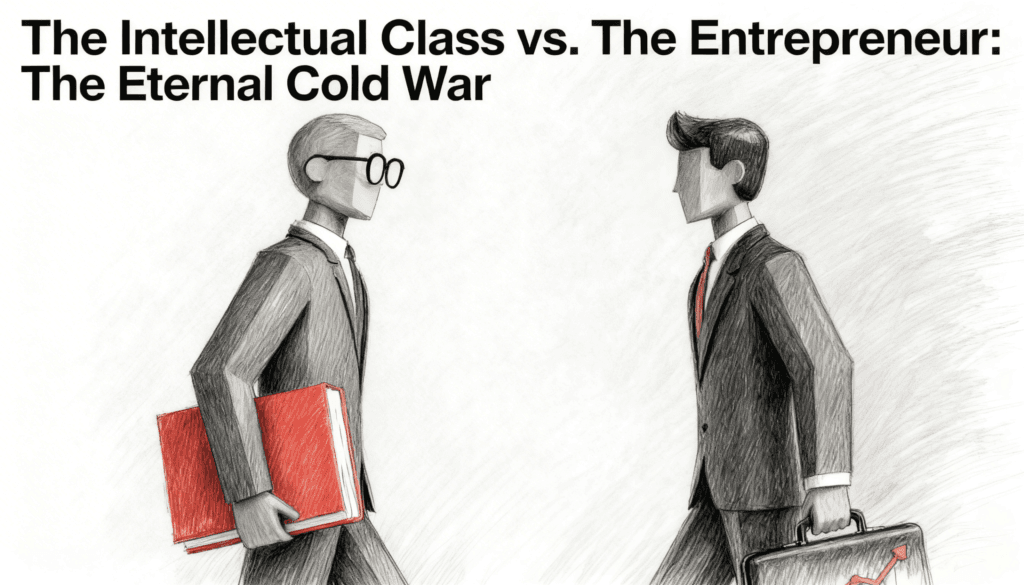
There is a peculiar war that has been raging for centuries. It does not involve armies or territories. No shots are fired. No treaties are signed. Yet its consequences shape economies, cultures, and the very fabric of how societies organize themselves. This is the war between the intellectual class and the entrepreneur. And the man who mapped it out with the precision of a surgeon was Joseph Schumpeter.
Most people, if they have heard of Schumpeter at all, know him for one phrase: creative destruction. It is a brilliant term. It captures the idea that capitalism progresses not through gentle improvement but through violent reinvention. The horse carriage does not slowly evolve into the automobile. The automobile obliterates the horse carriage. The bookstore does not adapt into Amazon. Amazon buries the bookstore and then sells flowers on top of the grave.
But creative destruction was only half of Schumpeter’s insight. The other half, arguably the more dangerous and prophetic half, was his analysis of why capitalism might destroy itself. Not from external attack. Not from its own economic failures. But from the hostility of the very intellectual class that capitalism itself made possible.
Let that sink in for a moment. The system that gave intellectuals their freedom, their platforms, their publishing houses, their universities, and their comfortable salaries would be undermined by those same intellectuals. Schumpeter saw this not as a bug in the system but as an inevitable feature of it.
The Entrepreneur as the Uninvited Hero
To understand the tension, you first need to understand how Schumpeter viewed the entrepreneur. This was not the suit wearing CEO managing quarterly earnings. This was not the heir to a family fortune making safe investments. The Schumpeterian entrepreneur was something far more radical. This was the person who sees a gap in reality, a mismatch between what exists and what could exist, and then throws everything into closing that gap.
The entrepreneur, in Schumpeter’s framework, is the engine of economic progress. Not the worker. Not the manager. Not the investor. The entrepreneur. This figure disrupts existing industries, introduces new products, opens new markets, and reorganizes entire sectors of the economy. The entrepreneur is, in the most literal sense, a revolutionary.
But here is where it gets interesting. The entrepreneur is not a revolutionary in the way intellectuals romanticize revolution. The entrepreneur does not write manifestos. The entrepreneur does not theorize about the ideal society. The entrepreneur simply builds. And in the process of building, old structures collapse. Workers in dying industries lose their jobs. Established companies go bankrupt. Entire communities built around obsolete technologies wither away.
This is uncomfortable. Progress, it turns out, is not a clean process. It is messy, uneven, and often cruel in the short term. And this is precisely where the intellectual class enters the picture with sharpened pens and righteous indignation.
The Rise of the Intellectual Class
Schumpeter observed something that many economists before him had ignored. Capitalism does not just produce goods and services. It produces an enormous class of educated people who have the time, the training, and the institutional support to sit around and think critically about the system that feeds them.
This is not an insult. It is a structural observation. Before capitalism, the vast majority of people were too busy surviving to write essays about the injustice of their condition. Feudal societies did not produce large intellectual classes because feudal societies did not produce the surplus wealth needed to sustain them. Capitalism did.
Universities expanded. Publishing became an industry. Journalism grew from pamphlets to empires. And within all of these institutions, a class of people emerged whose primary skill was the articulation and critique of ideas. These people did not build businesses. They did not risk their savings on untested ventures. They did not lie awake at night wondering if payroll would clear on Friday. What they did, and did exceptionally well, was analyze, criticize, and pass judgment.
Schumpeter did not necessarily blame them for this. He understood it as a natural consequence of the system. Capitalism creates abundance. Abundance creates leisure. Leisure creates a class of professional thinkers. And professional thinkers, almost by gravitational pull, tend toward skepticism of the system that employs them.
There is something almost comedic about it. The entrepreneur builds the theater. The intellectual buys a ticket and then writes a devastating review of the architecture.
Why Intellectuals Tend to Oppose Capitalism
Schumpeter’s explanation for why intellectuals lean against capitalism was remarkably psychological, not just economic. He identified several forces at work.
First, intellectuals deal in words and ideas, not in the practical realities of production and exchange. When you spend your career in abstraction, you develop a natural suspicion of people who succeed through action rather than theory. The entrepreneur’s success feels unearned to the intellectual because it does not come from mastering the right ideas. It comes from taking risks, reading markets, and executing under uncertainty. These are skills that do not translate well into academic papers.
Second, the intellectual class tends to be oversupplied relative to the positions available. Capitalism produces more educated people than it can absorb into elite roles. This creates a permanent pool of discontented graduates who are smart enough to articulate their frustration and motivated enough to channel it into systemic critique. Schumpeter saw this decades before anyone coined the term “credentialism” or worried about PhD students driving taxis.
Third, and this is perhaps the most subtle point, intellectuals have an institutional incentive to be critical. Nobody becomes famous in academia by writing a paper that says everything is fine. No journalist wins a prize for reporting that the system is working reasonably well. Criticism is the currency of intellectual prestige. And capitalism, with all its visible inequalities and disruptions, provides an endless supply of material.
The result is a class of people who are genuinely brilliant, genuinely well meaning in many cases, and genuinely hostile to the system that makes their existence possible.
The Paradox Schumpeter Could Not Solve
Here is the core paradox, and it remains unresolved to this day. The entrepreneur creates wealth but is bad at defending the system that allows wealth creation. The intellectual does not create wealth but is exceptionally good at attacking the system that does.
Entrepreneurs, by nature, are too busy building to engage in ideological warfare. They do not write books about why free markets work. They do not hold symposiums on the moral foundations of enterprise. They are in the trenches, negotiating deals, solving supply chain problems, hiring and firing, iterating on products. They have neither the time nor the temperament for public debate.
Intellectuals, on the other hand, have nothing but time for public debate. It is literally their job. And they are trained in rhetoric, argumentation, and persuasion. When the intellectual and the entrepreneur meet in the arena of public opinion, it is not a fair fight. The entrepreneur mumbles something about job creation and economic growth. The intellectual delivers a polished, emotionally resonant narrative about inequality, exploitation, and systemic failure.
Schumpeter watched this dynamic and concluded something deeply pessimistic. Capitalism would not fall because it failed. It would fall because it succeeded so spectacularly that it created a class of critics powerful enough to undermine public faith in it.
The Twist
Now here is where Schumpeter’s analysis takes a turn that surprises people on both sides of the political spectrum. You might expect a defender of entrepreneurship to simply dismiss the intellectual class as parasitic or irrelevant. Schumpeter did not do this. He recognized that intellectual criticism serves a function.
Without critical voices, capitalism would devour itself even faster. The entrepreneur, left entirely unchecked, would monopolize markets, exploit workers beyond endurance, and strip mine every natural resource in sight. Not because entrepreneurs are evil, but because the logic of competition demands relentless optimization, and relentless optimization without constraint is simply destruction without the creative part.
The intellectual class, for all its hostility, acts as a regulatory mechanism. It pressures the system to reform. It gives voice to those displaced by creative destruction. It forces entrepreneurs to justify their actions in terms beyond pure profit. This does not mean the intellectual class is always right. It is frequently wrong, sometimes catastrophically so. But its existence keeps the system from its own worst tendencies.
Schumpeter understood this. He was not naive about entrepreneurs, and he was not purely contemptuous of intellectuals. He was, above all, a realist. And the reality he saw was a system locked in permanent internal conflict, with neither side able to exist without the other and neither side willing to admit it.
Why This Matters Now
The tension Schumpeter identified has not disappeared. If anything, it has intensified. Social media has given the intellectual class a megaphone that Schumpeter could not have imagined. Every failed startup, every corporate scandal, every economic downturn is amplified, analyzed, and weaponized within hours. Meanwhile, entrepreneurs continue to build, disrupt, and create, largely indifferent to the discourse swirling around them.
The gig economy, artificial intelligence, cryptocurrency, automation. Each of these is a new front in the same old war. Entrepreneurs see opportunity. Intellectuals see exploitation. Both are partially right. Neither has the full picture.
And this, ultimately, is Schumpeter’s most enduring lesson. The conflict between the intellectual class and the entrepreneur is not a problem to be solved. It is a tension to be managed. The societies that manage it well, that allow entrepreneurs to build while giving intellectuals the freedom to criticize, tend to thrive. The societies that let one side completely dominate the other tend to stagnate or collapse.
The entrepreneur without the intellectual becomes a warlord. The intellectual without the entrepreneur becomes a priest of a religion with no church. Neither can build a civilization alone.
Because the war itself, uncomfortable as it is, might be the thing that keeps the whole machine running.