Table of Contents
Every boardroom has that person. The one who asks uncomfortable questions. The one who points out the elephant everyone pretends not to see. The one who suggests burning down the marketing strategy you spent six months building. Usually, this person gets labeled a troublemaker, shown the door, or relegated to a position where they can’t cause “damage.”
What if I told you that person should be running your most critical strategic function?
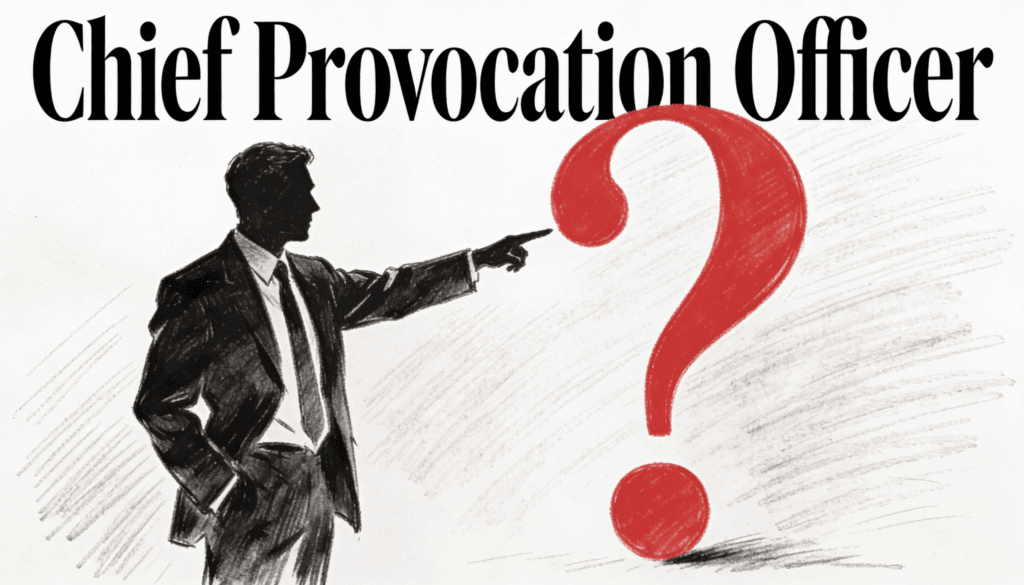
Welcome to the case for the Chief Provocation Officer, a role that sounds absurd until you realize your company is probably dying from politeness.
The Tyranny of Agreement
Most organizations operate like well-oiled agreement machines. Someone proposes an idea in a meeting. A few people nod. Someone adds a supportive comment. The idea moves forward not because it’s good, but because disagreement feels like conflict, and conflict feels unprofessional.
This is how businesses build products nobody wants, launch campaigns nobody remembers, and make strategic bets that seem obvious in hindsight as terrible decisions. The problem isn’t stupidity. Smart people make these mistakes constantly. The problem is that intelligence becomes useless in an environment optimized for consensus.
Think about the last major decision your company made. How many people argued passionately against it? If the answer is zero, you didn’t make a decision. You executed a ritual.
Physics gives us a useful lens here. In thermodynamics, entropy measures disorder in a system. Without external energy, systems trend toward entropy, toward sameness, toward equilibrium. Companies do the same thing. Without someone actively injecting disorder into your thinking, your ideas become increasingly similar, increasingly safe, and increasingly irrelevant.
A Chief Provocation Officer is that external energy.
What This Role Actually Does
The Chief Provocation Officer has one job: to be systematically wrong in useful ways.
Notice I didn’t say their job is to be right. Being right is easy when you cherry-pick your battles. The CPO’s mandate is to question foundational assumptions, even when those assumptions appear self-evidently true. Especially then.
Let me give you a concrete example. A retail company was planning to expand their loyalty program. Everyone agreed this was smart. Customers love rewards. Data showed loyalty members spent more. The business case was solid.
The person who eventually became their informal CPO asked: “What if our loyalty program is why our customer acquisition is terrible?”
The room went silent. Then someone explained, patiently, why this was nonsense. Loyalty programs reward existing customers. That’s the point.
But the question nagged at them. They investigated and discovered that their marketing budget had shifted dramatically toward loyalty program benefits and away from new customer acquisition. Worse, their best salespeople spent time managing loyalty member relationships instead of closing new business. The loyalty program was a golden cage.
They didn’t kill the program. But they restructured their entire approach to growth. That one uncomfortable question saved them from scaling the wrong thing.
This is what a CPO does. They don’t have better answers. They have better questions.
The Archaeology of Bad Ideas
Here’s something counterintuitive: most bad business decisions start as good ones.
That legacy system slowing down your entire operation? Someone championed it as cutting edge technology. That pricing structure that makes no sense? It was revolutionary when implemented. That organizational hierarchy causing endless bottlenecks? It solved a real problem once.
The issue is that businesses treat past decisions as permanent truths. We inherit strategies like we inherit furniture. Someone bought it years ago, so it stays.
A Chief Provocation Officer practices what I call strategic archaeology. They dig up old decisions and ask: “Why did we decide this?” More importantly, “Do those reasons still apply?”
Consider Blockbuster, everyone’s favorite example of corporate failure. But Blockbuster’s leaders weren’t idiots. Their late fee revenue model made perfect sense when physical media was scarce and distribution was expensive. The problem wasn’t the decision itself. The problem was treating that decision as permanent when the world changed.
A CPO would have asked, years before Netflix crushed them: “What if our most profitable feature is the thing customers hate most? What happens when someone removes that pain point?”
The question sounds simple now. It would have sounded heretical then. That’s precisely why you need someone whose job is heresy.
The Expertise Trap
Expertise is dangerous. Not because experts are wrong, but because they’re right so often that they stop questioning themselves.
There’s a concept in machine learning called overfitting. A model becomes so precisely calibrated to its training data that it loses the ability to generalize. It memorizes instead of learns. Experts do this with their domains. They know so much about how things work that they can’t imagine how things might work differently.
The Chief Provocation Officer doesn’t need deep expertise in your industry. In fact, it’s better if they don’t have it. Their value comes from bringing frameworks from completely different domains and asking: “What if we applied this here?”
Take the concept of antifragility from Nassim Taleb’s work in finance and risk. Antifragile systems don’t just resist shocks; they benefit from them. A CPO might ask: “Where in our business are we merely robust when we could be antifragile?”
This question transforms everything. Instead of building customer service to handle complaints, you might redesign it to learn from complaints in real time. Instead of protecting your supply chain from disruption, you might build optionality so disruptions reveal better suppliers.
These aren’t incremental improvements. They’re category shifts. And they come from importing ideas from outside your expert bubble.
The Innovation Theater Problem
Most companies already have innovation processes. Brainstorming sessions. Hackathons. Suggestion boxes. Innovation labs. These produce a comforting feeling of progress while changing almost nothing.
Why? Because innovation theater operates within boundaries. You’re encouraged to think outside the box, provided the box is clearly labeled and you don’t wander too far from it.
A CPO attacks the boundaries themselves.
When everyone is innovating the product, the CPO asks if you’re in the wrong business. When everyone is optimizing the customer experience, the CPO asks if you’re serving the wrong customers. When everyone is improving efficiency, the CPO asks if you’re doing the wrong things efficiently.
This sounds chaotic. It is chaotic. But chaos is where actual innovation lives. Apple didn’t innovate within the phone category. They redefined what a phone could be by treating it as a computer that happened to make calls. That required someone to question whether “phone” was even the right category.
Your innovation theater is probably generating ideas for better phones. You need someone asking if phones matter.
Why This Role Fails and How to Fix It
Let’s be honest: most companies that try this will screw it up.
They’ll hire someone provocative and then punish them for being provocative. They’ll create the role but strip it of power. They’ll ask for uncomfortable truths and then get uncomfortable when they hear them.
There’s a reason for this. Organizations are social systems, and social systems evolved to maintain stability, not to seek truth. Provoking questions threaten stability. They make people defensive. They create political problems.
So here’s how to make this work.
First, the CPO cannot be responsible for execution. The moment you make the provocateur responsible for implementing their ideas, they become invested in being right. Their questions become arguments. Their provocations become proposals. You’ve turned them into just another executive with a different title.
Second, protect them from retaliation. This sounds dramatic, but it’s essential. The CPO will make people angry. They’ll question pet projects. They’ll expose uncomfortable truths. If their career depends on popularity, they’ll soften their edge, and you’ve wasted the role.
Third, create a formal response protocol. When the CPO raises a question, someone senior must respond substantively within a defined timeframe. Not with “we’ll think about it.” With actual analysis. This prevents provocations from being ignored while ensuring they’re not just disruption for disruption’s sake.
Fourth, measure them on question quality, not answer quality. Did their questions reveal assumptions? Did they prevent groupthink? Did they expand the range of options considered? These are the metrics that matter.
The Economics of Being Wrong
Let’s say your CPO asks ten provocative questions about your strategy. Maybe one leads to a genuine insight. The other nine go nowhere. That sounds like a terrible success rate.
But consider the math. What’s the cost of exploring a wrong question? Some meeting time. Some analysis. Maybe a pilot program. These costs are bounded and relatively small.
What’s the cost of never asking the right question? Potentially everything. Kodak invented the digital camera and buried it because it threatened their film business. That’s not a failure of innovation. That’s a failure of provocation. Nobody with power asked: “What if film is dead and we’re already in the camera business?”
One good question can transform a company. Nine bad questions are just the cost of finding that one.
This is why venture capital works. VCs know most startups fail. But the wins are so massive that the math works anyway. Your CPO operates on the same principle, but instead of capital allocation, they’re allocating attention to questions everyone else is avoiding.
The Connection to Scientific Method
Science progresses through falsification. A scientist proposes a hypothesis specifically so they can try to prove it wrong. The theories that survive aggressive attempts at disproof are the ones we trust.
Business does the opposite. We propose strategies and then look for evidence that supports them. We ignore contradictory data. We interpret ambiguous results favorably. We’re running confirmation bias as a operating system.
A Chief Provocation Officer brings scientific method to strategy. They’re your in-house falsificationist. Their job is to try to break your assumptions before reality does.
This is psychologically brutal for most executives. Nobody wants to hear that their strategic initiative might be based on wishful thinking. But better to hear it internally than to learn it from the market.
Karl Popper, the philosopher of science, argued that theories become stronger through attempted falsification. The same applies to business strategies. Your strategy isn’t robust because everyone agrees with it. It’s robust because someone tried hard to find flaws and couldn’t.
What This Means for Culture
Adding a CPO doesn’t just change your strategy process. It changes your entire culture.
When provocation is legitimized, other things become possible. Junior employees feel safer sharing contrary opinions. Middle managers stop filtering bad news. Meetings become places where ideas are tested rather than blessed.
This is fragile. One executive who punishes dissent can destroy years of cultural work. But if you protect it, something remarkable happens. Your organization becomes a learning system instead of a executing system.
Executing systems optimize what they’re already doing. Learning systems question whether they should be doing it at all. In stable environments, executing systems win. In changing environments, they die.
Look around. Is your environment stable?
The Practical First Steps
You don’t need to create this role tomorrow with a executive salary and a corner office. Start smaller.
Identify someone in your organization who already asks uncomfortable questions. Give them protected time to do it formally. Maybe one day a week where their job is to question something foundational.
Alternatively, rotate the role. Every quarter, a different executive becomes the designated provocateur for a specific domain. This spreads the skill while preventing any one person from being permanently branded as difficult.
Or bring in outsiders for provocation sessions. Someone with no stake in your success who can ask stupid questions without career risk. Sometimes the stupid questions are the important ones.
The format matters less than the commitment. You need to decide that your organization values questions as much as answers, that challenging assumptions is rewarded not punished, that being wrong in useful ways is better than being right in predictable ones.
Why This Matters Now
The half-life of competitive advantage is collapsing. Whatever moat you have today will be narrower next quarter. The strategies that worked last year might be liabilities this year.
In this environment, the ability to question yourself faster than the market questions you becomes the core competency. Companies that can challenge their own assumptions will adapt. Companies that can’t will optimize themselves into irrelevance.
A Chief Provocation Officer is the organizational embodiment of that capability. They’re not a nice-to-have for innovative cultures. They’re a survival mechanism for any company operating in uncertainty.
Which, let’s be honest, is all of them.
The Real Resistance
The biggest obstacle to creating this role isn’t logical. It’s emotional.
Leaders don’t want to be wrong. Executives don’t want their strategies questioned. Teams don’t want their work challenged. Everyone wants validation, not provocation.
This is human. It’s also deadly for organizations.
The companies that will thrive in the next decade are the ones that build systematic skepticism into their structure. Not cynicism. Skepticism, intellectual insubordination. A commitment to testing assumptions, questioning orthodoxies, and remaining intellectually honest even when it’s uncomfortable.
That requires someone whose job is to make you uncomfortable. Someone who asks the questions you’d rather avoid. Someone who points out that the emperor’s new clothes are, in fact, no clothes at all.
You can call them a Chief Provocation Officer or something else entirely. The title doesn’t matter.
What matters is deciding that your organization needs someone whose job is to be wrong in useful ways, to question foundational assumptions, to inject disorder into your comfortable consensus.
Because the alternative isn’t comfort. The alternative is irrelevance, delivered by a competitor who asked the question you were too polite to ask yourself.
So maybe the real question is: can you afford not to have one?