Table of Contents
Walk into any corporate innovation lab and you’ll find the same artifacts. Whiteboards covered in sticky notes. Design thinking frameworks printed on foam boards. Stage gates mapped out like subway lines. Innovation consultants will sell you a five-step process. Business schools will teach you the funnel. Everyone promises that if you follow the recipe, breakthrough ideas will emerge like bread from an oven.
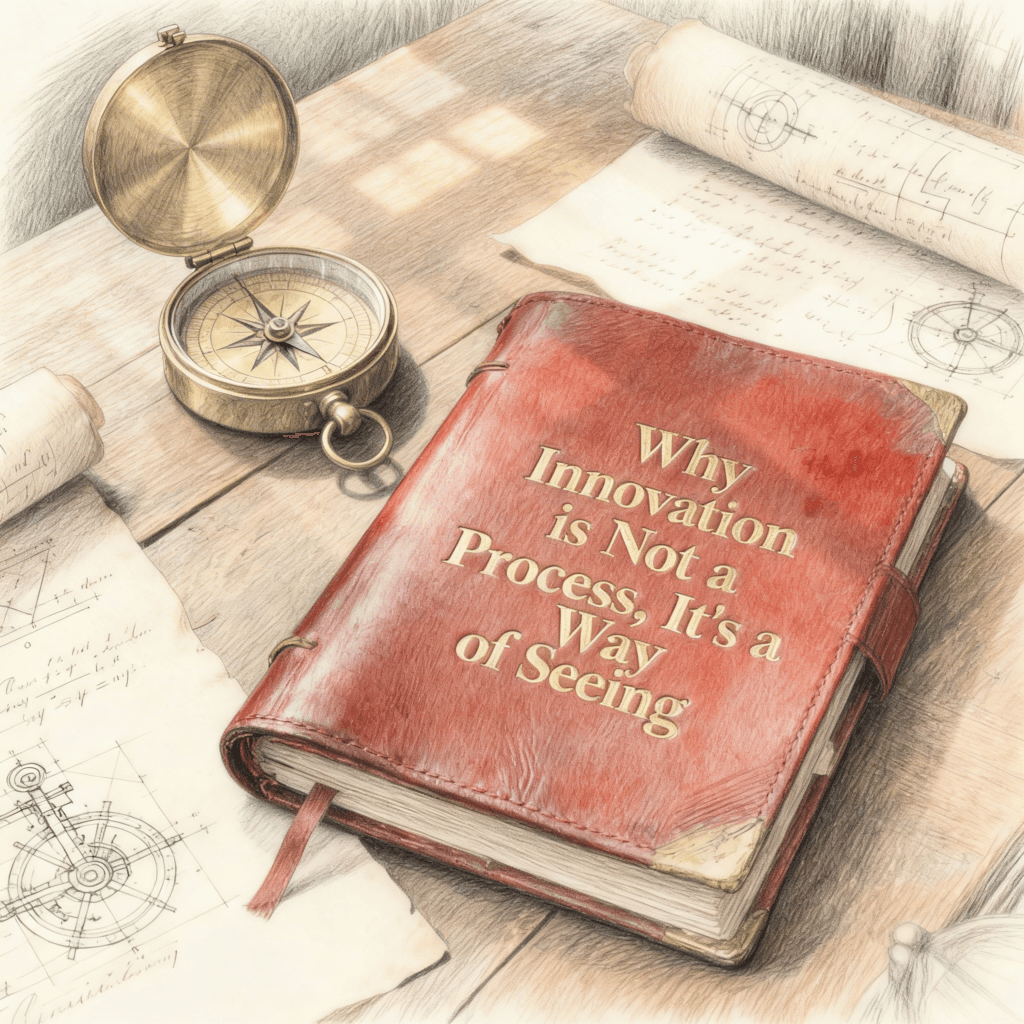
But here’s what nobody wants to admit. The companies that changed the world didn’t follow a process to get there. They saw something the rest of us missed.
The difference between process and perception sounds academic until you realize it explains why most innovation initiatives fail. A process assumes the problem is execution. Better brainstorming sessions, clearer milestones, more rigorous testing. But what if the real problem is that everyone in the room is looking at the same thing and seeing the same thing?
Consider what happened when Travis Kalanick couldn’t get a cab in Paris in 2008. Millions of people had stood on rainy streets with their arms raised, frustrated and cold. They all experienced the same problem. But most people saw it as bad luck or poor city planning. Kalanick saw a different problem entirely. He didn’t see a shortage of taxis. He saw idle cars and idle drivers separated by an information gap. Uber wasn’t built because someone ran a better innovation workshop. It emerged because someone looked at city transportation and saw a matching problem instead of a vehicle problem.
This matters because we’ve created an entire industry around innovation processes while ignoring the more fundamental question of how people learn to see differently. We teach people to brainstorm but not to observe. We teach them to prototype but not to question their assumptions. We’ve mistaken the scaffolding for the building.
The best innovators are not better at following steps. They’re better at noticing things that everyone else walks past. They see patterns where others see randomness. They see connections where others see separate domains. Most importantly, they see questions where others see settled answers.
The Checklist Trap
There’s a reason we love processes. They’re comforting. They promise control in an uncertain world. If innovation were truly just a process, then success would be reproducible. Spend X dollars, follow Y steps, get Z breakthrough. Companies would print money. Consultants would guarantee results.
But watch what actually happens when organizations try to systematize innovation. They create innovation departments, which immediately become isolated from the rest of the company. They set up stage gates, which filter out ideas that don’t fit existing categories. They establish metrics, which measure activity rather than insight. They schedule brainstorming sessions, which generate 200 ideas that all sound vaguely similar.
The process becomes the point. Teams celebrate completing the process regardless of the output. They filled out the canvas. They interviewed customers. They built a prototype. They pitched to leadership. All the boxes are checked. But nothing fundamentally new emerged because everyone was still seeing the world through the same lens.
Kodak invented the digital camera in 1975. They had the technology, the resources, and the market position. But they saw digital photography through the lens of film photography. They couldn’t imagine a world where cameras weren’t feeding an ecosystem of film sales, photo printing, and chemical processing. The technology didn’t fail them. Their way of seeing did.
Blockbuster passed on buying Netflix for $50 million. Not because they lacked an innovation process. They had planning committees and market research and strategic initiatives. But they saw themselves as being in the video rental business when they were actually in the home entertainment business. The frame was too narrow.
These weren’t failures of process. They were failures of perception.
The Artist’s Eye
Watch a painter look at a landscape. They don’t see trees and sky. They see shapes, values, color relationships, negative space. They’ve trained themselves to see the elements rather than the objects. A branch isn’t a branch. It’s a dark diagonal interrupting a light mass.
This is closer to how innovative thinking actually works. It requires seeing past the categories we’ve been taught and looking at the underlying elements. Not better brainstorming. Better seeing.
When Reed Hastings got charged a $40 late fee for Apollo 13, most people would have seen an annoying penalty. Some might have seen bad business practice. But Hastings saw a different question. Why does video rental work like a library when it could work like a gym? Same monthly fee, use it as much as you want, no penalties. That reframing created Netflix’s original subscription model.
The insight wasn’t produced by a process. It came from looking at something familiar and seeing it through a different metaphor.
The Tyranny of Expertise
Here’s something uncomfortable. Expertise can make it harder to see differently. The more you know about how things work, the more you’re invested in that explanation. Your mental models calcify. You stop seeing what’s actually there and start seeing what you expect to be there.
This is why breakthroughs often come from outsiders. Not because outsiders are smarter, but because they haven’t learned what to ignore yet. They still see the contradictions that experts have learned to overlook.
When psychologist Edward Jenner developed the smallpox vaccine, he was building on an observation that milkmaids seemed immune to smallpox. Medical experts at the time knew this observation existed, but they dismissed it as folklore. Jenner saw it as data. His relative lack of deep expertise in immunology might have helped. He wasn’t constrained by existing theories about how disease worked.
The computer mouse wasn’t invented by computer scientists. Doug Engelbart was working on human-computer interaction at a time when most computing experts saw computers as batch processing machines for scientific calculations. Because Engelbart wasn’t deeply embedded in that worldview, he could imagine computing as interactive and personal.
This doesn’t mean expertise is bad. Deep knowledge is essential for execution. But it suggests that the early stages of innovation benefit from a kind of productive naivete. A willingness to ask obvious questions. A resistance to the answer “that’s just how it works.”
Organizations struggle with this. They hire experts and then wonder why those experts produce incremental rather than revolutionary ideas. But experts are doing exactly what they were trained to do. They’re solving problems within the existing framework. Revolutionary ideas require questioning the framework itself.
The Beginner’s Mind
Zen Buddhism has a concept called shoshin, or beginner’s mind. It means approaching something without preconceptions, the way a beginner would. This is surprisingly difficult. Our minds are designed to create shortcuts. We categorize, we assume, we fill in gaps based on past experience.
Innovation requires temporarily suspending these shortcuts.
Watch a child encounter something new. They don’t immediately categorize it and move on. They explore. They test. They ask questions that seem obvious or absurd to adults. Why is the sky blue? Why can’t you walk on water? These questions seem simple because we’ve learned the answers. But the questions themselves often point to deeper principles.
When James Dyson developed the bagless vacuum cleaner, he started with a seemingly simple question. Why do vacuum cleaners lose suction? The industry answer was “because bags fill up.” But that wasn’t satisfying to Dyson. He kept asking why until he got to the real issue: the way air and dust interact. His solution came from industrial cyclone technology used in sawmills. Not from the vacuum cleaner industry.
Beginner’s mind doesn’t mean ignorance. It means holding your expertise lightly enough that you can still see the obvious questions.
This is hard to maintain. It requires active effort. You have to deliberately look at familiar things and ask “what am I assuming?” You have to resist the urge to jump to solutions and instead sit with questions longer.
The Observation Muscle
If innovation is fundamentally about seeing differently, then it follows that we should spend more time developing our capacity to observe. Not just to look, but to actually see.
Photography teaches this. When you first start taking photos, you point the camera at interesting things. After a while, you start noticing light, composition, the relationship between foreground and background. The world hasn’t changed. Your attention has.
Writing does something similar. When you’re actively writing, you notice the rhythm of speech, the precision of word choice, the structure of arguments. You become more attuned to language because you’re working with it consciously.
The same applies to innovation. You can develop the muscle of noticing anomalies, contradictions, workarounds, frustrations, inefficiencies. Not to immediately fix them, but to collect them. To wonder about them.
Most innovation advice focuses on generation. How to come up with ideas. But generation without observation is just recombination of existing patterns. Real innovation starts with seeing something true that others haven’t quite registered yet.
The Question of Timing
One thing that makes innovation tricky is that perception alone isn’t enough. You can see something clearly and still be too early or too late.
Numerous companies tried to launch tablet computers before the iPad. Microsoft had tablet PCs in 2001. They saw the opportunity. But the technology wasn’t ready, the ecosystem wasn’t there, and consumer behavior hadn’t shifted enough. Sometimes you can see the future clearly but the world isn’t ready to follow you there.
This is where judgment enters. Not just “what could be different?” but “what wants to be different right now?” You’re looking for tension in the system. Places where the old way is breaking down but the new way hasn’t quite emerged yet.
The rise of remote work during the pandemic is a good example. The technology existed for years. But most companies insisted on offices. The pandemic forced an experiment that revealed something many people had suspected: a lot of work doesn’t require physical presence. The perception was there. The permission to act on it wasn’t.
What This Means Practically
If innovation is about seeing differently rather than following a process, what should organizations actually do?
First, stop pretending that process guarantees outcomes. Processes can help organize work. They can improve communication. They can reduce waste. But they won’t make people see differently.
Second, create space for observation. Not as a formal step in a process, but as an ongoing practice. Let people spend time with customers, not to validate solutions, but to understand how they actually live. Let engineers see how their products break. Let designers see how people adapt tools for uses nobody intended.
Third, bring in diverse perspectives. Not diversity as a checkbox, but genuine cognitive diversity. People from different industries, different backgrounds, different disciplines. Not to be inclusive, though that matters. But because different experiences create different lenses.
The Deeper Point
The reason this matters goes beyond business success. We’re facing problems that won’t be solved by doing what we already know how to do slightly better. Climate change, inequality, educational gaps, healthcare costs. These require seeing the systems themselves differently.
The process mindset says “we need better execution.” The perception mindset says “we might be solving the wrong problem.”
When you’re stuck in a maze, running faster doesn’t help. You need to climb up and see the pattern from above. That’s what shifting perception does. It changes the level at which you’re operating.
This is why innovation feels rare even though creative potential is common. It’s not that most people lack ideas. It’s that most people are looking at the same things in the same ways. The innovation process industry has convinced us that we need better methods for generating ideas. But we actually need better ways of seeing what’s already there.
The good news is that this is learnable. You can train yourself to notice more, question more, connect more. You can deliberately expose yourself to different fields and different ways of thinking. You can practice holding your certainties more lightly.
The hard news is that there’s no shortcut. No five-step process to guarantee results. You have to do the work of actually looking at the world with fresh eyes, again and again. You have to make peace with uncertainty. You have to get comfortable with questions that don’t have immediate answers.
Innovation isn’t a process you complete. It’s a practice you maintain. A way of moving through the world that stays curious about what else might be true. Once you see it that way, the whiteboards and the frameworks and the stage gates start to look like what they are. Useful tools sometimes, but not the thing itself.
The thing itself is much simpler and much harder. It’s learning to see.