Table of Contents
Most people treat innovation like a light switch. They believe you either have it or you don’t. They think Steve Jobs woke up one day and simply knew how to make beautiful products. They imagine Elon Musk was born with the ability to think in first principles. This is comforting because it absolves us of responsibility. If innovation is a gift, we can’t be blamed for not having it.
But this is completely wrong.
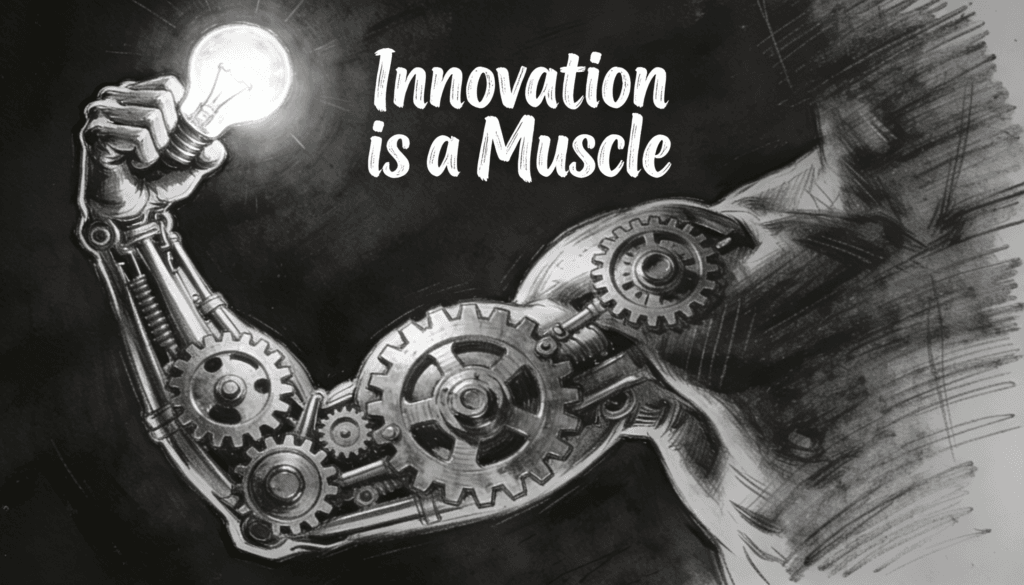
Innovation is a muscle. And like any muscle, it atrophies when you don’t use it. It grows when you stress it beyond its comfort zone. It needs consistent training, proper technique, and yes, a bit of pain.
The problem is that our entire educational and corporate infrastructure is designed to prevent this muscle from developing. We’ve built systems that reward the opposite of innovation. We celebrate people who follow the playbook, who color inside the lines, who deliver predictable results on predictable timelines. Then we wonder why breakthrough thinking is so rare.
The Comfort Zone is a Trap
Your brain is an energy conservation device. This sounds harsh, but it’s true. The human brain uses roughly 20% of your body’s energy despite being only 2% of your body weight. Evolution has therefore made it exceptionally good at finding shortcuts, patterns, and familiar paths that require less cognitive effort.
This is why you can drive home on autopilot while thinking about something else entirely. Your brain has optimized that route. It knows every turn, every traffic light, every landmark. The neural pathways are well worn highways.
Innovation requires you to bushwhack through the forest instead of taking the highway. It demands that you burn extra cognitive fuel to explore unfamiliar territory. Your brain resists this. It will offer you a thousand reasons why the familiar path is actually the smart choice.
This resistance feels like laziness, but it’s not. It’s your brain doing exactly what it evolved to do: conserve resources. Understanding this is critical because you can’t fight an enemy you don’t recognize.
When you sit down to solve a problem and immediately reach for the solution that worked last time, that’s not pragmatism. That’s your brain trying to avoid the gym. When you default to industry best practices without questioning them, you’re choosing the couch over the weight room. When you implement the same strategy as your competitors because it feels safe, you’re skipping leg day.
The innovative muscle gets built only when you force yourself past this initial resistance. You need to make your brain uncomfortable on purpose.
Repetition Creates Capability
Here’s something that sounds obvious but rarely gets applied to innovation: you get better at things you practice.
We accept this completely when it comes to playing piano or shooting free throws. Nobody expects to sit at a piano for the first time and play Chopin. Nobody picks up a basketball and immediately sinks twenty shots in a row. We understand that mastery requires repetition, failure, adjustment, and more repetition.
Yet somehow we expect ourselves and our teams to innovate brilliantly without practice. We hold an annual offsite, throw around some ideas, maybe stick some Post-it notes on a wall, and wonder why nothing transformative emerges.
Real innovation training means creating regular, structured opportunities to think differently. Not once a year. Not when there’s a crisis. Daily or weekly practice that forces you to approach familiar problems from unfamiliar angles.
What does this look like practically? It means asking different questions. Instead of “How do we make this 10% better?” you ask “What would this look like if we started from scratch today?” Instead of “What do customers say they want?” you ask “What problem are they actually trying to solve?”
It means deliberately seeking out uncomfortable perspectives. If you work in technology, spend time understanding how artists think. If you’re in finance, study how designers approach problems. If you’re in healthcare, learn from hospitality. The goal isn’t to become an expert in other fields. The goal is to build new neural pathways that connect disparate ideas in novel ways.
This cross training matters enormously. Innovation rarely comes from going deeper into your own field. It comes from importing insights from adjacent or distant domains. The person who invents the next breakthrough in education might be borrowing principles from video game design. The next revolution in manufacturing might come from someone who studied ecosystems.
But you only see these connections if you’ve trained yourself to look for them.
Failure is the Weight That Builds Strength
Physical muscles grow through a process called hypertrophy. You stress the muscle fiber beyond its current capacity, creating microscopic tears. The body repairs these tears, and the muscle comes back slightly stronger. Repeat this process enough times and you build significant strength.
Innovation works identically. You need to fail. Not occasionally. Regularly. Deliberately.
This is where most organizations completely lose the plot. They say they value innovation, then they punish every failure. They create systems where the smart career move is to never take risks. They promote the people who deliver consistent, mediocre results over those who swing for the fences and sometimes miss.
The result is an innovation muscle that never gets stressed. It never tears. It never repairs stronger. It just sits there, getting weaker with each quarter that passes.
Companies that actually innovate understand this differently. They create protected spaces where failure is not just tolerated but expected. Amazon’s Jeff Bezos famously said that if you’re going to take bold bets, some of them have to fail. Otherwise, you’re not betting boldly enough. Google’s celebrated 20% time wasn’t valuable because it produced Gmail and Google Maps. It was valuable because it produced hundreds of failures that taught people it was safe to try crazy ideas.
But here’s the critical nuance: not all failure builds strength. Random, chaotic failure just creates confusion and waste. Productive failure requires structure.
You need to fail fast, which means testing assumptions quickly rather than building for months before discovering you were wrong. You need to fail small, which means limiting the blast radius so a bad idea doesn’t take down the whole company. You need to fail informatively, which means actually learning something valuable from what didn’t work.
Most importantly, you need to separate identity from outcome. When someone’s innovative attempt fails, that doesn’t make them a failure. It makes them someone who is actively building their innovation muscle. Organizations that understand this difference attract and keep their best creative talent.
The Progressive Overload Principle
Athletes use a concept called progressive overload. You can’t lift the same weight forever and expect to get stronger. You need to gradually increase the difficulty to continue making gains.
The same applies to innovation. Solving the same types of problems in the same ways might feel productive, but you’re not growing. You’re maintaining at best, likely declining.
This is why successful innovators consistently seek harder challenges. Not arbitrary difficulty, but strategic increases in complexity that stretch their capabilities.
Early in your innovation journey, this might mean questioning one assumption in your current process. As you develop, it means questioning the entire framework. Eventually, it means questioning the fundamental premises of your industry.
Netflix provides a useful example. Early innovation was about mailing DVDs instead of requiring store visits. Moderate difficulty. Later innovation was about streaming instead of physical media. Significantly harder. Current innovation is about creating original content instead of licensing it. Extremely difficult and capital intensive.
Each level required different capabilities and different tolerance for uncertainty. If Netflix had stayed at the first level, Blockbuster’s eventual demise would have taken them down too. The progressive overload forced them to build muscles they didn’t initially have.
For individuals, this means deliberately taking on projects that make you uncomfortable. If you always work on things you know how to do, you’re not training. You’re just performing. Training requires attempting things you might fail at.
Recovery Matters Too
Here’s where the muscle metaphor becomes especially instructive. Professional athletes don’t train at maximum intensity every single day. They incorporate rest, recovery, and variation. They understand that growth happens during recovery, not during the workout itself.
Most innovation focused environments ignore this completely. They create cultures of perpetual urgency where everyone is always sprinting. This doesn’t build innovation capacity. It creates burnout.
Your brain needs downtime to process new information, form unexpected connections, and consolidate learning. This is why good ideas often come in the shower or on walks rather than during intense brainstorming sessions. Your diffuse mode thinking needs space to work.
Organizations serious about innovation build in structured recovery time. This doesn’t mean unlimited vacation or ping pong tables. It means protecting time for reflection, exploration, and non urgent thinking.
The person who works 80 hours a week on the same problems using the same thinking patterns isn’t training their innovation muscle. They’re just wearing it out.
Technique Matters as Much as Effort
You can spend hours at the gym with terrible form and make no progress while risking injury. You can also train smart with proper technique and see dramatic improvements.
Innovation has technique too. It’s not just about trying hard or thinking positive. There are specific mental models and frameworks that make innovative thinking more reliable and less random.
First principles thinking is one such technique. Instead of reasoning by analogy, which means doing what others do with minor variations, you break things down to fundamental truths and build up from there. This is how Elon Musk approached rocket costs. Instead of accepting that rockets are expensive, he asked what they’re made of and what those materials cost. The gap between material costs and rocket prices revealed massive room for innovation.
Another technique is inversion. Instead of asking how to succeed, ask how you could guarantee failure, then avoid those things. Instead of asking how to make customers happy, ask what would definitely make them angry, then do the opposite. This mental flip often reveals insights that forward thinking misses.
Constraint based thinking is powerful too. Instead of asking what you could do with unlimited resources, ask what you could do with severe limitations. Some of the most elegant innovations come from working around constraints rather than removing them.
These techniques aren’t magic. They’re just structured ways to force your brain out of default patterns. But like proper squat form or correct piano fingering, they make practice dramatically more effective.
The key is to actually use them repeatedly until they become habitual. Reading about first principles thinking once doesn’t help. Applying it to every significant problem for six months transforms how you think.
The Social Dimension of Training
Nobody builds serious muscle training completely alone. You need spotters, trainers, and fellow athletes who push you further than you’d push yourself.
Innovation works the same way. The lone genius inventor is mostly a myth. Real innovation almost always happens in networks of people who challenge each other’s assumptions and build on each other’s ideas.
But not just any social environment helps. Many groups actually suppress innovative thinking through social dynamics. Groupthink, status hierarchies, and the desire to fit in all push thinking toward convergence rather than divergence.
You need to deliberately construct your innovation training environment. This means finding people who think differently than you do. Not people who disagree for the sake of disagreement, but people whose fundamental frameworks and experiences give them genuinely different perspectives.
It also means creating psychological safety, which is not about being nice or avoiding conflict. It’s about making it safe to propose wild ideas, question sacred cows, and admit uncertainty without social penalty.
The best innovation teams have a weird mix of trust and tension. They trust each other enough to be vulnerable about half formed ideas. They create enough intellectual tension to avoid lazy thinking. This balance is hard to strike, but it’s essential for serious training.
You Can’t Outsource the Work
Here’s the uncomfortable truth: innovation consultants, frameworks, and methodologies can help, but they can’t do the actual muscle building for you.
Organizations love to buy innovation. They hire consulting firms to run design sprints. They implement stage gate processes. They create innovation labs physically separated from the main business. Then they’re surprised when nothing fundamental changes.
This is like hiring a personal trainer, listening to their advice, then never actually lifting any weights. The trainer can teach you proper form and design your program, but they cannot do your pushups for you.
Real innovation capacity gets built through direct experience. You have to personally struggle with hard problems. You have to personally experience the discomfort of not knowing the answer. You have to personally iterate through failed attempts.
This is why innovation theater is so common and so useless. Companies go through the motions of innovative processes without doing the actual cognitive work. They want the results without the training.
The executives who lead truly innovative organizations don’t just sponsor innovation. They personally practice it. They ask the uncomfortable questions in meetings. They challenge their own assumptions publicly. They model the behavior of someone actively training their innovation muscle.
The Compound Effect
Small, consistent training produces dramatic long term results that sporadic intense efforts never achieve. This is true for physical fitness and equally true for innovation.
If you spend just thirty minutes a day practicing innovative thinking, asking better questions, exploring adjacent fields, or challenging assumptions, you’ll build substantially more capability than if you attend an annual innovation workshop.
The problem is that daily practice feels less impressive. There’s no immediate visible result. No dramatic transformation. Just tiny incremental improvements that seem almost meaningless in isolation.
But these increments compound. The person who practices innovative thinking daily for a year doesn’t just think 365 days better than when they started. They think exponentially better because each day’s practice builds on all the previous days.
Their brain has formed new default pathways. What used to require conscious effort now happens automatically. They spot opportunities others miss not because they’re smarter but because they’ve trained their attention differently.
This compounds at the organizational level too. A company where everyone practices innovative thinking daily creates a completely different culture than one where people occasionally attend innovation training. The daily practitioners build shared language, mutual understanding, and collective capability that transforms what the organization can attempt.
Start Where You Are
The good news about innovation being a muscle is that anyone can develop it. You don’t need special genetics or lucky breaks. You just need to start training and stay consistent.
Start with small, manageable challenges. Pick one assumption in your work and question it seriously. Find one connection between your field and something completely different. Propose one idea that makes you slightly nervous because it might sound stupid.
These tiny acts of cognitive resistance are the beginning of real capacity building. They won’t revolutionize anything immediately. But they’ll start forming the neural pathways that make bigger innovations possible later.
The person who can do fifty pushups didn’t start there. They started with struggling through five. But they showed up consistently, pushed past comfort, and built capacity over time.
Your innovation muscle works exactly the same way. It will hurt a bit. That’s not a sign you’re doing it wrong. That’s a sign you’re actually training.
The question isn’t whether you have the innovation gene. The question is whether you’re willing to do the work to build the muscle. Everything else follows from that choice.