Table of Contents
You are about to say something you will regret. Your jaw tightens. Your pulse spikes. A coworker just took credit for your idea. A stranger cut you off in traffic. Your partner forgot something important for the third time. The anger is already moving through your nervous system like an electrical current, looking for a place to discharge.
This is the moment Marcus Aurelius wants to talk to you about.
Not after the outburst. Not during the silent treatment that follows. Not in the apology you will draft later that evening. Right now. In the five seconds before you open your mouth.
Marcus Aurelius was the emperor of Rome from 161 to 180 AD. He commanded legions, managed a plague, and dealt with betrayals that make modern office politics look like a game of tag. He also kept a private journal, never intended for publication, in which he essentially argued with himself about how to be a decent person. That journal became Meditations, and it has been in print for nearly two thousand years. Not because it is elegant philosophy. Because it works.
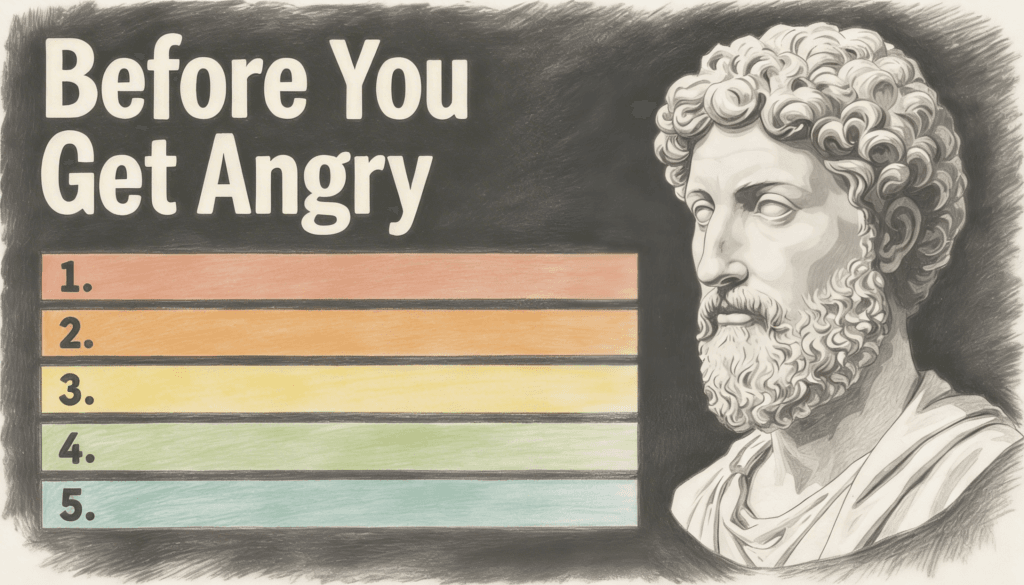
The core of his anger management strategy is deceptively simple. Before you react, ask yourself a sequence of questions that take roughly five seconds. These questions do not suppress the anger. They redirect it. They force your brain to switch gears, from the reactive limbic system to the prefrontal cortex, where reason lives. Neuroscience would catch up to this idea about eighteen centuries later, but Marcus figured it out with nothing more than a candle and some papyrus.
The First Question: Is This Actually About Me?
Most anger feels deeply personal. Someone insulted you. Someone disrespected you. Someone crossed a line that you drew.
Marcus would ask you to pause and consider whether the offending person even knows your line exists.
In Book 6 of Meditations, he writes that when someone wrongs you, you should immediately ask what their concept of good and evil is. This sounds abstract, but the practical implication is sharp. The person who cut you off in traffic is not making a philosophical statement about your value as a human being. They are late for something. They are distracted. They are, in the vocabulary of modern psychology, operating from their own internal model of the world, which has almost nothing to do with you.
This is where anger gets interesting from a cognitive science perspective. Research on attribution bias shows that we consistently overestimate the degree to which other people’s actions are about us. When someone is rude, we assume intent. When we are rude, we assume context. You were having a bad day. They are a bad person. This asymmetry is so reliable that psychologists have a name for it: the fundamental attribution error.
Marcus did not have the name, but he had the insight. And his remedy was not to excuse the behavior. It was to correctly identify it. There is a difference between someone who insults you deliberately and someone who is simply operating with a different set of assumptions. Confusing the two does not make you perceptive. It makes you exhausted.
The Second Question: Will This Matter Tomorrow?
This one sounds like a refrigerator magnet, but Marcus meant it with more teeth than most people realize.
He repeatedly reminded himself that empires fall. That the famous become forgotten. That the controversies of one era become the footnotes of the next. He was not being gloomy. He was using scale as a tool.
Consider when you experience a triggering event, your amygdala fires before your conscious mind can process what happened. The physiological response, the tight chest, the flushed face, the clenched fists, arrives before any thought at all. It is a survival mechanism designed for encountering predators, not for reading passive aggressive emails.
Marcus’s question about temporal significance is essentially a manual override. By asking whether this will matter tomorrow, next week, or next year, you are forcing your prefrontal cortex to engage. You are asking your brain to simulate the future, which is a complex cognitive task that cannot coexist with the simple fight or flight response. The anger does not disappear. But it loses its monopoly on your attention.
Here is the counterintuitive part: sometimes the answer is yes, this will matter tomorrow. And that is useful information. Because if something genuinely matters, you want to respond to it with clarity, not with whatever your adrenal glands cooked up in the first 200 milliseconds.
The Third Question: What Would I Advise a Friend to Do?
This is perhaps the most psychologically sophisticated move in the entire sequence, and Marcus never framed it as a technique. He simply practiced it.
Throughout Meditations, he writes to himself in the second person. You are disturbed not by things, but by your judgments about things. He creates distance between the experiencing self and the observing self. Modern therapy calls this cognitive defusion. Marcus called it Tuesday.
The friend test works because of a well documented phenomenon in decision science. When we make decisions for others, we tend to be more rational, more balanced, and less emotionally compromised than when we make decisions for ourselves. Researchers at the University of Waterloo found that people who reasoned about personal problems from a third person perspective showed better emotional regulation and wiser reasoning than those who thought in the first person.
So when you are trembling with rage because someone left a condescending comment on your work, ask yourself what you would tell your best friend to do in the same situation. You would probably not tell them to fire off a reply at 11 pm. You would probably say something like: Sleep on it. If you are still angry tomorrow, respond then. The advice is obvious. The difficulty is remembering that it applies to you too.
The Fourth Question: What Is the Cost of This Reaction?
This is where Marcus gets ruthlessly practical. He was an emperor. He could afford to be angry. He had the power to act on every impulse with devastating consequences. And he knew, precisely because of this, that the cost of unchecked anger is always paid by the angry person.
Think of anger as a loan shark. It offers you a burst of energy and righteousness right now, and then it collects interest for days, weeks, sometimes years. The argument you started at dinner ruins the evening. The email you sent in frustration creates a chain of damage control. The grudge you hold takes up mental real estate that could have been used for almost anything else.
There is a concept in economics called opportunity cost: the value of what you give up when you choose one option over another. Every minute you spend furious about a situation is a minute you did not spend solving it, learning from it, or simply enjoying its absence. Marcus understood this intuitively. He wrote that the best revenge is not to become like your enemy. The logic is not moral. It is economic. Becoming like your enemy is expensive. It costs you your composure, your time, and often your relationships.
This question also connects to something game theorists have studied extensively. In repeated interactions, which is what most relationships and workplace dynamics are, retaliatory anger tends to produce worse long term outcomes than measured responses. The research on the Prisoner’s Dilemma shows that strategies based on cooperation with proportional consequences outperform strategies based on escalation. Your grandmother probably told you something similar, but she did not have the data set.
The Fifth Question: Am I Reacting to Reality or to a Story?
This is the deepest cut, and it is the one most people skip.
When you are angry, you are almost never angry at raw facts. You are angry at your interpretation of the facts. Your coworker got the promotion. That is a fact. The story is that it happened because the boss is unfair, or because your coworker is manipulative, or because the system is broken. The story may be true. But the anger is attached to the story, not the event.
Marcus wrote about this with startling precision. Take away your opinion, and there is taken away the complaint. Take away the complaint, and the injury is gone. He was not saying that bad things do not happen. He was saying that we add layers of narrative to events and then react to our own additions.
This maps directly onto what psychologists call appraisal theory. Emotions are not produced by events. They are produced by our evaluation of events. Two people can experience the same setback and have entirely different emotional responses based on how they frame it. One sees a catastrophe. The other sees data.
The five second practice is not about becoming a person who never gets angry. That person does not exist, and if they did, you probably would not want to have dinner with them. The practice is about creating a gap between stimulus and response. Viktor Frankl, the psychiatrist who survived Auschwitz, described that gap as the location of human freedom. Marcus would not have phrased it that way. But he lived it.
Why Five Seconds Is Enough
There is a physiological reason this works in such a short window. The initial surge of neurochemicals that accompanies anger, primarily cortisol and adrenaline, takes about 90 seconds to peak and begin to dissipate. But the decision to act on that surge happens in the first few seconds. If you can interrupt the automatic response in that narrow window, you give your brain enough time to recruit the slower, more deliberate cognitive processes.
It is like catching a glass before it hits the floor. You do not need an hour. You need the right reflex at the right moment.
What makes Marcus Aurelius’s approach different from most anger management advice is that it does not ask you to be calm. It does not ask you to count to ten or take deep breaths, though those things have their place. It asks you to think. Specifically, it asks you to think about the nature of the situation, the significance of the trigger, the perspective of a rational observer, the cost of your response, and the gap between reality and narrative.
Five questions. Five seconds. Not because anger is wrong, but because uninspected anger is expensive.
The Practice in Daily Life
The obvious objection is that nobody runs through five philosophical questions in the heat of a moment. And that is fair. Marcus did not get this right every time either. He wrote about his failures repeatedly. The journal was not a victory lap. It was a training manual.
The way this works in practice is through repetition. You do not need to consciously recall each question in sequence. What you need is the habit of pausing. The questions become a reflex, a mental pattern that fires automatically when your anger threshold is crossed.
Start with whichever question resonates most. For some people, it is the temporal one. Will this matter tomorrow? For others, it is the friend test. For others still, it is the story question. Over time, the full sequence becomes a single mental motion, like turning a key in a lock.
What Marcus Knew That We Keep Forgetting
There is something strange about a man who ruled the known world spending his evenings writing reminders to himself about patience. It suggests that wisdom is not a permanent state. It is a practice. Marcus did not write Meditations because he had mastered his emotions. He wrote it because he had not.
That is the most useful thing about his approach. It does not require you to become a different person. It does not require you to suppress who you are. It requires you to insert a five second delay between what happens to you and what you do about it.
In those five seconds, you are not becoming a Stoic philosopher. You are becoming someone who chooses their response instead of having it chosen for them. The anger is still there. The situation is still real. But you are no longer on autopilot.
Marcus Aurelius had every reason to be angry, every day, for the entire duration of his reign. Wars, plagues, conspiracies, ungrateful subordinates. He had the power to destroy anyone who annoyed him. Instead, he wrote in his journal, night after night, trying to be a little less reactive than he was the day before.
If the most powerful man in the ancient world thought he needed a five second check on his anger, you probably do too.
The good news is that five seconds is all it takes.