Table of Contents
You scrolled for forty minutes last night. You know this because your phone told you so, in that passive aggressive weekly report it sends like a concerned parent. And what did you gain? A vague sense that everyone is on vacation, everyone is in love, and everyone has better abs than you.
This is not a failure of willpower. It is not even a failure of the algorithm. It is something far older and far more stubborn. Arthur Schopenhauer figured it out nearly two hundred years ago, long before anyone had a ring light or a content strategy.
The Pendulum That Never Stops
Schopenhauer’s central observation about human life was brutally simple. We are driven by will. Not willpower in the motivational poster sense, but a blind, ceaseless wanting that defines our existence. We want things. We get them. And then, almost immediately, we want something else.
He described life as a pendulum swinging between suffering and boredom. When we lack something, we suffer. When we obtain it, the satisfaction evaporates and we are left restless. There is no resting place. The pendulum does not stop in the middle.
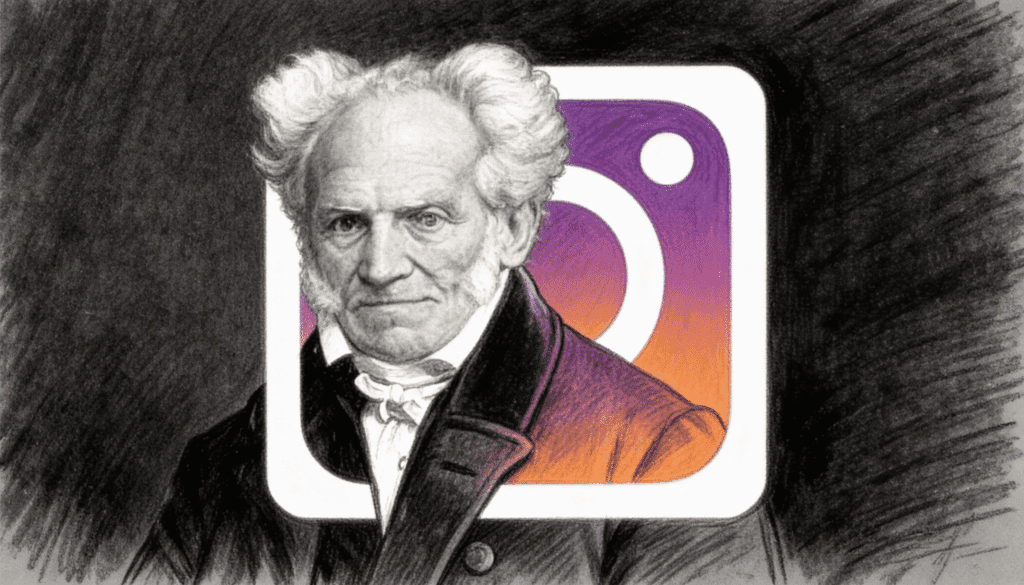
Instagram is this pendulum in digital form.
Think about what actually happens when you open the app. You see someone’s kitchen renovation and suddenly your kitchen feels small. You see a couple on a cliff in Portugal and your Tuesday evening seems pale. You see a fitness influencer’s morning routine and your own morning, which involved hitting snooze three times and eating cereal over the sink, feels like a personal failing.
Each image creates a want. And each want, the moment you register it, is already a small suffering. You have not even put down your phone, and you have already manufactured dozens of tiny dissatisfactions. Schopenhauer would have been unsurprised. He might have even smiled, which by all accounts he rarely did.
Desire Is Not a Bug. It Is the Operating System.
Most self help advice treats your phone habits as a discipline problem. Put the phone in another room. Set a timer. Use grayscale mode so Instagram looks like a Soviet newspaper.
These fixes miss the deeper issue. The problem is not that you lack discipline. The problem is that Instagram has found the most efficient delivery mechanism ever invented for what Schopenhauer identified as the root of all unhappiness: endless, regenerating desire.
Consider how the feed works. It is infinite. There is no bottom. This is not an accident of design. It is the design. An infinite feed means an infinite supply of new things to want, new lives to compare against, new gaps between where you are and where you could be. The scroll itself is an act of wanting. You are not looking for anything in particular. You are just looking, which is to say, you are just wanting.
This connects to something the Buddhist tradition noticed independently of Schopenhauer, though he read Buddhist texts and admired them. The Sanskrit word “tanha” is usually translated as craving or thirst. It does not refer only to craving specific things. It refers to the craving itself, the background hum of wanting that persists regardless of what is wanted. Instagram does not create this hum. But it amplifies it to a volume that would have made the Buddha wince.
The Paradox of Aspiration Content
Here is where things get counterintuitive. Much of what fills your feed is supposed to be inspiring. Fitness transformations. Entrepreneurs sharing their journey. People who quit their corporate jobs to make pottery in Tuscany. The implicit message is: you could have this too.
But Schopenhauer would point out that aspiration is just desire with better marketing.
When you see someone’s “morning routine that changed my life” post, you do not feel inspired in any lasting way. What you feel is the gap. The distance between their morning and your morning. The distance between their apparent contentment and your current state. Inspiration, in this context, functions as a particularly elegant form of dissatisfaction.
This is why motivational content has such a short half life. You feel a surge of something that resembles determination. It lasts about as long as it takes to close the app. By dinner, the feeling has evaporated. Not because you are lazy, but because the feeling was never about action. It was about desire. And desire, as Schopenhauer observed, consumes itself the moment it arises.
The self improvement industry understands this cycle intuitively, even if it would never frame it this way. That is why there is always another routine, another habit, another system. The product is not transformation. The product is the perpetual feeling that transformation is just one more piece of content away.
Social Comparison Is Older Than Phones
The psychologist Leon Festinger formalized social comparison theory in 1954. Humans evaluate themselves by comparing to others. Upward comparisons, where we measure ourselves against people who seem to be doing better, tend to make us feel worse. Downward comparisons, against those doing worse, tend to make us feel better, though we usually feel guilty about it.
Instagram is essentially an upward comparison engine. People post their best moments, best angles, best lighting. You are comparing your unedited life to everyone else’s highlight reel. This observation has become almost a cliché, which is unfortunate, because it is still perfectly true and people keep forgetting it the moment they pick up their phone.
But Schopenhauer adds a layer that Festinger does not. For Schopenhauer, the comparison itself is not the deepest problem. The deepest problem is that even if you won every comparison, even if you were the most attractive, most successful, most well traveled person on the entire platform, you would still be unhappy. Because satisfaction is structurally impossible. The will always generates new wants. You would simply find a new dimension on which to feel inadequate, or, failing that, you would be bored.
This is the genuinely dark part of Schopenhauer’s philosophy, and the part most relevant to our current situation. He is not saying that you are unhappy because you are comparing yourself to the wrong people. He is saying that the comparing mind itself, the wanting mind, cannot arrive at happiness no matter what it is given.
The Attention Economy Meets 19th Century Pessimism
There is a reason tech companies hired behavioural psychologists and not philosophers. Psychologists help you build sticky products. Philosophers might have told you the product was a bad idea.
The attention economy is built on the Schopenhauerian mechanism without acknowledging it. Every notification, every like, every follower count exploits the gap between wanting and having. You post a photo. You want likes. The likes come, and for a moment there is a flicker of satisfaction. Then it fades. You check again. You post again. The cycle repeats.
B.F. Skinner described this with pigeons and pellets in the 1930s. Variable ratio reinforcement, where rewards come unpredictably, produces the most persistent behaviour. Slot machines use it. So does every social media platform. The unpredictability of engagement, will this post do well or not, keeps you pulling the lever.
Schopenhauer and Skinner make an unlikely pair, but they describe the same trap from different angles. Skinner explains the mechanics. Schopenhauer explains why the mechanics work. They work because we are built to want, and wanting never resolves into lasting satisfaction. The pigeon keeps pecking. The user keeps scrolling. The pellet is never enough.
What Schopenhauer Actually Suggested
Schopenhauer was not entirely without solutions, though his solutions are not the kind you find in a carousel post titled “5 Ways to Reclaim Your Peace.”
His primary escape route was aesthetic contemplation. When you lose yourself in a piece of music, a painting, or a natural landscape, you temporarily step outside the cycle of willing. You are not wanting anything. You are simply perceiving. The will quiets down. The pendulum, for a moment, stops.
This is interesting because it suggests something specific about the difference between consuming Instagram content and consuming art. Both involve looking at images. But the relationship is fundamentally different. Art, at its best, arrests desire. It takes you out of yourself. Instagram does the opposite. Every image pulls you back into wanting. Even images of beautiful things become occasions for wanting, wanting to be there, wanting to look like that, wanting that life.
Schopenhauer’s other suggestion was compassion. Recognizing that everyone else is trapped in the same cycle of wanting reduces the grip of individual desire. This is perhaps the most counterintuitive takeaway for the Instagram age. The cure for envy is not achieving what the other person has. It is recognizing that they are suffering in the same way you are. The person on the cliff in Portugal checked their likes after posting that photo. Probably twice.
The Most Honest App Review Ever Written
If Schopenhauer were to review Instagram, he might write something like this: works as intended. Efficiently surfaces the fundamental structure of human suffering. Five stars.
He would probably be right. The app is not broken. You are not broken. The mechanism is working exactly as it should, both from Silicon Valley’s perspective and from the perspective of a 19th century German pessimist. Your desire is being captured, monetized, and fed back to you in a loop that generates engagement metrics and existential unease in roughly equal measure.
So What Do You Actually Do?
The practical question remains. And here I will depart slightly from Schopenhauer, who was not especially interested in practical questions and who spent much of his life bitter about Hegel’s popularity, which is perhaps the 19th century equivalent of being mad about someone else’s follower count.
You probably will not delete Instagram. And Schopenhauer would say that even if you did, the wanting mind would find new objects. Which is true. But there is a meaningful difference between handing your wanting mind an infinite feed of curated desire and simply letting it fend for itself.
The useful insight from Schopenhauer is not “desire is bad” or “stop wanting things.” It is the more specific observation that the act of wanting contains its own suffering, right now, in the present tense. Not when you fail to get the thing. Not when the thing disappoints. Right now, in the wanting itself.
This reframing changes the question. Instead of asking “how do I get what they have” when you see an enviable post, you might notice the wanting itself and ask whether the wanting is doing anything for you. Usually the answer is no. The wanting is just sitting there, making you feel slightly worse about a life that, thirty seconds ago, before you opened the app, was perfectly fine.
Schopenhauer did not know about algorithms or dopamine loops or engagement metrics. But he knew about wanting, and he knew it was bottomless. Two centuries later, the bottomlessness has merely been optimized.
The feed will never make you happy. Not because the content is bad, not because the people in it are fake, and not because the algorithm is malicious. It will never make you happy because nothing satisfies wanting. That is not a tech problem. It is the human condition, now available in an infinitely scrollable format.