Table of Contents
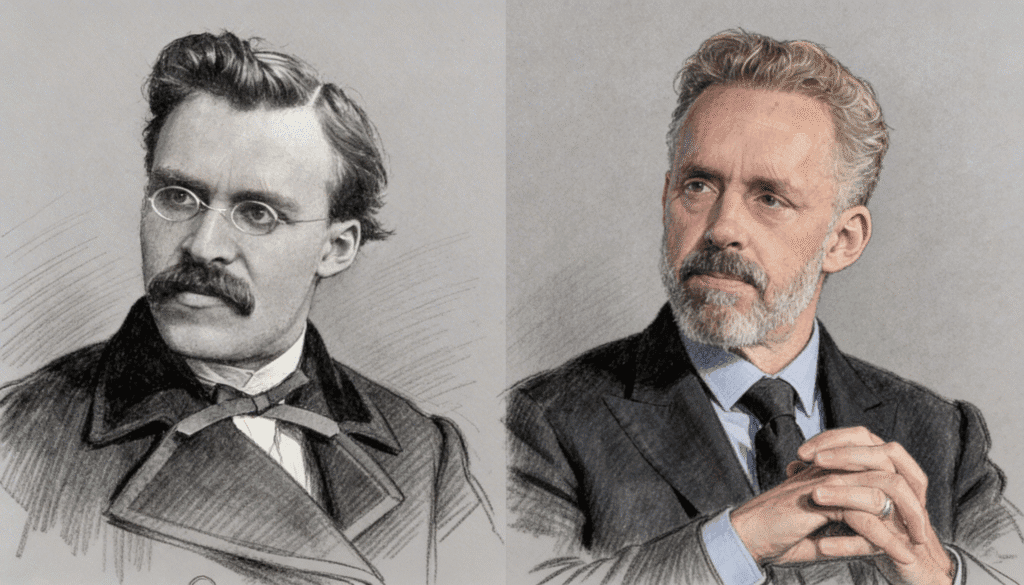
There is something almost comedic about it. A 19th century German philosopher who went insane, wrote in aphorisms, and once declared God dead has become the most quoted thinker in podcasts, self help lectures, and online intellectual culture. Friedrich Nietzsche shows up everywhere. Jordan Peterson references him constantly. So does Sam Harris. So do the hosts of countless philosophy channels, political commentators, and even fitness influencers. The man has been dead for over 120 years and he is having the best century of his career.
The question is not really whether Nietzsche is relevant. That much is obvious. The question is why he became the philosopher that everyone keeps returning to, especially people who disagree with each other about almost everything else.
The Uncomfortable Mirror
Nietzsche does something that most philosophers avoid. He does not build a tidy system and ask you to live inside it. He holds up a mirror and forces you to look at yourself without the stories you normally tell. This is why Peterson keeps going back to him. Peterson’s entire project, at its core, is about confronting uncomfortable truths about human nature. Nietzsche is the original uncomfortable truth teller.
When Peterson talks about the necessity of meaning, about the danger of nihilism, about the chaos that waits on the other side of collapsed belief systems, he is walking through a landscape that Nietzsche mapped first. Peterson often frames this in psychological terms, drawing on Carl Jung and clinical practice. But the raw material is Nietzschean. The idea that modern people are walking around with a hole where God used to be, and that this hole creates real psychological and social consequences, comes straight from Nietzsche’s diagnosis in The Gay Science.
What makes this interesting is that Peterson is, in many ways, arguing against Nietzsche’s proposed solution while accepting Nietzsche’s diagnosis. Peterson thinks the answer is something like a return to deep narrative structures, archetypes, responsibility, and the traditions embedded in Western religion. Nietzsche thought the answer was to go further, to become something new, to create your own values from scratch. Peterson uses Nietzsche the way a doctor uses an X ray. The image reveals the fracture, but the treatment plan is entirely different from what the radiologist might suggest.
The God Shaped Hole in Modern Culture
The “God is dead” declaration is probably the most misunderstood sentence in the history of philosophy. It was not a celebration. Nietzsche was not standing on a rooftop cheering. He was issuing a warning. He was saying that the foundation Western civilization had built its morality, meaning, and social order on was crumbling, and that most people had not yet realized the consequences.
This is the part that resonates now more than ever. We live in a time when institutional trust is collapsing. Church attendance in the West has been falling for decades. Political ideologies function as substitute religions, complete with their own creation myths, moral codes, heretics, and rituals of public confession. Social media has created a marketplace of meaning where people scroll through competing narratives the way they scroll through products. Everything is available and nothing feels sufficient.
Peterson saw this early and articulated it in a way that connected with millions of people, many of them young men who felt loose. His lectures on Nietzsche are not academic exercises. They are interventions. He is saying: this philosopher predicted exactly the crisis you are living through, and if you do not take it seriously, you will drown in it.
But Peterson is not the only one who noticed. The entire landscape of popular intellectualism is essentially a series of different responses to the problem Nietzsche identified. Sam Harris tries to build a secular morality grounded in science and wellbeing. Slavoj Žižek uses Nietzsche as a launching pad for Marxist and psychoanalytic critique. They are all standing in the same crater. They just disagree about what to build there.
Why Nietzsche and Not Someone Else
There are plenty of philosophers who diagnosed modernity’s problems. Kierkegaard wrote about the anxiety of freedom before Nietzsche did. Dostoevsky, through fiction, explored what happens when people abandon moral foundations. Heidegger examined the technological flattening of human experience. So why does Nietzsche get the most airtime?
Part of it is style. Nietzsche is a phenomenal writer. He is quotable in a way that Heidegger, for instance, is absolutely not. You can pull a Nietzsche line out of context, put it on a black background with a mountain behind it, post it to Instagram, and it works. “He who has a why to live can bear almost any how.” “If you gaze long into an abyss, the abyss also gazes into you.” Try doing that with a passage from Being and Time. You will lose your audience before they finish the first clause.
But there is a deeper reason. Nietzsche is the philosopher of the individual. His entire body of work is addressed to the person who feels that something is wrong with the world but cannot quite articulate what. He speaks to the experience of being intelligent enough to see through the stories your culture tells but not yet strong enough to live without them. This is an experience that millions of people in the modern world share, and it has only intensified with the internet and social media, which are basically machines for dissolving shared narratives while offering no replacement.
This is also why Nietzsche shows up in unexpected places. Startup culture is full of Nietzschean thinking, even when the founders have never read a page of his work. The idea that you should create something new, disrupt existing structures, trust your own vision over established norms, and push past the limits of what others think possible is pure Nietzsche. Silicon Valley runs on a secularized version of the will to power. The entrepreneur as the Übermensch, building the future while everyone else clings to the past.
Fitness culture has absorbed Nietzsche too, though in a simplified form. The obsession with self overcoming, with discipline, with becoming a harder version of yourself is drawn from the same well. When David Goggins talks about pushing through suffering to find your real self on the other side, he is essentially paraphrasing Nietzsche without the footnotes.
The Selective Reading Problem
Here is where things get complicated and a little ironic. Almost everyone who quotes Nietzsche reads him selectively. Peterson emphasizes the dangers of nihilism and the importance of meaning, but he does not spend much time on Nietzsche’s critique of pity, his contempt for democratic equality, or his deeply uncomfortable views on what he called “slave morality” in Christianity. These are not minor themes in Nietzsche. They are central to his philosophy. But they do not fit Peterson’s project, so they get quietly set aside.
The same thing happens on the political left. Nietzsche is sometimes invoked in discussions about power structures and the arbitrary nature of moral systems. This is useful if you want to argue that existing hierarchies are constructed rather than natural. But Nietzsche also despised socialism, thought mass movements were expressions of weakness, and had no interest in equality as a value. He was not a progressive ally. He was not anyone’s ally. He was making arguments that cut across every existing political alignment, which is precisely why both sides can find something to use and something to ignore.
This selective reading is not necessarily dishonest. Every generation reads philosophers through its own lens. But it does create a strange situation where Nietzsche is simultaneously the darling of conservative self help, libertarian individualism, postmodern critique, and new atheist rationalism. He is the philosophical equivalent of a Rorschach test. What you see when you read him says as much about you as it does about him.
The Connection to Psychology and Neuroscience
One of the less discussed reasons Nietzsche keeps coming back is that modern psychology and neuroscience have been slowly validating many of his intuitions. His idea that much of human reasoning is post hoc rationalization of deeper drives and instincts is now mainstream in cognitive science. Jonathan Haidt’s work on moral reasoning, which shows that people arrive at moral conclusions through intuition and then construct rational justifications afterward, is essentially Nietzsche translated into experimental data.
His concept of sublimation, the idea that destructive drives can be redirected into creative and productive activity, anticipated Freud and has been supported by research on channeling aggression into achievement. His observation that suffering is not the opposite of meaning but often its prerequisite shows up in everything from Viktor Frankl’s logotherapy to contemporary research on post traumatic growth.
Peterson’s psychological reading of Nietzsche is therefore not a stretch. It is arguably one of the most accurate ways to read him. Nietzsche was, among other things, a psychologist of the first order. He was interested in why people believe what they believe, why they do what they do, and what happens to them psychologically when their deepest beliefs collapse. These questions are not abstract for a clinical psychologist like Peterson. They walk into his office every day.
The Danger Nietzsche Saw Coming
There is a passage in Nietzsche that Peterson quotes often, about the “last man.” The last man is Nietzsche’s vision of humanity’s worst possible future. Not a world of tyrants and suffering, but a world of comfortable mediocrity. The last man wants nothing difficult. He seeks only pleasure, comfort, safety, and entertainment. He has no ambitions beyond avoiding discomfort. He blinks and says, “We have invented happiness.”
If you look at the trajectory of modern consumer culture, this vision is disturbingly accurate. The entire architecture of apps, streaming services, algorithmically curated content, and convenience technology is designed to create last men. Not through coercion, but through seduction. The path of least resistance leads directly to the couch, the screen, and the infinite scroll.
This is why Nietzsche resonates with people who feel uneasy about where things are going even as material conditions improve. The problem he identified is not poverty or oppression but the subtler danger of a life without challenge, without stakes, without the friction that produces meaning. Peterson’s emphasis on responsibility, on voluntarily accepting burdens, on the idea that aiming at something difficult is better than being comfortable, is a direct response to the last man problem.
It is also why Nietzsche appeals to the generation that grew up online. They have more entertainment, more information, and more connection than any humans in history. And many of them are miserable. Nietzsche predicted this paradox 140 years ago.
The Eternal Return as a Practical Question
Nietzsche’s thought experiment of the eternal return is usually treated as an abstract philosophical idea. The premise is simple. Imagine that you will live this exact same life, with every joy and every pain, over and over for eternity. Would you say yes to that? Would you embrace it?
But strip away the metaphysics and this is actually a practical diagnostic tool. It asks: are you living a life you would choose again? Not in theory, not in some imagined perfect version, but this life, with all its specifics? The answer most people give, honestly, is no. And that gap between “no” and “yes” is where almost all of self improvement, therapy, and personal development lives.
Peterson has built much of his practical advice around this exact gap. Clean your room. Tell the truth. Pursue what is meaningful, not what is expedient. These are not deep philosophical insights in themselves. But they are answers to the question the eternal return poses. They are ways of moving your life from something you would not want to repeat toward something you might actually affirm.
This is perhaps the deepest reason Nietzsche keeps coming back. He does not just describe problems. He poses questions that demand personal answers. You cannot read Nietzsche passively. He reaches through the text and grabs you by the collar. He asks: what do you actually believe? What would you do if no one were watching? What would you sacrifice comfort for? These questions never go out of date.
Why This Will Not Stop
Every era gets the Nietzsche it needs. The early 20th century got Nietzsche the prophet of individual will, which was used and badly misused in the service of various political movements. The mid 20th century got Nietzsche the existentialist, filtered through Camus and Sartre. The late 20th century got Nietzsche the deconstructionist, read through Foucault and Derrida. The 21st century is getting Nietzsche the psychologist and cultural diagnostician, read through Peterson, Harris, and the broader landscape of popular intellectual culture.
Each reading is partial. Each one highlights certain themes while downplaying others. But the fact that Nietzsche can sustain all these readings without being exhausted is itself significant. It suggests that he was working at a level of depth that most philosophers do not reach. He was not solving problems. He was identifying the permanent tensions in human existence. Those tensions do not go away just because technology advances or political systems change.
Peterson will keep returning to Nietzsche because the problems Nietzsche described are getting worse, not better. The collapse of shared meaning, the seduction of comfortable nihilism, the difficulty of creating genuine values in a world that has seen through all its old ones. These are not historical artifacts. They are the daily experience of millions of people.
And that is the final irony. Nietzsche, who wanted to create a philosophy for the few, for the rare spirits who could handle the truth about existence, has become the philosopher for everyone. His ideas are discussed in lecture halls and podcasts and YouTube comment sections and gym locker rooms. The man who wrote “the masses” with barely concealed disdain has become a mass phenomenon. He would probably hate it. He would also, one suspects, understand exactly why it happened.