Table of Contents
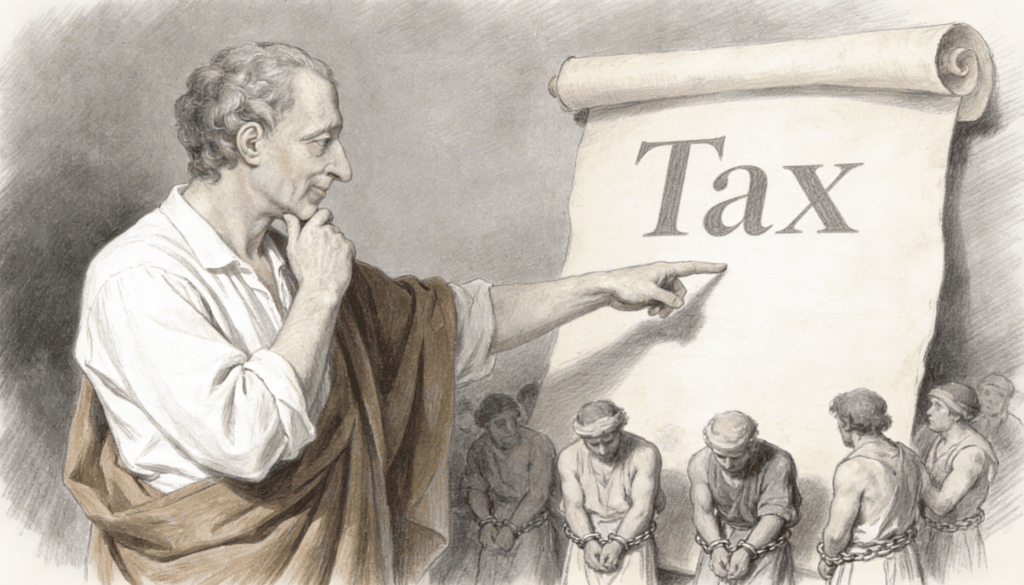
The modern state has an appetite. It consumes revenue the way a growing organism consumes nutrients, always requiring more to sustain its expanding functions. We accept this as normal, even inevitable. But Charles-Louis de Secondat, Baron de Montesquieu, writing in eighteenth-century France, saw something different when he looked at heavy taxation. He saw the slow strangulation of freedom.
Montesquieu’s argument sits uncomfortably in our current moment. We debate tax rates and brackets, arguing over percentages and thresholds. He questioned something more fundamental: whether a government that takes too much can remain free at all. His answer, developed across his masterwork “The Spirit of the Laws,” was stark. Heavy taxation doesn’t just burden citizens economically. It transforms the entire character of a political system, pulling it inevitably toward despotism.
The Simple Logic Nobody Wants to Hear
Start with the basic mechanics. A government needs money to function. Citizens provide it through taxes. So far, uncontroversial. But Montesquieu noticed that the relationship between how much a government takes and what kind of government it becomes is not merely practical. It’s constitutional in the deepest sense.
In a republic, citizens are supposed to govern themselves. They participate in public life, they deliberate, they take responsibility for common affairs. This requires a certain kind of person: independent, engaged, capable of thinking beyond immediate survival. But a person struggling under heavy taxation becomes a different creature entirely. They spend their energy managing scarcity. They have no time for civic virtue, no surplus attention for the common good. They become, in Montesquieu’s view, subjects rather than citizens.
The transformation is subtle. No dramatic moment announces the change. A republic doesn’t wake up one morning to discover it has become a despotism. Instead, the fiscal pressure mounts gradually. Each new tax seems justifiable in isolation. Together, they remake the relationship between government and governed.
Why Frugality Isn’t About Penny Pinching
When Montesquieu argued for a frugal republic, he wasn’t making an accountant’s case for balanced budgets. Frugality, in his framework, meant something closer to restraint or moderation. A frugal government is one that knows what it should not attempt, that recognizes limits on its proper sphere of action.
This sounds almost naive to contemporary ears. We expect government to solve problems, to act, to do something about every emerging challenge. The notion that government should deliberately limit its ambitions feels like neglect of duty. But Montesquieu would say we have the causation backwards. It’s precisely because government attempts too much that it must tax heavily. And because it taxes heavily, it must control more of society to extract those resources efficiently.
Consider the parent who gives their child everything requested. The child doesn’t develop independence or resourcefulness. They remain dependent, expecting provision. Montesquieu saw nations falling into a similar pattern with their governments. As government does more, citizens expect more. As they expect more, government must grow. As government grows, it needs more revenue. The cycle feeds itself.
The frugal republic breaks this cycle by design. It undertakes only essential functions. This limitation isn’t austerity for its own sake. It’s the recognition that a government attempting less can demand less, and demanding less, can leave its citizens free.
The Despotic Temptation in the Tax Code
Here’s where Montesquieu’s analysis becomes unsettling. He argued that despotic governments actually have an easier time with taxation in one respect. They can simply take what they want. No need for complex tax codes, elaborate collection systems, or public justification. The despot owns everything in principle. What looks like taxation is really just the master allocating resources.
Republican taxation, by contrast, requires consent. This should make it moderate, since citizens won’t consent to their own impoverishment. But Montesquieu noticed a dangerous loophole. If you can convince citizens that heavy taxation serves their interests, you can extract despotic levels of revenue with republican forms. The tyranny arrives through the front door, invited.
Modern democracies have become remarkably sophisticated at this trick. We don’t experience taxation as confiscation because it’s embedded in every transaction, deducted before we see our wages, hidden in the price of goods. The total burden remains somewhat abstract. Meanwhile, we see government benefits as concrete and immediate. The bridge gets built. The program launches. The subsidy arrives.
Montesquieu would recognize this as the exact trap he warned against. A republic can tax itself into despotism while maintaining all the outward forms of self-government. The voting continues, the assemblies meet, the representatives debate. But the substance has shifted. When government commands half or more of a nation’s resources, can we still meaningfully call it limited government?
The Character Question
Behind the fiscal argument lies a deeper concern about human character. Montesquieu believed that different regime types cultivated different virtues in their citizens. Republics required civic virtue: the ability to place common good above private interest. Monarchies ran on honor: the desire for distinction and glory. Despotisms operated through fear.
Heavy taxation corrodes civic virtue in specific ways. First, it forces citizens into a zero-sum mindset about public goods. If I’m paying half my income in various taxes, I start calculating whether I’m getting my share back. Politics becomes transactional. The question shifts from “what does the community need?” to “what can I extract from the system?”
Second, it creates what we might call fiscal learned helplessness. When government takes most of your surplus, you stop thinking about what you could accomplish with those resources. You stop imagining alternative ways to solve problems. Government becomes the default solution because you’ve already paid for it. Your capacity for independent action atrophies.
Third, and perhaps most important, it reorients ambition. In a lightly taxed society, an ambitious person can accumulate resources and deploy them according to their vision. They can start enterprises, fund causes, build institutions. In a heavily taxed society, the ambitious person’s best strategy is often to seek government positions or government favor. The incentive structure pulls talent toward political rather than productive activity.
None of this requires malicious intent. Nobody sets out to corrupt civic character through taxation. But Montesquieu understood that institutions shape behavior whether we intend them to or not. The fiscal constitution of a society writes itself into the souls of citizens.
The Curious Case of Luxury and Revenue
Montesquieu made a fascinating observation about luxury goods and taxation. He noted that despotic governments could tax luxury heavily without much resistance. Citizens in such regimes had no security in their property anyway. They might as well spend lavishly while they could, and let the despot take his cut.
Republics face a different dynamic. In a free society, citizens can accumulate wealth with some security. This should lead to prosperity and the ability to afford some luxury. But here’s the trap: as a republic grows wealthy, it becomes tempting to tax that wealth. The luxury itself seems to justify heavier taxation. After all, these are not necessities.
But luxury, in Montesquieu’s view, was never really about the goods themselves. It was about what the ability to afford them represented: surplus, security, and the freedom to make choices beyond mere survival. When a republic begins taxing away this surplus aggressively, it attacks the very prosperity that made the republic successful.
We see this pattern repeat. A society becomes wealthy through relatively free exchange and light taxation. The wealth creates both opportunities and problems. Government grows to address the problems. The growth requires more revenue. The taxation reduces the surplus that created the wealth. Eventually, the dynamism that made prosperity possible begins to fade.
The counterintuitive element here is that protecting luxury might actually protect liberty. Not because luxury itself is good, but because a society that allows its citizens to keep enough resources for what Montesquieu called “comfortable superfluity” is a society that hasn’t yet crossed the line into fiscal despotism.
The Federalist Connection
The American founders read Montesquieu obsessively. His influence appears throughout the Federalist Papers and the constitutional debates. But they adapted his arguments to their own circumstances in revealing ways.
The founders worried intensely about taxation because they had just fought a revolution partly over it. But they also recognized that their new republic needed revenue. Their solution was to fragment tax authority. Let the federal government have some powers, the states others. Make the system complicated enough that no single entity could easily extract despotic levels of revenue.
This wasn’t elegant, but it was clever. By dividing sovereignty, they divided the tax base. To get heavily taxed, a citizen would need both federal and state governments to grow large simultaneously. The friction in the system provided a kind of protection.
Of course, this protection has eroded considerably. The federal income tax, unthinkable to the founders, arrived in 1913. The total tax burden as a percentage of GDP has climbed steadily. State and federal governments have learned to coordinate rather than compete. But the basic Montesquieuian insight remains: concentrated taxing authority is dangerous to liberty.
The Services Problem
The strongest objection to Montesquieu’s argument comes from the catalog of government services that modern citizens expect. Education, healthcare, infrastructure, research, safety nets, environmental protection. The list expands constantly. How can government provide these with the modest revenues of a frugal republic?
Montesquieu would likely question the premise. Do governments actually need to provide all these services? Or have we fallen into the dependency trap he warned about? When government does everything, citizens forget how to do things for themselves. Institutions outside government atrophy. The skills and social capital required for voluntary cooperation fade.
This isn’t an argument that all government services are bad. It’s a question about substitution effects and opportunity costs. Every function government assumes is a function that civil society doesn’t perform. Every dollar government spends is a dollar not available for private initiative. At what point does the trade-off become damaging?
Consider education. In Montesquieu’s France, education was largely private and religious. Not ideal, certainly not universal. But the expansion of state education didn’t just add a public option. It gradually displaced and defunded alternatives. Now we have systems where nearly everyone depends on government schools, those schools consume enormous resources, and attempting anything different requires swimming against a heavy current of regulation and forgone tax revenue.
The pattern repeats across sectors. Government involvement doesn’t just supplement private action. It reorganizes the entire field. And because it reorganizes the field, it requires more taxation. And because it requires more taxation, it moves the society incrementally toward the despotic end of Montesquieu’s spectrum.
What Frugality Would Actually Require
If we took Montesquieu’s argument seriously, what would it demand? Not tinkering with tax rates or shifting from income to consumption taxes. It would require a fundamental rethinking of what we expect government to do.
This seems politically impossible. No constituency exists for dramatic government retrenchment. Everyone depends on something. The farmer wants agricultural subsidies. The developer wants infrastructure spending. The parent wants education funding. The retiree wants pension security. The business wants regulatory protection from competitors.
But Montesquieu’s point was precisely that these dependencies make republican government unsustainable. A population that expects government to secure everyone’s private interests isn’t really governing itself collectively. It’s engaged in elaborate rent-seeking, with taxation as the transfer mechanism.
The frugal republic would disappoint almost everyone’s immediate interests. It would provide basic security, impartial justice, and infrastructure truly common to all. Everything else would return to civil society, private initiative, and voluntary association. The immediate result would feel like loss.
Yet Montesquieu would argue that the trade gives back something more valuable: genuine self-government, both individual and collective. Citizens who must solve problems through cooperation rather than taxation develop different capacities. They build institutions that belong to them rather than depending on bureaucracies. They remain free in the sense that matters most, free from the comprehensive oversight that extensive government requires.
The Question We’re Not Asking
Modern fiscal debates focus on distribution and efficiency. Who should pay? What rates are fair? How can we collect revenue with minimal economic distortion? These are legitimate questions, but they accept the scale of taxation as given.
Montesquieu’s challenge goes deeper. He asks whether taxation beyond a certain threshold is compatible with the survival of republican government, regardless of how fairly distributed or efficiently collected. He suggests there’s a constitutional limit built into the nature of republics themselves.
This claim can’t be settled with economic analysis alone. It’s a question about political possibility and human nature. Can people who transfer half or more of their economic output to government remain, in any meaningful sense, self-governing? Or have they already conceded the substance of freedom while maintaining its forms?
The question makes us uncomfortable because the implications are stark. We like our government services. We’ve built complex lives around their availability. Unwinding this arrangement would be wrenching. But Montesquieu forces us to consider whether we’ve made a bargain that looks different from the other side. We traded away fiscal independence for security and services. What if that trade included our capacity for genuine republican citizenship?
His answer isn’t that taxation equals tyranny in some simple equation. It’s that past a certain point, the relationship between government and governed fundamentally changes. The republic becomes something else, even if we keep calling it a republic. The transformation happens quietly, through budget bills and appropriations, through the gradual ratcheting up of what we consider normal.
Montesquieu wrote for aristocrats and philosophers in an age of absolute monarchs. His frugal republic never existed in pure form, even in his idealized conception. But his central insight remains worth confronting. A government unlimited in its functions will be unlimited in its exactions. And a government unlimited in its exactions will not long remain limited in its power.