Table of Contents
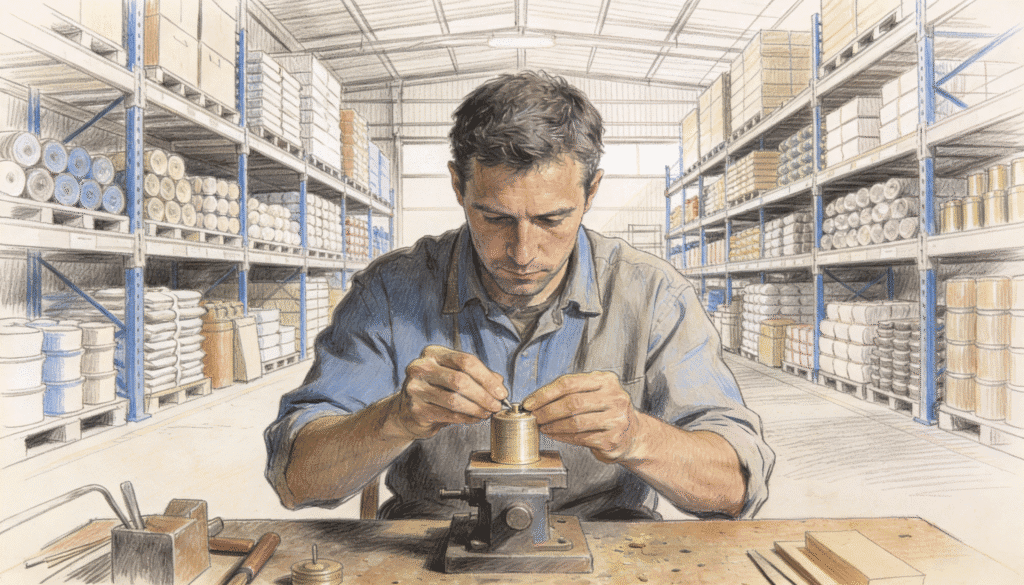
Adam Smith never meant to make you stupid. When he wrote about pin factories in 1776, he was trying to explain why England was getting rich. One worker draws the wire, another straightens it, a third cuts it, a fourth points it. Eighteen distinct operations to make a single pin. Ten workers could make 48,000 pins in a day. One worker doing everything alone? Maybe twenty pins if he was lucky.
Smith discovered something that would reshape civilization. When people specialize, they become absurdly productive. The economy explodes. Wealth multiplies. Everyone gets richer.
But Smith also noticed something else, something darker that gets quoted far less often. The worker who spends his entire life performing the same simple operation “generally becomes as stupid and ignorant as it is possible for a human creature to become.” Not my words. His.
This is the paradox. The same system that makes us collectively smarter makes us individually dumber. We’ve built a world of unprecedented abundance on a foundation of deliberate narrowing.
The Magic of Knowing One Thing Really Well
Think about your doctor. He spent four years studying medicine, then another three to seven years in residency, possibly more in fellowship. If he’s a neurosurgeon, he might have invested fifteen years becoming excellent at operating on brains. He knows almost nothing about fixing your car, building a website, or arguing a legal case. He has traded breadth for depth, and we all benefit from that trade.
This is specialization working as intended. Your neurosurgeon can do things that would have seemed like magic a century ago. He can remove a tumor from your brain while you’re awake, chatting with him. The mechanic can diagnose your engine problem in minutes using knowledge you’ll never possess. The lawyer navigates legal complexities you can’t even perceive.
We live in a world where nearly everyone is incompetent at nearly everything, yet somehow everything works. Your morning coffee involves hundreds of specialists. Someone grew the beans in Colombia. Someone else designed the roasting equipment. Others managed the logistics of shipping. The barista perfected the extraction. You couldn’t replicate this chain if your life depended on it, yet you barely think about it.
This is what economists call comparative advantage, and it’s why global trade exists. Even if you could grow coffee and roast it and brew it better than anyone in Colombia, you shouldn’t, because you can create more value doing whatever you actually specialize in. A neurosurgeon should perform surgeries, not grow coffee beans, even if he’d make a decent farmer.
The math is beautiful. Everyone focuses on what they do best. Total output soars. We all consume more than we could ever produce alone. Wealth happens.
The Narrowing
But here’s what we don’t talk about enough. That neurosurgeon? Outside his domain, he might be shockingly helpless. He might not understand how interest rates work, why the sky is blue, or what his elected representatives actually do. He has outsourced everything else to other specialists.
This isn’t stupidity. It’s rational adaptation. There are only so many hours in a day, only so much a brain can hold. Every hour he spends learning about monetary policy is an hour not spent mastering the latest surgical techniques. The opportunity cost is real.
So he narrows. We all narrow. We have to.
The programmer stops reading literature. The writer stops understanding statistics. The businessman stops thinking about philosophy. Each person burrows deeper into their tunnel, and the tunnels rarely intersect.
Smith saw this coming. He worried that the common person, confined to repetitive tasks, would lose “the habit of exertion” and become unable to “conceive any generous, noble, or tender sentiment.” The mind atrophies outside its narrow specialty.
We like to think we’re different from factory workers, but are we? The software engineer who spends ten hours a day writing code is every bit as specialized as the pin maker. More specialized, actually. At least the pin maker could see the whole pin.
The Dangerous Illusion of Expertise
Here’s where it gets interesting. Specialization doesn’t just make us ignorant outside our field. It makes us confident in that ignorance.
Psychologists call this the halo effect. We’re good at one thing, so we assume we’re good at other things too. The successful entrepreneur thinks his business acumen translates to politics. The acclaimed novelist thinks his narrative skills mean he understands economics. The scientist thinks his laboratory rigor applies to social policy.
It doesn’t. Expertise is domain specific. Being brilliant at neurosurgery tells us nothing about your ability to analyze foreign policy. But it feels like it should. We conflate specialized competence with general intelligence.
This creates a peculiar modern phenomenon. We have more expertise than ever before and more confident ignorance than ever before. Everyone is an expert in something, and everyone thinks that something prepares them to have strong opinions about everything else.
Social media amplifies this perfectly. The platform doesn’t distinguish between the epidemiologist explaining disease transmission and the yoga instructor explaining disease transmission. Both get the same sized megaphone. Both feel equally entitled to use it.
What We’ve Lost
There used to be polymaths. Leonardo da Vinci painted, invented, studied anatomy, designed weapons, and investigated geology. Benjamin Franklin was a printer, scientist, inventor, diplomat, and writer. Thomas Jefferson designed buildings, collected fossils, played violin, and founded a university while also doing that president thing.
Try that today. You can’t. The frontier of knowledge in any field has moved so far beyond the basics that mastery requires complete devotion. You can be a great neurosurgeon or a great novelist, but probably not both. The required knowledge base is too vast. The skill development takes too long.
We’ve gained incredible depth. We’ve lost breadth. Nobody can see the whole picture anymore because the picture has become too large for any one mind to hold.
This matters more than you might think. The biggest problems we face sit at the intersection of multiple domains. Climate change requires understanding physics, chemistry, biology, economics, political science, and engineering. Nobody has all that expertise. We need teams of specialists who can barely talk to each other because they don’t share vocabulary or frameworks.
The specialist knows more and more about less and less. The old joke says eventually they’ll know everything about nothing. We’re getting close.
The Fragility Problem
Here’s something counterintuitive. Specialization makes systems more efficient and more fragile at the same time.
When everyone does one thing, we become dependent on everyone else doing their one thing. The supply chain becomes a house of cards. One specialist fails and the whole structure wobbles.
We saw this during the pandemic. A shortage of semiconductor chips halted car production. Why? Because modern cars contain dozens of computer chips, and we’d outsourced all chip manufacturing to a handful of specialists in Taiwan and South Korea. Very efficient. Very fragile.
Your great grandfather probably knew how to grow food, build shelter, mend clothes, and fix basic machinery. You probably know how to do exactly one thing well enough to trade for money, which you then trade for everything else. This works beautifully until it doesn’t.
The specialist is powerful in their domain and helpless outside it. We’re all powerful and helpless now, just in different ways.
The Meaning Problem
There’s another cost we rarely discuss. Specialization can drain meaning from work.
Smith’s pin maker performs one operation. He never sees the completed pin, never interacts with someone using it, never experiences the satisfaction of creation. He’s a cog.
We tell ourselves knowledge work is different. But is it? The programmer who spends six months optimizing database queries is doing specialized work that matters to nobody except other specialists. The consultant who makes PowerPoint decks is several layers removed from anything resembling tangible impact.
Humans seem to crave a sense of completion, of seeing their work matter in a concrete way. Specialization often denies us that. We contribute tiny pieces to massive projects we’ll never fully understand. Our impact is real but invisible.
This might explain the surge in hobbies where people make complete things. Baking bread. Building furniture. Knitting. Gardening. These activities are wildly inefficient compared to buying bread or furniture or clothes. But they offer something specialization doesn’t: the satisfaction of beginning, middle, and end.
Is There a Way Out?
Some people advocate for generalism. Be a jack of all trades. Learn widely. Resist specialization.
This sounds nice but doesn’t quite work. The generalist will be outcompeted by specialists in almost every domain. You can’t be adequately good at everything. You’ll be mediocre at most things and poor at the rest.
But maybe there’s a middle path. Maybe we can specialize for production and generalize for understanding.
You specialize in your work because that’s how you create value. But outside work, you deliberately pursue breadth. Read widely. Learn about fields unrelated to your expertise. Study history, science, art, philosophy not to become expert but to become less ignorant.
This isn’t about becoming a polymath. It’s about escaping the tunnel vision that specialization creates. It’s about maintaining enough general knowledge to spot when specialists are wrong, to see connections between fields, to remain intellectually alive.
The neurosurgeon can still be a neurosurgeon. But maybe he also reads about economics, studies some philosophy, learns a language, understands basic statistics. Not to expert level. Just enough to think.
The Question Smith Never Answered
We’ve accepted Smith’s bargain. We’ve chosen wealth over wisdom, efficiency over understanding, depth over breadth. The results are remarkable. We live better than kings did a few centuries ago.
But Smith worried about what we’d lose. He thought education might help, that schooling could give people enough general knowledge to resist the stupefying effects of specialized labor. We tried that. It hasn’t quite worked. Education itself has become specialized.
The paradox remains unresolved. We need specialization to maintain our complex civilization. But specialization narrows us in ways that might make us less capable of addressing the very complexity it creates.
Maybe this is just the price we pay. Maybe you can’t have modern medicine, technology, and abundance without also having modern fragmentation, ignorance, and narrowness. Maybe the pin factory and the stupid pin maker are a package deal.
Or maybe we’re still figuring it out. Maybe the next evolution isn’t choosing between specialization and generalization but finding new ways to connect specialists, to help them see beyond their tunnels, to build bridges between domains.
Because the problems we face don’t respect the boundaries between disciplines. Climate, inequality, technology, governance. These are whole system problems. We’re trying to solve them with an army of specialists who each see one small piece.
Smith gave us the diagnosis. We’re still searching for the cure. In the meantime, we keep specializing, keep narrowing, keep getting richer and, in some important sense, dumber. The paradox of plenty persists. We have everything except the wisdom to see the whole picture.
And maybe that’s the final irony. We’re so specialized now that we need specialists to help us understand what specialization has done to us. Even understanding our predicament requires expertise we’ve outsourced to someone else.