Table of Contents
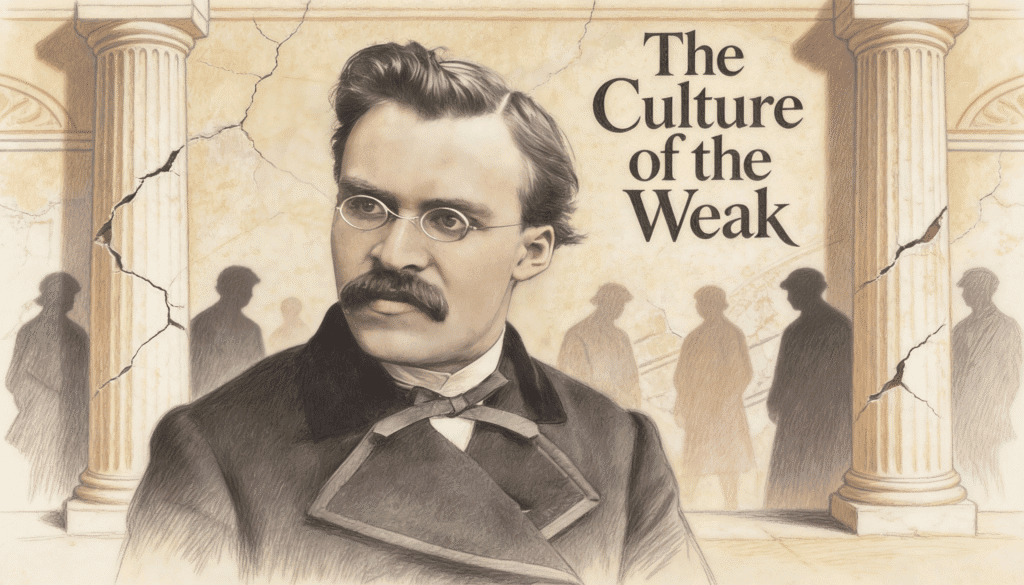
Friedrich Nietzsche saw something disturbing in the world around him. It wasn’t poverty or war or disease. It was something more insidious: a moral system that celebrated weakness and punished strength. He called it slave morality, and he believed it was poisoning Western civilization from within.
The German philosopher’s critique cuts deeper than most people realize. This isn’t about being mean to the unfortunate or celebrating cruelty. It’s about how societies can build entire value systems around resentment, and how those systems ultimately harm everyone, including the people they claim to protect.
The Birth of Resentment
Nietzsche traced this phenomenon back to ancient Rome. The powerful Romans valued strength, courage, and excellence. They admired winners. But among the conquered peoples, particularly early Christians, a different morality emerged. Unable to compete with Roman power directly, these groups did something clever. They flipped the script entirely.
Suddenly, meekness became virtue. Suffering became noble. The powerful were recast as evil oppressors. The weak declared themselves morally superior precisely because of their weakness. This wasn’t just sour grapes. It was a complete revaluation of values, turning the Roman moral universe upside down.
Think about how radical this was. Imagine losing a competition and then declaring that winning was actually bad and losing was actually good. That’s not just consolation. That’s changing the rules of the game after you’ve already lost.
Nietzsche didn’t see this as harmless philosophy. He saw it as resentment crystallized into morality. The weak couldn’t become strong, so they made strength itself suspect. They couldn’t achieve greatness, so they made humility the highest virtue. This was revenge dressed up as righteousness.
The Modern Echo Chamber
Fast forward to today, and Nietzsche’s warning feels relevant. Modern culture increasingly celebrates victimhood as identity. People compete to demonstrate how they’ve been wronged. Suffering becomes currency in the marketplace of sympathy.
Social media amplifies this dynamic beautifully. Platforms reward displays of harm with attention and validation. The algorithm doesn’t care about excellence or achievement. It cares about engagement, and nothing engages quite like outrage and grievance.
We’ve created systems where announcing your wounds brings more status than showing your strengths. Where admitting weakness is brave but displaying competence is suspicious. Where the question “How have you suffered?” matters more than “What have you built?”
This isn’t to dismiss real injustice or genuine suffering. Those exist and matter deeply. But Nietzsche would ask us to examine whether our moral frameworks sometimes encourage people to organize their entire identities around their wounds. Whether we’ve made victimhood so valuable that we incentivize people to stay weak rather than become strong.
The Safety Paradox
Here’s where things get counterintuitive. Cultures built around protecting the weak often end up keeping them weak. Overprotection prevents growth. Remove all challenges and you remove all opportunities for development.
Consider the modern obsession with safety. Not just physical safety, which is obviously important, but safety from discomfort, disagreement, and difficult emotions. Universities create safe spaces. Workplaces eliminate all friction. Social groups police language to avoid any possible offense.
The intention is compassionate. The result is often infantilizing. We’re treating adults like fragile children who can’t handle the normal rough and tumble of human interaction. We’re suggesting that people are so weak that mere words or ideas can shatter them.
Nietzsche would see this as slave morality in action. We’ve made fragility into a virtue. We celebrate those who need protection and suspect those who don’t. We’ve created a moral framework where being strong enough to handle adversity is somehow less noble than being too weak to face it.
The irony runs deep. The generation most protected from offense seems most offended. The culture most focused on safety seems most anxious. By treating people as weak, we may be making them weaker.
The Revenge of the Mediocre
Nietzsche worried about something else too. In a culture that celebrates weakness, excellence becomes threatening. Those who achieve, who excel, who rise above the crowd make others feel bad by comparison. So the collective finds ways to cut them down.
This happens subtly. We become suspicious of success. We assume those who win must have cheated or gotten lucky or had unfair advantages. We create moral frameworks that make ambition seem greedy and achievement seem selfish.
Look at how we talk about successful people. We’re more interested in their scandals than their accomplishments. We search for the hidden privilege that explains their success, as if merit alone couldn’t possibly be enough. We feel more comfortable when they fail than when they succeed.
This is what Nietzsche called the leveling instinct. Unable to rise, we pull others down. Unable to create, we tear down. We make mediocrity into a virtue by suggesting that anyone who rises above it must be morally suspect.
The tech industry provides a perfect case study. Innovation requires people who are willing to push boundaries, take risks, and believe they can achieve what others say is impossible. These are precisely the qualities that a culture of weakness finds disturbing. So we focus on the arrogance of founders, the disruption of workers, the wealth inequality they create. We frame their achievement as a social problem rather than recognizing that progress usually comes from people audacious enough to attempt the difficult.
The Health Crisis Nobody Talks About
Here’s something Nietzsche understood that we often miss. Chronic resentment literally makes you sick. Not metaphorically sick. Actually sick.
When you organize your identity around being wronged, you marinate in stress hormones. Your body stays in threat mode. Your immune system suffers. Your mental health deteriorates. The person you resent continues their life while you consume yourself with bitterness.
Modern psychology has confirmed what Nietzsche intuited. Victimhood orientation correlates with anxiety, depression, and reduced life satisfaction. People who see themselves primarily as victims of unfair circumstances have worse mental and physical health than those who see themselves as agents capable of changing their situations.
This is the cruel trap of slave morality. It offers the satisfaction of moral superiority but at the cost of your wellbeing. You get to feel righteous about your suffering, but you still suffer. You get to blame others for your problems, but your problems remain unsolved.
The alternative Nietzsche proposed wasn’t callousness. It was something more radical: taking responsibility for your own flourishing regardless of circumstances. Not because circumstances don’t matter, but because resentment poisons you more than it harms your enemies.
The Creativity Question
Strong cultures create art that celebrates human potential. Weak cultures create art about suffering and limitation. Look at what we valorize in modern storytelling.
The hero’s journey used to be about someone ordinary becoming extraordinary through courage and growth. Now our heroes stay traumatized. Their wounds define them. They’re celebrated not for overcoming adversity but for enduring it. Victory becomes almost embarrassing, as if the real story is always about how we’re damaged.
Nietzsche would see this as imagination colonized by slave morality. We’ve become so invested in weakness as identity that we can’t even tell stories about strength without apology. Our myths are about limits rather than possibilities.
Compare this to other historical periods. Renaissance art celebrated human achievement and beauty. Enlightenment thought emphasized human reason and progress. Romantic literature explored the heights of human passion and creativity. We’ve replaced these with narratives of oppression, trauma, and systemic limitation.
This matters more than you might think. The stories a culture tells shape what that culture believes is possible. If all our stories are about how we’re broken, we become more broken. If all our heroes are victims, we become better at being victimized than at being victorious.
The Real Compassion
Here’s the part that makes people uncomfortable. Nietzsche’s critique doesn’t mean we should be cruel to those who suffer. It means real compassion requires helping people become strong, not celebrating their weakness.
True care means having high expectations. It means believing people can grow and change and overcome. It means treating adults as capable of handling challenges rather than as fragile things that need constant protection.
Think about good parenting. Bad parents either neglect their children or coddle them. Good parents do something harder: they support their children while also pushing them to develop competence. They provide safety while also allowing struggle. They believe in their children’s capacity to become strong.
We need to apply this same principle to social morality. Compassion that keeps people weak isn’t compassion. It’s a subtle form of contempt, suggesting that some people are simply incapable of strength and therefore need perpetual protection.
The welfare state provides an interesting test case. The generous version offers support while encouraging independence. The pathological version creates dependence, trapping people in systems that meet immediate needs while eliminating opportunities for growth. Nietzsche would ask which version actually respects human dignity more.
Beyond Resentment
So what’s the alternative? Nietzsche called it master morality, but that term carries unfortunate baggage. Better to think of it as a life affirming morality. A value system that celebrates growth, achievement, and the full expression of human potential.
This doesn’t mean ignoring injustice or abandoning those who need help. It means building a culture where the goal is always to help people become stronger, not to make weakness comfortable. Where we support those who fall but always with the aim of helping them stand again.
It means measuring our moral systems not by how much they validate suffering but by how well they promote flourishing. Not by how comfortable they make weakness but by how effectively they cultivate strength.
It means being honest about what actually helps people versus what merely makes us feel virtuous. Sometimes the kindest thing is also the hardest thing: expecting people to rise to challenges rather than removing all challenges from their path.
The Stakes
Nietzsche’s warning matters because cultures built on resentment eventually consume themselves. They become so focused on what they oppose that they forget what they support. They become so skilled at tearing down that they lose the ability to build up.
Look around and ask whether we’re building or destroying. Whether we’re creating systems that make people stronger or systems that make weakness more comfortable. Whether our moral frameworks encourage growth or trap people in permanent victimhood.
The answer matters more than we realize. Strong cultures that celebrate human excellence lift everyone. They create art, science, and social progress. They solve problems. They build futures worth living in.
Weak cultures that worship at the altar of resentment stagnate. They become bitter. They turn inward. They spend all their energy on grievance and none on creation. They make everyone smaller in their rush to tear down anyone who stands tall.
We’re at a crossroads. We can continue down the path of slave morality, making weakness ever more sacred while viewing strength with increasing suspicion. Or we can choose something harder and more honest: a culture that genuinely wants people to flourish, even if that means expecting them to grow beyond their wounds.
Nietzsche issued his warning over a century ago. We’re still deciding whether to pay attention to it.