Table of Contents
Arthur Schopenhauer spent most of his life being ignored. He published his masterwork, The World as Will and Representation, at age thirty. It sold almost nothing. He lectured at the University of Berlin, scheduling his classes to compete directly with Hegel, the most famous philosopher in Germany. Students chose Hegel. Schopenhauer lectured to empty rooms.
This failure didn’t surprise him. He believed the world was fundamentally irrational, driven by blind striving rather than reason. He thought most people were idiots. And he was certain that anything genuinely profound would be misunderstood by crowds seeking easy comfort.
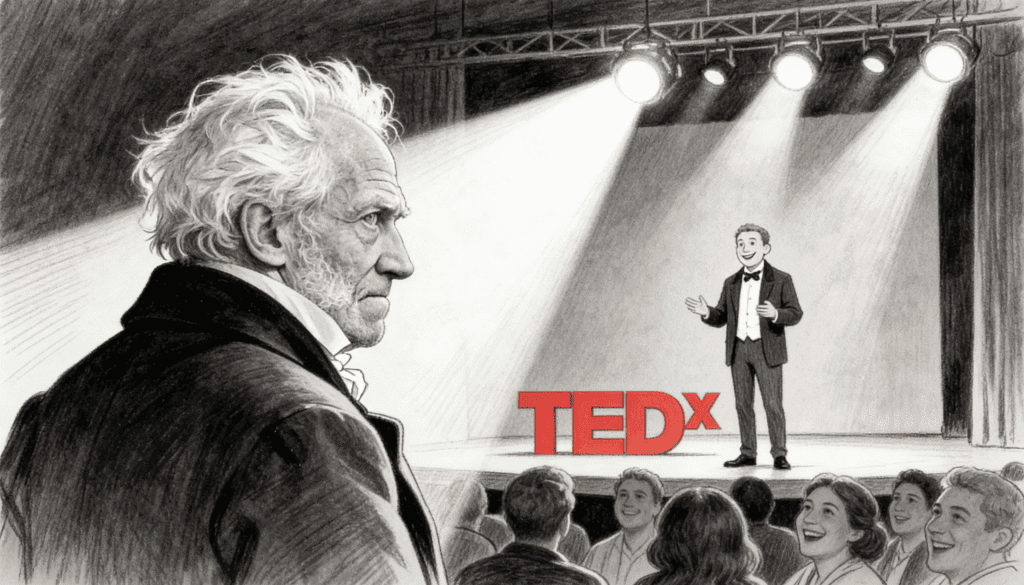
Which brings us to TED Talks.
The Optimism Problem
TED exists in a universe Schopenhauer would find nauseating. Every talk operates on the assumption that problems have solutions, that human intelligence can overcome obstacles, that sharing ideas makes the world better. The tagline itself, “Ideas Worth Spreading,” contains a cheerfulness that would have made Schopenhauer reach for his smelling salts.
For Schopenhauer, the fundamental problem with existence isn’t that we lack good ideas. The problem is existence itself. We are driven by an endless, insatiable Will that can never be satisfied. You want something, you get it, and immediately the wanting starts again. Happiness is just a brief pause between desires. This isn’t a bug that innovation can fix. It’s the operating system.
TED speakers stand on red circles and explain how blockchain will revolutionize supply chains, how we can rewire our brains for success, how vulnerability is the path to connection. Schopenhauer would see this as people rearranging deck chairs on the Titanic while insisting they’ve discovered a new sailing technique.
The deeper absurdity is that TED’s optimism depends on ignoring what Schopenhauer saw as obvious. Suffering isn’t an accident or a result of poor planning. It’s baked into consciousness. Animals eat each other. Everyone you love will die. Your body is already betraying you. These aren’t problems to solve. They’re the terms and conditions of being alive.
The Performance of Wisdom
Schopenhauer hated academics who performed philosophy rather than pursuing truth. He accused Hegel of writing incomprehensible gibberish to seem profound, of twisting ideas into pretzels to please the Prussian state. He despised what he called “windbags” who valued applause over insight.
TED perfected the performance Schopenhauer loathed. Speakers get eighteen minutes to change your life. They pace the stage with wireless mics. They pause for effect. They structure their revelations like magic tricks: setup, misdirection, reveal. The form demands confidence, charisma, conviction. Uncertainty doesn’t fit in eighteen minutes.
Real thinking, for Schopenhauer, was difficult and often ugly. It meant confronting uncomfortable truths. It meant acknowledging the limits of knowledge. It meant sometimes saying “I don’t know” or “this is complicated” or “maybe there’s no answer.” These phrases don’t work in a format designed to go viral.
The TED Talk optimizes for shareability. The ideas need to be clear enough to explain at dinner parties but surprising enough to feel fresh. They need to inspire without demanding too much. They need to make you feel smarter for having watched. This isn’t philosophy. It’s entertainment dressed as enlightenment.
Schopenhauer would recognize the dynamic. The speaker gets validation and career advancement. The audience gets the pleasant feeling of learning without the hard work of study. Everyone wins, except truth, which gets simplified into something that fits on a slide.
The Democratization of Expertise
One of TED’s implicit promises is that expertise is accessible. A twelve minute talk can teach you neuroscience, economics, design thinking. The format says: complex knowledge can be compressed, packaged, delivered. You don’t need years of study. You just need the right explanation.
Schopenhauer would call this flattery. He believed genuine understanding required sustained effort and natural aptitude. Most people, in his view, weren’t capable of abstract thinking. This sounds elitist because it is elitist. But it’s worth considering what happens when we pretend difficulty doesn’t exist.
When a psychologist gives a TED Talk about resilience, she’s translating years of research, clinical experience, and theoretical framework into a narrative with three memorable points. Something is necessarily lost. The nuance disappears. The contradicting studies get omitted. The statistical limitations go unmentioned. What remains is a story that feels true because it’s coherent and satisfying.
The audience leaves thinking they understand resilience. They don’t. They understand a polished performance about resilience. The gap between these is enormous, but TED’s format makes it invisible.
Schopenhauer spent decades studying Eastern philosophy, aesthetics, and metaphysics. His work is dense and often contradictory. He revised his ideas. He acknowledged influences. He built arguments that required following threads across hundreds of pages. This isn’t because he was a bad communicator. It’s because the ideas were actually complex.
The TED model suggests complexity is just poor communication. If you really understand something, you can explain it simply. Einstein’s quote about explaining things to a six year old gets cited constantly. But this confuses understanding with explanation. Some things are genuinely difficult. Pretending otherwise doesn’t educate people. It gives them the illusion of education, which might be worse.
The Celebrity Intellectual
TED created a new species: the thought leader. These aren’t traditional academics or artists. They’re people whose primary skill is having ideas that travel well. They write books with one word titles. They build personal brands. They give keynotes. Their work is measured in views, shares, and speaking fees.
Schopenhauer published The World as Will and Representation and then spent decades writing supplements because he knew he hadn’t said everything clearly the first time. The idea that he would condense his philosophy into “Arthur Schopenhauer: Why Everything Is Terrible (And That’s Okay)” for a conference in Vancouver would have struck him as insane.
The thought leader economy rewards a specific type of thinking: bold, contrarian enough to feel fresh, but not so radical that it’s uncomfortable. The insights need to be applicable. Actionable. Something you can use on Monday morning.
Schopenhauer’s philosophy offers nothing actionable. His solution to suffering was essentially: stop wanting things, appreciate art, maybe pet a dog. This doesn’t scale. You can’t build a consulting practice around “existence is futile.” There’s no workshop for “everything you do is pointless.”
But notice what TED’s model does to ideas. It turns them into products. A TED Talk is intellectual property in the most literal sense. It gets packaged, marketed, distributed. The speaker becomes a brand. The idea becomes a commodity. This isn’t about truth. It’s about what sells.
Schopenhauer would see this as confirmation of his views. Of course ideas get commodified. Of course wisdom becomes performance. The Will that drives existence also drives capitalism, academia, and social media. There’s no escape from it. Thinking you can optimize your way out just proves you don’t understand the problem.
The Tyranny of Inspiration
TED Talks end with inspiration. The music swells. The audience applauds. You feel motivated to change something, do something, be something. This emotional climax is the point. The talk isn’t successful if you don’t feel different afterward.
Schopenhauer would recognize this feeling as exactly what’s wrong. You’re being manipulated into wanting more, doing more, striving more. The talk promises that effort will be rewarded, that change is possible, that you can be better. This feeds the Will. It makes the problem worse.
Genuine wisdom, in Schopenhauer’s view, leads to resignation, not motivation. It means seeing through the illusions that keep us chasing goals. It means recognizing that achievement doesn’t satisfy, that success is temporary, that getting what you want just reveals another want behind it.
This is why Schopenhauer loved art. Music, poetry, painting—these offered temporary escape from wanting. They let you contemplate form without desire. They provided relief from the endless striving. But you can’t monetize that. You can’t build a conference around “maybe just listen to music and stop trying so hard.”
The inspiration industrial complex needs you dissatisfied enough to seek improvement but hopeful enough to believe it’s possible. TED exists in that sweet spot. The talks identify problems you didn’t know you had and offer solutions you didn’t know existed. They generate wanting while promising fulfillment. It’s an infinite loop.
The Counter Argument
But maybe Schopenhauer would have been wrong. Maybe democratizing ideas is valuable even if something gets lost. Maybe inspiring people to try matters more than philosophical purity. Maybe accessible explanations serve as gateways to deeper study.
TED has introduced millions to concepts they never would have encountered. Someone watches a talk about cognitive biases and gets interested in psychology. Someone sees a talk about effective altruism and starts donating differently. Someone hears a talk about systems thinking and changes how they approach problems at work. These downstream effects have value.
And perhaps Schopenhauer’s pessimism was itself a kind of performance. He claimed to hate fame while carefully crafting his writing to be provocative. He said suffering was universal while living comfortably off his inheritance. His pessimism was intellectually rigorous but practically selective.
The strongest counter to Schopenhauer is that engagement matters. A complex truth that no one hears changes nothing. A simplified truth that reaches millions might actually reduce suffering, even if the mechanism is imperfect. Maybe the performance of wisdom is better than no wisdom at all.
The Real Problem
But the deeper issue isn’t whether TED Talks are good or bad. It’s what they reveal about how we relate to ideas. We want them quick, confident, and comfortable. We want to feel smarter without the discomfort of genuine uncertainty. We want transformation without sacrifice.
Schopenhauer’s philosophy demands something different. It asks you to sit with discomfort. It offers no solutions. It suggests that what you think is wisdom might be self deception. It’s not inspirational. It’s not shareable. It doesn’t optimize for anything except maybe accuracy about how difficult existence really is.
The choice between Schopenhauer and TED isn’t really about formats or philosophies. It’s about what we’re willing to accept. Are we okay with entertainment that feels like education? Are we comfortable with inspiration that might be manipulation? Do we want to feel good or know truth, and are those sometimes opposed?
Schopenhauer would say we’ll choose feeling good. That’s what the Will demands. We’ll keep watching talks that make us feel enlightened while changing nothing fundamental. We’ll keep believing that the right idea, delivered the right way, will finally satisfy us.
And he’d probably be right. Which is exactly why he’d hate TED Talks. Not because they’re bad at what they do, but because they’re too good at giving us what we want instead of what we need. They’re perfectly designed for a world that Schopenhauer understood completely and found utterly hopeless.
The real tragedy isn’t that TED exists. It’s that Schopenhauer would watch a talk explaining his philosophy in eighteen minutes, see it get a standing ovation, and recognize that even his pessimism has been turned into another form of entertainment. The Will finds a way. It always does.