Table of Contents
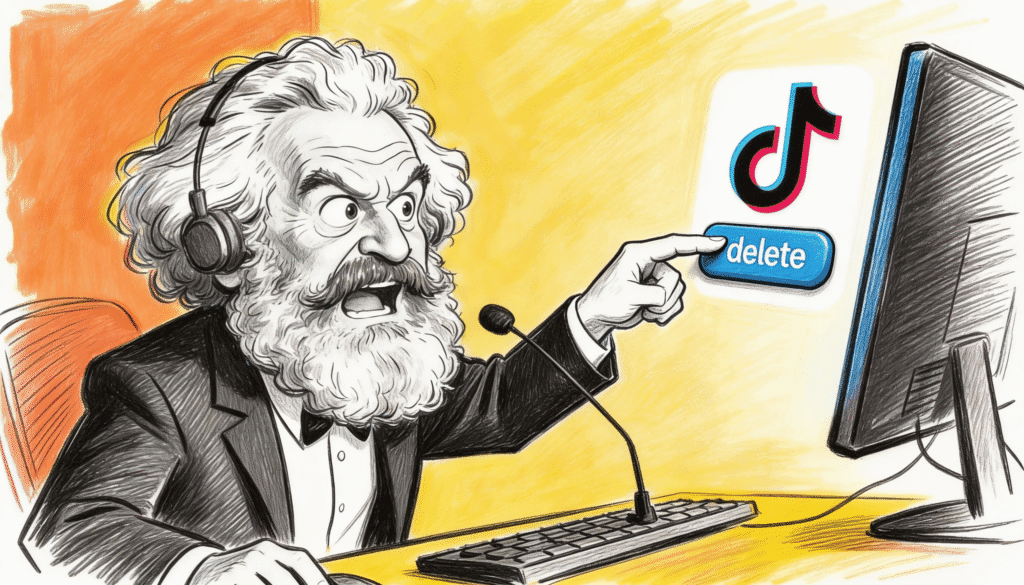
Karl Marx spent his life analyzing how capitalism shapes society. He wrote about alienation, commodity fetishism, and the ways economic systems warp human relationships. If he were alive today, he’d probably take one look at TikTok, understand exactly what it was doing to us, and delete the app immediately.
Not because he’d be a boomer about new technology. Marx was actually quite enthusiastic about technological progress. He saw it as a force that could liberate humanity from drudgery. No, Marx would delete TikTok because the app represents everything he warned about, just wrapped in a dopamine delivery system disguised as entertainment.
The Means of Production Are Now in Your Pocket
Here’s the ironic part. TikTok appears to democratize content creation in exactly the way Marx might have appreciated. Anyone with a phone can be a producer, not just a consumer. You don’t need expensive equipment, a film crew, or a distribution deal. The means of production are literally in your pocket.
This seems revolutionary. For the first time in history, ordinary people can reach millions without gatekeepers. A teenager in rural Idaho has the same potential reach as a Hollywood studio. Marx, who wanted workers to control the means of production, should love this, right?
Wrong. Because while you might own the camera, you don’t own the platform. And the platform is everything.
TikTok’s algorithm decides who sees your content. It owns your audience, your distribution, and ultimately, your ability to reach anyone at all. You’re not a independent producer. You’re an unpaid worker in ByteDance’s content factory, and your compensation is the occasional viral video that gives you a brief dopamine hit.
Marx would recognize this immediately. It’s like a factory owner who lets workers use the equipment for free, but keeps all the products they make and sometimes tosses them a few coins when they produce something particularly valuable. Except in this case, the coins are likes and the products are pieces of your life, packaged and sold to advertisers.
Karl Marx Alienation But in 15 Second Intervals
Marx’s concept of alienation described how industrial capitalism separated workers from the products of their labor, from the labor process itself, from their fellow workers, and from their own humanity. Workers became cogs in a machine, disconnected from meaning.
TikTok creates a new form of alienation that would fascinate and horrify Marx in equal measure.
First, you’re alienated from your own content. The moment you post a video, it’s no longer really yours. The algorithm decides its fate. It might get shown to millions or buried completely. The quality of your work matters less than its ability to trigger engagement metrics. You start creating not what you want to make, but what you think the algorithm wants to see.
Second, you’re alienated from the creative process itself. Everything becomes content. Your breakfast is content. Your breakup is content. Your dog is content. The line between living your life and performing your life dissolves. You’re not experiencing moments anymore. You’re producing material.
Third, you’re alienated from other people. Those millions of viewers aren’t really connecting with you. They’re consuming you. The relationship is fundamentally extractive. They take a micro dose of entertainment from your life and scroll to the next hit. There’s no real reciprocity, no genuine human exchange.
Fourth, and most importantly, you’re alienated from yourself. When every moment becomes potential content, you start viewing your own life from the outside. You’re simultaneously the performer and the audience. This creates a strange split consciousness where you’re never fully present because part of you is always thinking about how this moment would play on camera.
Marx would see this as capitalism colonizing not just your labor, but your entire existence.
The Commodity Form of Human Experience
Marx wrote about commodity fetishism, the way capitalism makes us forget that commodities are products of human labor and instead treat them as having inherent value. A chair isn’t just wood and labor. It’s a thing with a price tag that seems to have value all on its own.
TikTok does something similar with human experience. It transforms lived moments into discrete, consumable units. Your wedding dance becomes content with a specific value measured in views and engagement. Your mental health struggle becomes a relatable trend. Your identity becomes a brand position.
This isn’t just documentation. It’s transformation. The experience exists primarily as something to be consumed by others. Its value is determined by market dynamics, by what plays well, by what advertisers want to be associated with.
The most successful TikTokers understand this instinctively. They’re not sharing their lives. They’re producing commodities that happen to be made from the raw material of their existence. They’ve internalized the logic of the market so completely that they can’t separate their authentic selves from their marketable selves.
Marx would point out that this is exactly how capitalism works. It doesn’t force you at gunpoint. It creates conditions where the most rational individual choice is to participate in your own exploitation. Of course you should turn your life into content. That’s where the attention is. That’s where the opportunities are. That’s how you stay relevant.
The Attention Economy and Surplus Value
Marx’s theory of surplus value explained how capitalists profit by paying workers less than the value they create. A worker produces $100 worth of goods but gets paid $40. The capitalist keeps the difference.
TikTok operates on the same principle, but the math is even more tilted. You create all the content. You get paid nothing unless you’re in the very top tier of creators, and even then, the compensation is a tiny fraction of the value generated.
Your attention is being sold to advertisers. Your data is being sold to whoever wants to buy it. Your content is training AI systems. Your behavior patterns are being analyzed and monetized in dozens of ways you’ll never fully understand. Meanwhile, you get the privilege of using the app for free.
Marx would laugh at calling this “free.” You’re working. You’re producing enormous value. You’re just not getting paid for it. Instead, you’re compensated in the psychological currency of likes, views, and the occasional brush with virality.
This creates a class system within the app itself. There are the mega creators who actually make money, though even they are dependent on the platform’s whims. Then there’s everyone else, the digital proletariat, laboring away in hopes of one day joining the creator class. Most never will. But the hope keeps them posting.
The Algorithmic Panopticon
Marx was writing before surveillance capitalism, but he understood power dynamics. TikTok’s algorithm functions as a kind of invisible manager, constantly watching, measuring, and controlling.
You don’t know exactly how it works. No one does except ByteDance engineers, and probably not even all of them. But you know it’s watching. Every second you watch a video, every time you scroll past, every hesitation, every rewatch. It’s all data. It’s all being analyzed.
This creates what we might call algorithmic discipline. You start to police your own content creation. Not because anyone explicitly told you the rules, but because you’re trying to please a system you can’t fully understand. You’re guessing at what works, experimenting, adapting.
This is power at its most efficient. You’re controlling yourself on behalf of the platform’s interests. You’ve internalized the logic of engagement maximization. You’re a self managing worker in the content mines.
Marx would recognize this as ideology in action. The system doesn’t need to force you. It just needs to create conditions where serving its interests feels like serving your own.
The Contradictions Mount
Here’s where it gets interesting from a Marxist perspective. TikTok, like capitalism itself, contains contradictions that might eventually undermine it.
The platform needs authentic content to keep users engaged. But the more people optimize for the algorithm, the less authentic everything becomes. Everyone starts making the same videos, following the same trends, using the same sounds. The feed becomes repetitive. The magic fades.
The platform needs a stable base of creators producing content. But it also needs to keep changing the algorithm to maximize engagement and ad revenue. This creates instability for creators. What worked last month doesn’t work this month. People get frustrated and leave.
The platform promises connection but delivers isolation. People spend hours consuming content about other people’s lives while their own relationships atrophy. The loneliness epidemic grows even as we’re more “connected” than ever.
These contradictions don’t necessarily mean TikTok will collapse. Capitalism is full of contradictions and it keeps chugging along. But they do create openings for alternatives, for different ways of organizing our digital lives.
The False Consciousness of Digital Natives
Marx talked about false consciousness, the way exploited classes often fail to recognize their own exploitation. They adopt the worldview of their exploiters.
Watch young people talk about TikTok and you’ll see this in action. They know the app is probably bad for them. They know it’s designed to be addictive. They know their data is being harvested. But they frame this as an individual failing rather than a structural problem.
“I just need more self control.” “I should limit my screen time.” “I need to be more intentional about my usage.”
These are all attempts to solve through individual willpower what is actually a systemic issue. The app is designed by some of the smartest engineers in the world using cutting edge psychology and AI to be as addictive as possible. Your individual self control is being pitted against a billion dollar system optimized to defeat it.
Marx would tell you this is like a factory worker in 1850 saying “I just need to work harder” instead of recognizing that the factory system itself is the problem. The solution isn’t individual virtue. It’s collective recognition of the structure you’re trapped in.
What Would Marx Actually Do?
So Marx deletes TikTok. Then what?
He wouldn’t just retreat into digital asceticism. Marx was never about individual purity. He was about collective transformation. He’d be looking for ways to restructure how we create and share content that don’t involve handing all the power and profit to a massive corporation.
He might be interested in federated social networks where users control their own data and algorithms. He’d probably like the idea of creator cooperatives where people collectively own and govern the platforms they use. He’d want to see the value created by users flowing back to those users, not to shareholders.
More fundamentally, he’d want us to question why we’re spending hours a day on these apps in the first place. What needs are they filling? What are we actually looking for when we endlessly scroll? Connection? Meaning? Distraction from alienating jobs and hollow consumer culture?
Marx would argue that as long as we’re living in a society that alienates us from our labor, from each other, and from ourselves, we’ll keep seeking out these digital pacifiers. The app isn’t the root problem. It’s a symptom of deeper contradictions in how we’ve organized society.
The Real Revolution Won’t Be Livestreamed
Here’s the final irony. TikTok is full of leftist content. Young people discovering Marx, explaining capitalism’s contradictions, calling for revolution. The algorithm loves it because it’s engaging. It generates comments and shares. It drives engagement metrics.
Marx would see the absurdity immediately. Revolutionary content being delivered through the most capitalist mechanism imaginable. Your criticism of capitalism is being monetized by capitalists. Your calls for collective ownership are generating shareholder value for ByteDance.
This doesn’t mean the content is worthless. Ideas can spread and evolve anywhere. But Marx would caution against confusing engagement with action, content with organizing, and virality with actual power.
Real change requires building alternative structures, not just critiquing existing ones on the very platforms that embody everything you’re critiquing. It requires collective action in the physical world, not just the accumulation of likes.
Marx would delete TikTok not as an act of personal purity but as a recognition that some tools are too compromised to be reformed. When the medium itself embodies the logic you’re trying to escape, sometimes the most radical act is simply to opt out.
And maybe, just maybe, to start having conversations face to face again. To create things without metrics. To live moments without performing them. To remember what it feels like to be human in ways that can’t be captured, commodified, or sold.
That’s not nostalgia. It’s liberation.