Table of Contents
There’s a peculiar shame attached to profit in modern discourse. We celebrate the entrepreneur who “gives back” but eye with suspicion the one who simply makes money. We applaud companies that announce charitable initiatives but question those that focus on doing one thing exceptionally well at a good price. This moral framework treats profit as a necessary evil, something to be tolerated and then atoned for through philanthropy.
But what if we have the entire relationship backwards? What if profit, properly understood, is not the morally neutral byproduct of business but rather the measure of value created for other people?
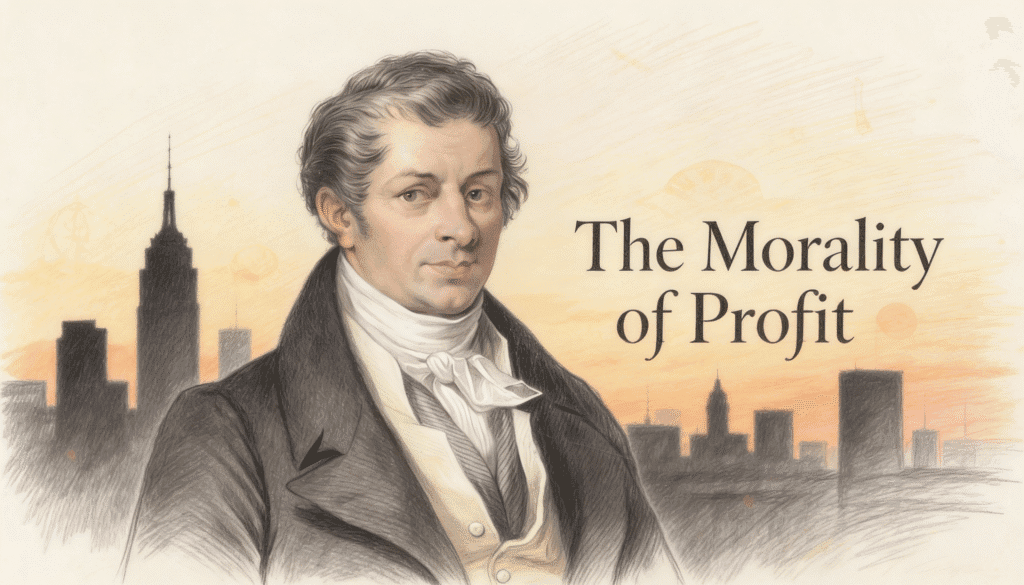
Jean-Baptiste Say, the French economist writing in the early 1800s, understood something that seems to elude many contemporary thinkers. In his view, production and exchange are fundamentally about serving human needs. The businessman succeeds not by extracting value from society but by adding to it. Every voluntary transaction represents two people who believe they are better off for having made the trade. Profit emerges when you’ve managed to create something people value more than what it cost to produce.
This isn’t clever wordplay. It’s the basic arithmetic of mutual benefit.
The Baker and the Invisible Vote
Consider your local bakery. Every morning, the baker transforms flour, water, and yeast into bread. The ingredients cost money. The oven consumes energy. The baker’s time has value. Yet people line up to pay more for the finished loaf than the sum of these inputs.
Why? Because a warm baguette at breakfast is worth more to them than flour in a bag. The baker has quite literally added value to the world. The profit is not what the baker takes from customers. It’s the measure of what the baker has given them beyond the raw materials.
Each purchase is a small vote of thanks. The customer is saying, in effect, “You have made my life better, and I am willing to prove it by giving you my money rather than spending it elsewhere.” Scale this up across millions of transactions, and profit becomes a running tally of genuine service to others.
The bakery that fails to turn a profit hasn’t committed a moral sin. It has simply failed to create enough value for others to sustain itself. The market has spoken, and it has said, “We appreciate the effort, but we’d rather spend our limited resources on something else.”
This might sound harsh until you realize the alternative. In systems where profit is abolished or severely constrained, someone else decides what gets produced and in what quantities. That someone is usually a bureaucrat with no personal stake in whether you actually want what’s being made. The Soviet Union produced plenty of goods. It just rarely produced the goods people actually needed, in the qualities they required, at the times and places they could use them.
Profit is simply the signal that tells producers, “Yes, keep doing that. The world needs more of what you’re offering.”
The Morality of Saying No
Here’s where things get interesting. The profit motive doesn’t just reward value creation. It punishes value destruction.
A company that pollutes a river while making widgets might show a profit on paper, but only because it has externalized costs onto others. The fisherman downstream, the family that drinks the water, the ecosystem that dies slowly all pay the hidden price. This isn’t capitalism working. It’s capitalism broken by the absence of property rights and legal frameworks that force businesses to account for the full costs of their actions.
The solution isn’t to abandon profit but to ensure that profit accurately reflects total value created minus total costs imposed. Tax the pollution. Enforce liability for damages. Create markets for clean air and water. When these mechanisms work, profit becomes an even more accurate measure of genuine contribution to human welfare.
The truly moral stance isn’t anti-profit. It’s pro-accurate-accounting.
The Paradox of Self-Interest
Adam Smith famously observed that we get our dinner not from the benevolence of the butcher, the brewer, or the baker, but from their regard for their own self-interest. This offends our sensibilities. We want people to help us because they care about us, not because they care about themselves.
Yet there’s something profound happening here. The market creates a system where the surest path to serving yourself is to serve others. You want to get rich? Figure out what people need and give it to them better or cheaper than anyone else. You want to stay rich? Keep doing it, because the moment you stop creating value, customers will abandon you for someone who does.
This is almost the opposite of how power works in other domains. The politician’s surest path to power is often to promise things to one group while taking from another. The bureaucrat’s security comes from making himself indispensable, not from making himself useful. The aristocrat’s wealth came from birth and was maintained through force.
But the entrepreneur’s wealth comes from persuading people, one transaction at a time, that what he offers is worth more than what he asks. It’s a strange kind of power that exists only so long as you continue to deserve it.
When Profit and Purpose Diverge
Of course, not all profit is created equal. A casino might be highly profitable while creating questionable social value. A payday lender might exploit the desperate. A monopolist might extract wealth without creating it.
These cases matter, but they prove the rule rather than disproving it. The casino profits from entertainment and the thrill of risk, but when it tips into addiction, it’s capturing value rather than creating it. The payday lender fills a genuine need for short-term credit, but when it traps people in debt spirals through deceptive terms, it has stopped serving and started extracting. The monopolist profits without competition, which means without the discipline of having to continuously earn customer loyalty.
What all these examples share is a breakdown in the mechanism that ties profit to value creation. The problem isn’t that businesses pursue profit. It’s that in certain circumstances, the rules of the game allow profit without corresponding benefit to others.
This is why functioning markets require more than just freedom to trade. They need transparency so people can make informed choices. They need competition so businesses must continually improve. They need fraud protection so trust can exist between strangers. They need externality pricing so costs don’t get quietly pushed onto third parties.
The Knowledge Problem Nobody Talks About
There’s another dimension to this that Say understood implicitly. When you try to organize an economy without profit, you face an impossible knowledge problem.
Imagine trying to centrally plan just the restaurants in a single city. You’d need to know how many people want Italian food on Tuesday evening versus how many want Thai. You’d need to predict shifting tastes, dietary trends, population movements. You’d need to coordinate thousands of supply chains, each with their own complexities. You’d need to match chef skills with cuisine demands. You’d need to balance the desire for new experiences against the comfort of familiar favorites.
This is completely impossible for any planning committee. But it happens automatically when restaurants can profit from getting it right and lose money from getting it wrong. The Thai place that opens across from three other Thai restaurants quickly learns its mistake. The Italian spot that notices an underserved neighborhood and takes a risk gets rewarded if they’re correct. Nobody needs to possess all the knowledge. The profit signal coordinates millions of small decisions into something that roughly matches supply with demand.
Profit is the information system that makes economic complexity possible. Without it, you’re left with shortages, surpluses, and the pretense that someone in an office can know what millions of people want better than they know themselves.
The Dignity of Exchange
There’s something deeply humanizing about market exchange that often gets overlooked in discussions of profit. When you sell your labor or your products, you are being valued for what you contribute, not for who you are or whom you know.
The market doesn’t care if you went to the right school or grew up in the right family. It cares whether you can solve someone’s problem. This is often portrayed as cold and impersonal, but compared to what? Compared to systems where advancement depends on political connections? Where opportunity flows through family networks? Where your last name matters more than your competence?
The profit motive creates space for merit in a way that few other systems do. Yes, inherited wealth exists. Yes, some start with advantages. But the daily discipline of the market is unforgiving: create value or fail. The aristocrat’s ne’er-do-well son could maintain his position for generations. The business owner’s incompetent heir will watch the company crumble.
There’s a cold comfort in this, perhaps. But there’s also dignity. Your worth in the market is determined by your contribution, updated continuously based on current performance. That’s a kind of equality of opportunity that’s rare in human affairs.
The Gratitude We Forget to Feel
We live in a world of abundance that would astound our ancestors. The average person today has access to foods from around the world, entertainment beyond measure, medical care that would seem like magic a century ago, and tools that amplify human capability in extraordinary ways.
Almost none of this came from altruism. It came from people trying to make a profit by giving other people what they wanted. The smartphone in your pocket exists because a company thought it could make money selling it. The coffee you drink traveled thousands of miles because someone could profit from bringing it to you. The roof over your head, the clothes on your back, the words you’re reading right now all exist within a vast web of profitable exchange.
This doesn’t diminish the achievement. It amplifies it. These things exist not despite the profit motive but because of it. They were conjured into being by people who found a way to serve their own interests by serving yours.
Say saw this clearly. Production is not about taking from a fixed pie. It’s about making the pie larger. And the signal that tells you whether you’ve succeeded in making it larger is whether people voluntarily give you their money in exchange for what you’ve produced.
What We Talk About When We Talk About Greed
The common objection runs something like this: Sure, some profit is fine, but what about excessive profit? What about greed?
This question assumes we can separate good profit from bad profit by quantity. But the amount matters far less than the source. A 5% margin extracted through monopoly power is more morally problematic than a 50% margin earned through genuine innovation. The question isn’t how much you profit but whether you earned it by creating value or by preventing competition.
Greed is a useful concept, but it’s often misapplied. The greedy person wants more for himself. Fair enough. But in a functioning market, the only way to get more for yourself is to give more to others. The greedy entrepreneur must innovate, must improve, must find ways to serve customers better. His greed becomes the engine of your convenience.
Compare this to the greed of the person who seeks wealth through politics, through regulatory capture, through cronyism. That greed creates no value. It only redirects it. Yet somehow we reserve our moral outrage for the former while tolerating or even celebrating the latter when it’s dressed up in the language of public service.
The Human Face of Profit
In the end, being pro-business is being pro-human because business, at its best, is simply the organized effort to serve human needs at scale. Every successful business is an ongoing referendum on whether it deserves to exist. Customers vote with their wallets, employees vote with their time, investors vote with their capital. When all three groups keep voting yes, it’s because they believe their lives are better for the association.
This doesn’t mean every business is noble or that every profitable venture serves humanity. It means that the profit mechanism, when operating within proper bounds, channels self-interest toward mutual benefit in a way that no other system has matched.
Say understood that production is fundamentally an act of service. The profit you earn is the measure of how much service you’ve provided. It’s not perfect. No human system is. But it’s remarkable how well it works and how much we take for granted the daily miracles it produces.
The baker rises before dawn not because he loves you but because he loves profit. Yet you get fresh bread all the same. That’s not a bug in the system. That’s the entire point.