Table of Contents
Imagine having a friend who responds to every statement you make with a question. Not just any question, but the kind that makes you realize you have no idea what you’re actually talking about. You say the sky is blue, and they ask what you mean by blue. You mention you want to be happy, and suddenly you’re in a philosophical crisis about whether you’ve ever truly understood happiness at all.
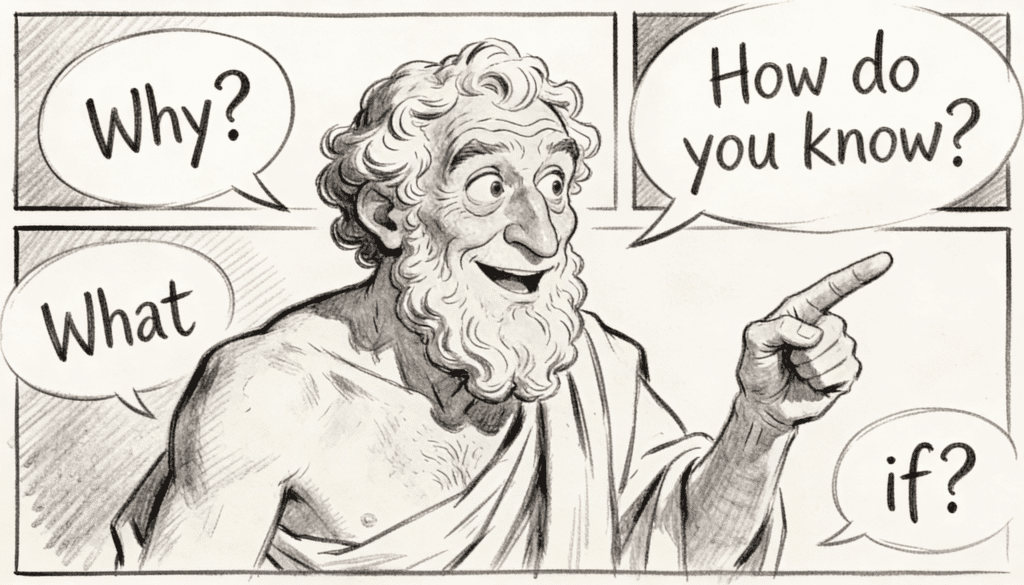
This was Socrates. The man Plato immortalized wasn’t just asking questions to be difficult. He had discovered something profound about how human beings think, learn, and fool themselves. Twenty-four centuries later, his approach remains one of the most powerful tools for cutting through nonsense, whether you’re in a boardroom, a classroom, or trying to figure out why your life feels stuck.
The Art of Productive Irritation
Most of us go through life accepting things at face value. We adopt beliefs from our parents, absorb opinions from our culture, and collect ideas like souvenirs without ever really examining them. We think we know what justice means, what makes a good leader, or how to live well. Then someone like Socrates shows up.
His method was deceptively simple. He would approach people who claimed expertise in something, particularly abstract concepts like courage, virtue, or knowledge itself. Then he would ask them to define it. Not in a casual way, but precisely. What exactly is courage? Can you give me a definition that covers all cases of courage and excludes everything that isn’t courage?
The person would offer a definition. Then Socrates would find an exception or contradiction. They would refine their definition. He would find another problem. Back and forth they would go, and typically the conversation would end with the supposed expert admitting they didn’t actually know what they thought they knew. This wasn’t because Socrates had the answer. He claimed ignorance himself. But he was really, really good at exposing when someone else’s certainty was built on sand.
You can see why Athens eventually got tired of him.
Why Questions Matter More Than Answers
Here’s something counterintuitive about learning: having the right answer matters less than asking the right questions. We treat knowledge like a warehouse where we store facts. But Socrates understood that real understanding is structural. It’s about how ideas connect, what they rest on, and whether they can support any weight.
Think about it this way. Someone tells you that democracy is the best form of government. You nod along. Sounds right. But Socrates would ask: What makes a government “best”? Is it the outcomes it produces, the process it follows, or something else? If it’s outcomes, what outcomes specifically? And if a dictatorship produced those same outcomes, would it then be best? If it’s the process, why does that process matter more than results?
Notice what’s happening. We’re not arguing about whether democracy is good. We’re uncovering the hidden assumptions underneath that belief. We’re revealing the foundation. And often, we discover the foundation is shakier than we thought.
This matters because most of our mistakes come from unexamined assumptions. We make bad decisions in business because we never questioned what success actually means. We stay in unfulfilling careers because we accepted someone else’s definition of a good job. We pursue happiness in ways that make us miserable because we never really defined what we mean by happiness.
The Mirror Technique
Plato showed us that Socrates functioned like a mirror. He didn’t tell people what to think. He reflected their own thinking back at them, making the contradictions visible. When someone said they valued honesty above all else but admitted they would lie to protect a friend, Socrates didn’t call them a hypocrite. He just held up both statements and asked them to explain how they fit together.
This is different from debate. In debate, you’re trying to win. You’re attacking the other person’s position while defending your own. Socratic dialogue assumes everyone starts from ignorance, including Socrates himself. The goal isn’t victory. It’s clarity.
The beauty of this approach is that people convince themselves. When you tell someone they’re wrong, they get defensive. Their ego gets involved. But when you ask questions that lead them to discover the contradiction on their own, something different happens. They can’t dismiss it as easily because it came from their own reasoning.
Modern therapists use this constantly. A patient might say they’re worthless. The therapist doesn’t argue. They ask questions. “What does worthless mean?” “Can you think of anything you’ve done that had value?” “If your friend said they were worthless, would you agree?” The patient starts to see their own thinking pattern and realizes it doesn’t hold up.
Uncomfortable Truths About Expertise
Socrates particularly enjoyed questioning people who claimed expertise. Generals, politicians, poets, craftsmen. What he discovered still applies today: people who are good at something often can’t explain why they’re good at it. The poet writes beautifully but can’t define beauty. The successful businessperson makes good decisions but can’t articulate their decision-making process.
This reveals something unsettling. Much of what passes for expertise is really just successful pattern matching. People develop an intuition through experience, but they don’t necessarily understand the underlying principles. They can do the thing, but they can’t teach you to do the thing, because they don’t know how they do the thing.
This matters tremendously when we’re choosing who to trust or learn from. Someone can have impressive credentials and still not understand the fundamentals of their field. They might be operating on autopilot, repeating what they learned without ever examining whether it makes sense.
Conversely, someone might understand the principles deeply without much practical experience. The question Socrates forces us to ask is: what are we actually looking for? Practical results or genuine understanding? Sometimes we need one, sometimes the other, but we should be clear about which we’re getting.
The Socratic Method in Modern Life
You don’t need to corner people at parties to use Socratic thinking. The most powerful application is internal. You can be Socrates to yourself.
When you’re convinced you need to buy something, ask yourself what problem you think it will solve. Then ask if that’s really the problem you have. When you’re certain about a political position, try to state the strongest version of the opposing view. When you think you know what you want from life, define those terms precisely. What does success mean? What does love mean? What does meaning itself mean?
This self questioning prevents you from drifting through life on borrowed ideas. It’s uncomfortable. You’ll discover you believe contradictory things. You’ll realize you can’t defend positions you feel strongly about. You’ll find that many of your goals are vague wishes rather than clear intentions.
But this discomfort is valuable. It’s the difference between living deliberately and living on autopilot. Most people never examine their core assumptions until something breaks. A career crisis, a divorce, an illness. Socratic thinking lets you do that examination before the crash.
Why Being Wrong is Better Than Being Certain
Here’s where Socrates gets really annoying. He claimed to know nothing except that he knew nothing. Everyone else didn’t even know that they didn’t know. This sounds like a clever paradox, but it’s actually the foundation of intellectual honesty.
Certainty is seductive. It feels powerful. It ends the anxiety of not knowing. But false certainty is dangerous. It leads to bad decisions made confidently. It closes you off from new information. It makes you brittle because you can’t adapt when reality doesn’t match your expectations.
Socratic ignorance is different from stupidity or laziness. It’s an active acknowledgment of the limits of your knowledge. It keeps you curious. It makes you ask questions instead of just asserting answers. It lets you change your mind when you encounter better arguments or evidence.
Think about the smartest person you know. Chances are, they say “I don’t know” a lot more than average. They’re comfortable with uncertainty. They update their views when they learn something new. This isn’t weakness. It’s intellectual strength.
The paradox is that admitting what you don’t know makes you more credible, not less. People trust someone who says “I’m not sure, but here’s my current thinking” more than someone who radiates false confidence. The first person is clearly thinking things through. The second is performing certainty.
Connections to Modern Thinking
Socratic dialogue shows up everywhere once you start looking for it. The scientific method is basically institutionalized Socrates. You form a hypothesis, then try your hardest to prove it wrong. If it survives rigorous questioning and testing, you provisionally accept it while remaining open to new evidence.
Good journalism works the same way. The reporter asks the questions everyone should be asking. What’s your evidence? How do you know that? What about this contradiction? The public doesn’t need more people confidently asserting opinions. We need more people rigorously examining claims.
Even in creative fields, the best work often comes from this kind of questioning. The writer asks what their character really wants and keeps digging until they find something true. The designer questions every assumption about how a product should work. The musician deconstructs why certain combinations of sounds feel right.
The Dark Side of Socratic Thinking
We should be honest about the risks. You can use Socratic questioning as a weapon. Some people deploy it not to seek truth but to tear down anyone who claims to know anything. They demand infinite precision and reject any answer that isn’t perfectly airtight. This isn’t philosophy. It’s intellectual bullying.
There’s also a practical limit to how much you should question. At some point, you need to act. You need to make decisions without perfect information. You need to live your life instead of endlessly analyzing it. Socratic thinking is a tool, not a lifestyle. Use it to examine important beliefs and decisions, but don’t let it paralyze you.
Athens executed Socrates partly because he was genuinely annoying. He made important people look foolish. He questioned traditions people held sacred. He inspired young people to question authority, which threatened the social order. Sometimes there are real costs to constant questioning.
Practical Applications
Let’s make this concrete. Imagine you’re in a meeting and someone proposes a new strategy. Most people will either agree because it sounds good or disagree based on gut feeling. A Socratic approach asks different questions.
What problem are we trying to solve? How will we measure success? What assumptions are we making about our customers or market? If those assumptions are wrong, what happens? What’s the strongest argument against this strategy? Have we tested any of this?
These aren’t hostile questions. They’re clarifying questions. They expose where the thinking is solid and where it’s wishful. They don’t guarantee you’ll make the right decision, but they dramatically increase the odds.
Or consider personal relationships. Someone tells you they love you but keeps doing things that hurt you. Instead of arguing or accepting the contradiction, ask Socratic questions. What does love mean to you? How do you show love? Is this how I experience feeling loved? The answers reveal whether you’re operating with incompatible definitions or whether someone is confused about their own feelings.
The Ultimate Goal
Plato presents Socrates as someone pursuing truth above all else. But truth wasn’t an abstract concept for him. It was deeply practical. He believed that the unexamined life isn’t worth living not because philosophy is noble but because an examined life is simply better.
When you question your assumptions, you make better decisions. When you understand your values clearly, you stop chasing goals that don’t actually matter to you. When you can see the structure of your thinking, you can fix the parts that lead you astray.
This doesn’t mean you’ll have perfect knowledge or make perfect choices. Socrates himself claimed no such thing. But you’ll be less foolish. You’ll waste less time on things that don’t align with what you actually care about. You’ll be harder to manipulate because you understand the reasoning behind your beliefs.
Being Annoying with Purpose
So yes, Socrates was annoying. He interrupted comfortable certainties. He made simple things complex by demanding precision. He refused to let people hide behind vague generalities and confident assertions.
But this annoyance served a purpose. It was the friction that polished away false beliefs. It was the discomfort that led to growth. It was the challenge that separated genuine understanding from mere opinion.
You don’t need to become a philosophical gadfly stinging everyone around you. But you can adopt the core insight: most of what we think we know, we don’t actually know. Most of our beliefs rest on foundations we’ve never examined. Most of our certainties would crumble under gentle questioning.
The Socratic method isn’t about having answers. It’s about being honest enough to admit when you don’t, curious enough to keep asking questions, and brave enough to follow those questions wherever they lead. Even if they lead to the uncomfortable conclusion that you’ve been wrong about something important.
That kind of honesty might make you annoying. But it will also make you effective. Because while everyone else is confidently heading in the wrong direction, you’ll be the one actually trying to figure out where you’re going and why.
And in a world full of unexamined assumptions and borrowed beliefs, that makes you dangerously rare.