Table of Contents
You cut someone off in traffic because your child is vomiting in the back seat and you need to pull over immediately. The other driver thinks you’re a selfish idiot. Later that week, someone cuts you off and you think they’re a selfish idiot. You have no idea they’re rushing to the hospital.
This isn’t hypocrisy. It’s neuroscience.
Dan Ariely, the behavioral economist who studies irrationality with the precision of a watchmaker, has spent years documenting this mental quirk. We grant ourselves the luxury of context while denying it to everyone else. When we mess up, we had reasons. When they mess up, that’s who they are.
The pattern shows up everywhere. Your colleague missed the deadline because they’re lazy. You missed it because your laptop crashed and your daughter got sick and the client changed the requirements at the last minute. Your friend cancelled dinner because they don’t value the friendship. You cancelled because work exploded and you needed one night to decompress. They’re flaky. You’re overwhelmed.
The Machinery Behind the Mistake According to Dan Ariely
Here’s what makes this fascinating: you’re not choosing to be unfair. Your brain is running on autopilot, using shortcuts that usually work pretty well. When you judge yourself, you have access to the full movie of your experience. All the pressures, all the constraints, all the things you were trying to balance. You know the difference between who you are and what you did in that specific moment.
When you judge others, you only see the trailer. One action. One moment. No backstory.
Your brain fills in the gaps with assumptions because that’s more efficient than saying “I don’t know” a hundred times a day. It creates a character sketch from limited information. And because humans are cognitive misers, always looking to conserve mental energy, the brain takes a shortcut: it assumes the action reveals the person.
This isn’t stupidity. For most of human history, this worked. If someone in your tribe of 30 people kept stealing food, they were probably a thief. You had enough repeated observations to make that judgment stick. But now you interact with thousands of people, most of them strangers, and you still use the same mental software designed for a world that doesn’t exist anymore.
The Courtroom in Your Head
Imagine your mind runs two different courts. In one, you’re always on trial. The judge knows everything: what you were thinking, what you were feeling, what pressures you faced, what you were trying to accomplish. The verdict accounts for context.
In the other court, everyone else stands trial. The judge only sees the crime scene photos. No testimony about motive. No evidence of circumstances. Just the action and the outcome.
Same judge. Same legal system. Completely different standards of evidence.
Psychologists call this the fundamental attribution error, though that name makes it sound like a technical glitch when it’s really more like a design flaw in how consciousness works. We attribute other people’s behavior to their character and our own behavior to our situation. The error isn’t occasional. It’s fundamental. It’s baked into the architecture.
When Good People Look Bad
The truly counterintuitive part? This bias gets stronger when people are actually trying to do the right thing.
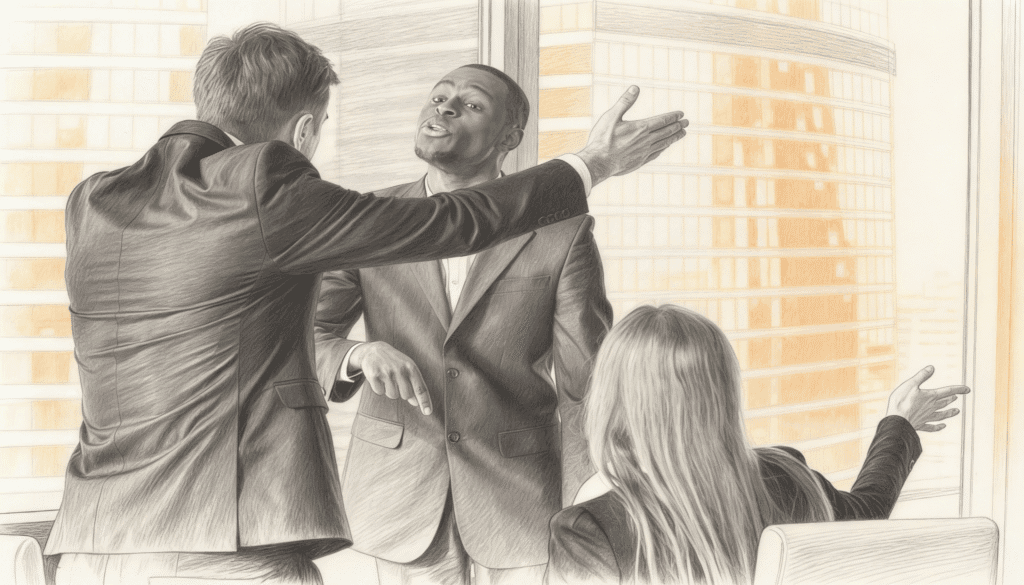
Let’s say you’re in a meeting and someone asks a question you think is stupid. If you snap at them, you know you were stressed and tired and this was the fifteenth pointless question in a row. You were trying to move things forward. You had good intentions that got expressed badly.
But when someone snaps at you? They’re just rude. You don’t see their stress or their exhaustion or their fifteen previous irritations. You see rudeness, full stop.
The gap between intention and perception creates most human conflict. Not malice. Not incompetence. Just the simple fact that we experience our own intentions directly and everyone else’s actions at a distance.
Your teenage son leaves dishes in the sink. To you, it looks like he doesn’t care about the household or respect your time. To him, he was planning to wash them after finishing his homework but got distracted by a text about tomorrow’s exam. Same dishes. Completely different realities.
The Social Media Amplifier
Social media takes this cognitive bug and turns it into a feature. You see people’s highlight reel and their lowlight reel, but never their full reel. Someone posts about their promotion and you think they’re bragging. You post about yours because you worked incredibly hard and you’re proud and your mom wants to see it.
Someone shares a political opinion you disagree with and you think they’re ignorant or tribal or brainwashed. You share one because you’ve done research and you’re trying to inform people and you care about the issue.
The platform shows you actions without access to intentions. It’s judgment day every day, and context is the first casualty.
This creates an interesting paradox: the more connected we become, the more we see each other’s actions, the less we understand each other’s intentions. We have more data and less insight.
Why Smart People Miss This Too
You might think education or intelligence protects against this bias. It doesn’t. Ariely’s research, along with decades of social psychology, shows that smart people are just as susceptible. Sometimes more so, because they’re better at generating sophisticated justifications for why their snap judgments are actually rational analysis.
A CEO who prides herself on data-driven decisions will still assume the employee who missed a meeting is uncommitted rather than sick. A professor who teaches critical thinking will still conclude that the student who submitted a sloppy paper is lazy rather than dealing with a family crisis.
The bias doesn’t discriminate. It affects progressives and conservatives, atheists and believers, scientists and artists. Your worldview might change who you judge harshly, but it doesn’t change the fact that you’re judging actions while experiencing intentions.
The Empathy Disconnect
Here’s where it gets uncomfortable: empathy doesn’t solve this problem. You can be a deeply empathetic person and still fall into this trap constantly. Because empathy requires you to actively imagine someone else’s internal state, and most of the time, you’re not doing that. You’re just reacting.
True empathy is effortful. It requires you to pause, to wonder, to imagine. But daily life doesn’t pause. Your colleague interrupts you in the meeting, your neighbor plays music too loud, the barista gets your order wrong, your partner forgets to call. These moments flash by, and your brain makes instant judgments before your empathy can even warm up.
The people who seem most empathetic often have just trained themselves to insert a buffer between observation and judgment. A tiny pause where they ask: what might be going on here? It’s not that they feel more. It’s that they’ve created a habit of questioning their first interpretation.
The Leadership Trap
This bias creates a specific problem for anyone in a position of authority. Leaders are professionally obligated to judge others by their actions because that’s what the organization sees. But they judge themselves by intentions because they have access to the full strategic context.
A manager thinks: I gave critical feedback because I’m invested in this person’s growth and I see their potential and I want them to succeed. The employee thinks: my manager is harsh and impossible to please.
Both are right about their own reality. Both are wrong about the other person’s.
Good leaders develop what you might call applied skepticism about their own interpretations. When they catch themselves thinking “this person is unreliable,” they force themselves to ask: “or did something happen I don’t know about?” Not as a touchy-feely exercise, but as a practical debugging tool for reality.
The best leaders Ariely studied weren’t more charitable than average. They were more paranoid about their own certainty.
The Mirror Test
Try this experiment. Think about the last time you did something you’re not proud of. Notice how quickly your mind serves up the context. The pressure you were under. What you were trying to accomplish. How it wasn’t really you, just a bad moment.
Now think about the last time someone else did something that annoyed or hurt you. Notice how your mind jumps to character judgment. They’re inconsiderate, or selfish, or careless.
Same moral crime, different courts, different verdicts.
The gap between these two experiences is the gap where most misunderstandings live. Not because people are bad, but because brains are biased.
From an evolutionary perspective, this bias probably made sense. Quick character judgments helped our ancestors navigate social hierarchies and avoid threats. If you saw someone act aggressively, assuming they were an aggressive person kept you safer than assuming they were having a bad day.
But we’re no longer optimizing for survival in small tribes. We’re trying to cooperate in massive, complex societies where most people we interact with are strangers or near strangers. We need more nuance than our hardware provides.
The tragedy is that we’re stuck with Paleolithic brains trying to navigate a digital world. The software can’t be upgraded. We’re running on legacy code.
The Relationship Tax
This bias taxes every relationship you have. Your partner doesn’t text back and you think they don’t care. They were in a meeting with their phone off and thought you’d understand. You forget an anniversary because work has been crushing and you’ve been mentally exhausted. They think you don’t care enough to remember.
The closer the relationship, the higher the tax. Because intimacy creates higher expectations. You think: if they really knew me, they’d give me the benefit of the doubt. They think the exact same thing.
Both of you are judging the other by actions while judging yourself by intentions. Both of you feel misunderstood. Both of you are right.
The couples who make it long term aren’t the ones who transcend this bias. They’re the ones who recognize it and build systems around it. They explicitly talk about intentions. They ask questions before making judgments. They’ve learned that their first interpretation is probably wrong.
The Correction
So what do you do about a bias that’s fundamental to how your brain works? You can’t think your way out of it any more than you can think your way out of optical illusions.
But you can build better habits. Not to eliminate the bias, but to notice it faster and correct it more often.
Start with self-awareness. When you catch yourself making a harsh judgment about someone, flag it. Not to suppress the judgment, but to recognize it as a first draft, not a final verdict. Your brain just showed you what it does automatically. Now you can decide whether to trust it.
Ask a simple question: what would have to be true for this action to make sense? Not “what ridiculous excuse could they have,” but genuinely: what situation would make this behavior reasonable?
Someone cuts you off in traffic. What would make that necessary? Medical emergency. Avoiding an accident. Distracted by devastating news. You don’t know which. You can’t know. But asking the question creates space for possibility.
This isn’t about being a doormat or excusing bad behavior. It’s about accuracy. Most of the time, people aren’t villains in your story. They’re protagonists in their own, dealing with complexity you can’t see.
The Professional Application
In professional settings, this bias costs real money. Managers who judge employees by actions while judging themselves by intentions create toxic cultures without meaning to. Teams that don’t account for this bias waste energy on conflicts that aren’t real.
The most effective teams Ariely studied had built in a simple practice: when someone’s behavior seemed off, the default assumption was “something else is going on” rather than “this reveals who they are.”
This isn’t naive. It’s empirically smarter. Because most of the time, people are dealing with constraints and pressures and contexts that aren’t visible from the outside. Assuming invisible complexity is just more accurate than assuming you can read character from behavior.
The Political Dimension
This bias might explain more about political polarization than any policy disagreement. We judge our side by intentions and their side by actions. Our team wants justice. Their team wants power. Our policies come from careful thought. Theirs come from corruption or stupidity or malice.
Everyone is doing this simultaneously. Conservatives think liberals are judging them unfairly. Liberals think conservatives are judging them unfairly. Both are right. Both are trapped in the same cognitive machinery.
The path forward isn’t agreement. It’s recognition. You’re never going to see the world through their eyes. But you can remember that they’re seeing something you’re not, just like you’re seeing something they’re not.
The Practice
This isn’t a problem you solve. It’s a bias you manage. Every day, multiple times a day, for the rest of your life.
The practice is simple but not easy: pause between observation and judgment. Insert a question mark where your brain wants to put a period. They did X. Period. Becomes: They did X. Why might a reasonable person do that? You won’t always get the right answer. But you’ll stop getting the easy wrong one.
The gap between action and intention is where most human pain lives. Not because people are terrible, but because minds are limited. We can’t see inside each other. We can barely see inside ourselves.
But we can remember that the gap exists. We can hold our judgments lightly. We can give others the same generous interpretation we give ourselves. Not because it’s nice. Because it’s accurate.
Your brain will keep judging actions while experiencing intentions. That’s not changing. But you can notice when you’re doing it. And in that noticing, there’s freedom. Not from the bias, but from letting it run your life.
The next time someone does something that bothers you, try this: imagine you’re them, right before they did it. What were they thinking? What did they want? What were they afraid of?
You won’t know. But you’ll stop pretending you do. And that’s the beginning of wisdom.